🔤 Yokai by Kana

Find yokai in hiragana order

81 Yokai|12 Category|Page 1 of 4
Localization in Progress - More content available in Japanese version
View Japanese

Filter by hiragana row

Sort by: ReadingAscending
Grave Fire

Grave Fire

Rare

HAH-kah-noh HEE

Traditional Iconography Edition

Natural Phenomena SpiritsGraveyards across Japan, notably Kyoto Prefecture

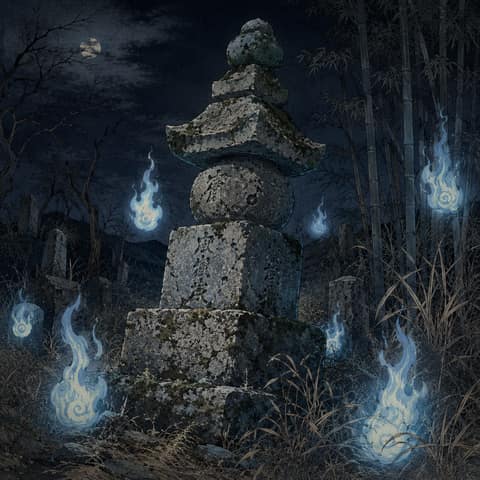
Grave Fire is a type of ghostly flame that appears around cemeteries and old gorintō (five-ring pagoda gravestones). In Toriyama Sekien’s Konjaku Gazu Zoku Hyakki, flames blaze from a timeworn gorintō with damaged Sanskrit seed syllables amid an overgrown burial ground. Some interpret the missing syllables as leaving worldly desires unsevered, which flare up as fire. Early modern ghost tales describe it as a phosphorescent flame arising from blood or fat seeping from corpses or graves, drifting and wavering at night.

Hakuzosu

Hakuzosu

Epic

はくぞうす

White Fox Disguised as a Monk

KitsuneYamanashi

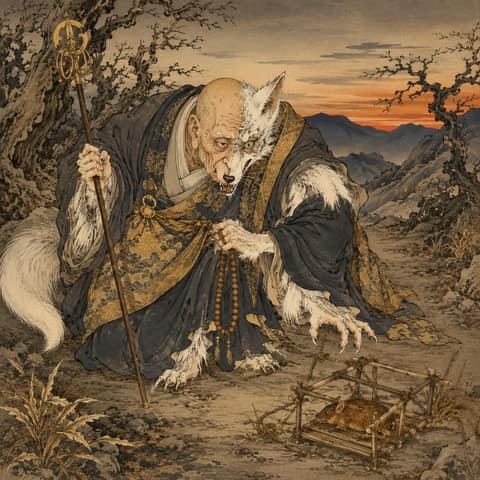
Hakuzosu is a shape-shifting fox that borrows the form of a monk, simultaneously illuminating human killing and the fox's instincts. The most widely known plot is from the kyogen play Tsurigitsune (Fox Trapping), where an old fox whose clan was trapped by a hunter disguises himself as the hunter's uncle, the monk Hakuzosu, and comes to preach to him to stop fox trapping. There, the fox is not merely a beast deceiving humans. The fox is spoken of as something close to a god, and manipulates words admonishing human killing, even drawing upon the historical tales of Tamamo-no-Mae and the Sessho-seki (Killing Stone). However, on the way home, the old fox cannot resist the smell of the bait placed in the trap, and finally reveals his fox form. The terror of Hakuzosu lies not only in the skill of his transformation, but in the moment when intellect and instinct, preaching and hunger, faith and bestiality tear apart within a single body. Hakuzosu is also a yokai that makes us consider the meaning of the "form" a fox chooses when entering human society. In fox tales where they transform into beautiful women, mothers, or travelers, the transformation often becomes an entrance for emotion or desire. Hakuzosu, however, dons a monk's robes and stops a human with the voice of preaching. The form of a monk represents a form of knowledge and admonition trusted in the village, and the fox borrows that authority to move the hunter. Because Hakuzosu is also included in the Ehon Hyaku Monogatari (Picture Book of a Hundred Stories) published in 1841, this fox has been read not only as a stage role but also as a transforming fox preserved in late Edo-period ghost story art collections. If Kuzunoha of Shinoda Forest is a fox burdened with human love and separation, Hakuzosu is the old fox torn between monk's robes and a trap, an entity that carved the spirituality and peril of the fox into stage gestures. Therefore, Hakuzosu is not a hero flaunting his transformation abilities, but a yokai showing where the transformation breaks down. The more he resembles a human, the more he can speak of human laws, but as long as he is a fox, he cannot separate himself from the bait, the smell, and the urge for revenge. This contradiction turns the fox tale into both an ethical drama and a ghost story.

Hakutaku (White Marsh)

Hakutaku (White Marsh)

Divine

hah-koo-TAH-koo

Iconographic Tradition Conformant

Deities & Divine SpiritsIntroduced from China (widely circulated across Japan as apotropaic images)

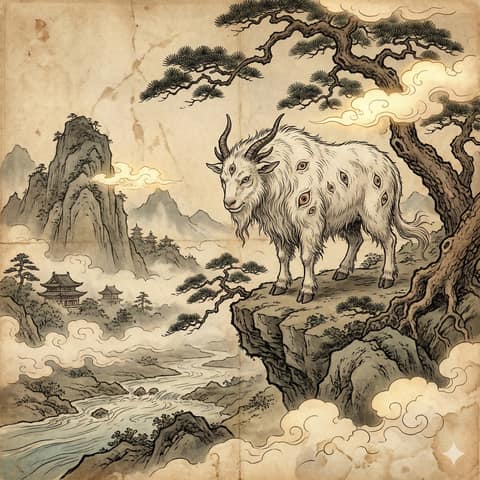
Hakutaku is an auspicious beast from ancient Chinese lore said to understand human speech and to know all manner of monsters, demons, and calamities. It appears in eras of virtuous rulership, and the famed Hakutaku Chart records creatures of anomaly and methods to counter them. In Japan, such images spread in the Edo period as talismans against misfortune, carried for safe travel and protection from illness. Depictions show a white beast, with features varying by period.

Hashihime (Bridge Princess)

Hashihime (Bridge Princess)

Epic

HAH-shee-HEE-meh

Hashihime of Uji (Traditional Form)

Half-Human BeingsKyoto

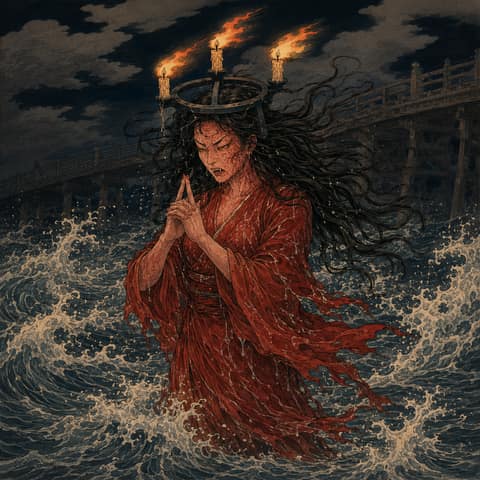
Hashihime is a figure born from ancient water and land deities fused with beliefs in bridge guardians. Revered at old great bridges, she is known as a goddess or ogress. A shrine to her stands at Uji Bridge on the Uji River, with traditions also tied to Nagara Bridge and Karahashi at Seta. Taboos warn against praising other bridges while standing on a bridge, or singing songs of jealousy there. She appears in the Kokin Wakashū, and later lore recasts her as a woman transformed into a demon by jealousy.

Hatahiro

Hatahiro

Rare

HAH-tah-HEE-roh

Emaki Source – Sekien Edition

Tsukumogami and object apparitionsJapanese folklore

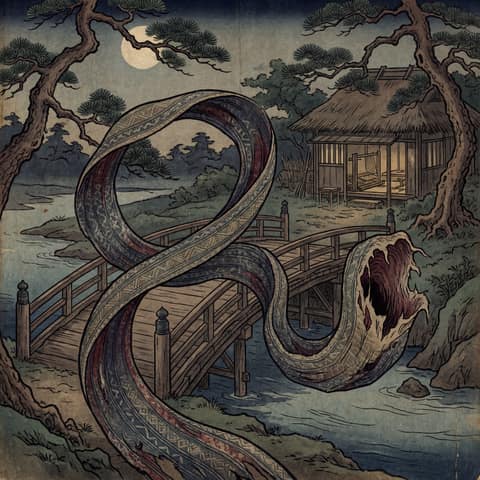
Hatahiro is a cloth yokai depicted by Toriyama Sekien in his Konjaku Hyakki Shūi. It represents a grudge that has seeped into woven fabric, taking the form of a serpentine body that roams in search of people. Sekien’s note explains that a woman’s passion and resentment, as she weaves while waiting for a husband who never returns, transform the fabric. No living oral tradition has been verified; the figure is regarded in art history as an idea-driven apparition originating from Sekien’s imagination.

Hachiman

Hachiman

Divine

hachiman

Triune Guardian of War and State

神霊・神格Oita

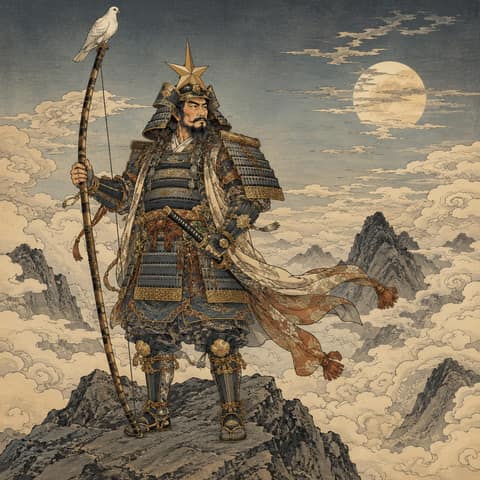
Hachiman (Hachiman-shin or Yahata-no-kami) is one of the most widely worshipped deities in Japan, enshrined as the principal god in approximately 40,000 Hachiman Shrines (Hachimangu) nationwide. His origins are traced to a local indigenous deity worshipped in Usa, Buzen Province (Usa City, Oita Prefecture) in Kyushu. However, he possesses an extremely mysterious background, as he does not appear at all in the classic Japanese mythologies such as the Kojiki or Nihon Shoki. From the Nara to the Heian periods, he came to be identified (syncretized) with the divine spirit of Emperor Ojin (Homudawake-no-mikoto), the 15th emperor, thus establishing his status as an ancestral deity of the imperial family (Kososhin). Furthermore, he was the first Japanese deity to be bestowed with the Buddhist title of "Bodhisattva," becoming "Hachiman Daibosatsu," a god who spearheaded the history of Shinto-Buddhist syncretism. From the Middle Ages onward, he became the tutelary deity (Ujigami) of the Minamoto clan, garnering overwhelming veneration from samurai nationwide as the "God of Lasting Fortunes of War (War God)."

Hachirotaro

Hachirotaro

Legendary

Hachirotaro

Hachirotaro, Dragon God of the Three Lakes

Water YokaiAkita

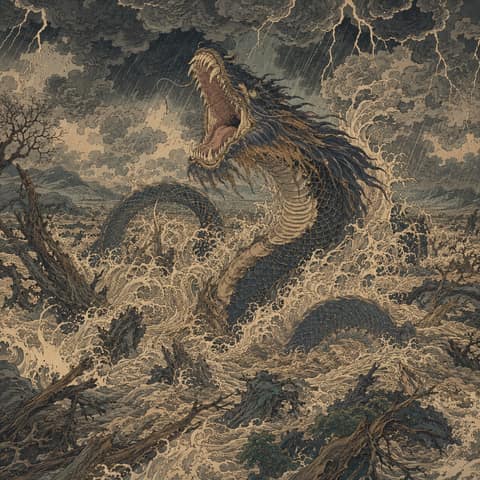
Hachirotaro is a dragon god (ryūjin) whose primary domain is Lake Hachirōgata in Akita Prefecture. Legend says he was originally a matagi (traditional winter hunter) from the Kazuno region. After breaking a taboo by roasting and eating three char (iwana) that he was supposed to share with his companions, he was struck by an insatiable thirst. As he continued to drink from the mountain stream, he transformed into a giant serpent, and eventually a dragon. The transformed Hachirotaro dammed Lake Towada to make it his home. However, he later fought the monk Nansobō from Kumano for lordship of the lake and was defeated. Fleeing to the northwest, he carved out the Hachirōgata lagoon and became its master. He stands at the center of the "Legend of the Three Lakes" (Sanko Densetsu), an epic tale of dragon gods spanning three major lakes in Akita (Lake Towada, Hachirōgata, and Lake Tazawa). Including his later romance with Princess Tatsuko of Lake Tazawa, Hachirotaro is the central protagonist in the narrative that systematizes the lake and marsh worship of the northern Tōhoku region.

Hachishakusama

Hachishakusama

Legendary

Hasshakusama

Hachishakusama, the Tall Woman in a Pale Dress

Spirit / GhostOnline (2channel Occult Board)

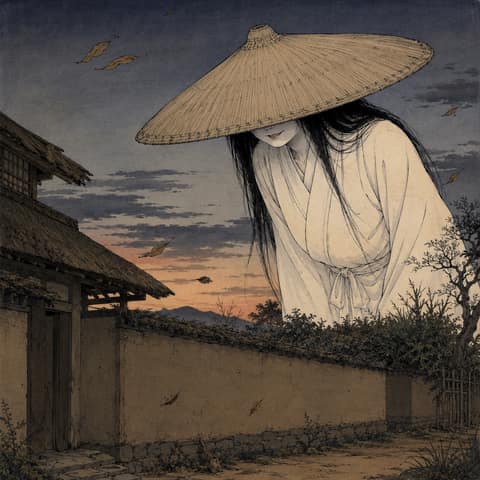
At the beginning of spring break, an unintelligible humanlike sound comes from a farm garden. After a sound wavering between po and bo, a hat passes above a hedge about two meters high, and a woman in a pale dress appears through a gap, her head higher than the hedge. Hachishakusama is one of modern Japan's best-known internet ghost stories, beginning when familiar proportions suddenly cease to make sense. When the narrator tells his grandparents, their manner changes at once. His grandmother says that the Hachishakusama in their district is, as her name implies, about eight shaku tall. She may look to different witnesses like a young woman in mourning clothes, an old woman in a formal kimono, or a middle-aged woman in work clothes. What remains constant is a female form, abnormal height, something worn on the head, and an uncanny laugh like a man's voice. Under the modern standard of measurement, one shaku is ten thirty-thirds of a meter, so eight shaku is about 2.424 meters. The text leaves the hat's color and shape, hair, and face undescribed, making room for diverse later imagery. The setting is a district about the size of an ōaza, with its city and former-village names withheld. Four Jizō statues stand at the village boundaries in the cardinal directions, blocking Hachishakusama's routes. The narrator spends the night from sunset until 7:00 the next morning in an upstairs room protected by paper talismans, sealed windows, salt at the four corners, a small Buddhist image, and prayer. In the night, a voice nearly identical to his grandfather's calls outside the door as something lightly taps the window. The next morning he sits at the center of a nine-seat vehicle, surrounded in eight directions by seven distantly related men and K in the front passenger seat; her prayers and vehicles before and behind carry him beyond the district. Ten years later, a call says that the Jizō on the road to his home has been broken, leaving the fear that the voice may return. The earliest verifiable starting point is posts 908 through 916 of "Shall We Collect Stories So Scary They Are No Laughing Matter? 196," posted to the Occult Board of the anonymous forum 2channel on August 26, 2008. The same anonymous user made nine consecutive posts in roughly nine minutes, from 9:45:56 to 9:54:54 a.m. The thread welcomed personal accounts and fiction alike, and no independent source is known to substantiate a real place or event. Hachishakusama is internet lore born from the union of a story shaped like an old memory of the land and the rapid, consecutive-post form of an anonymous message board. By September 22, 2008, less than a month after the post, it had been reposted under the title "Hachishakusama" on a Sharekowa compilation site. It later became a subject of folklore and narrative research, while the video anthology *Fūin Eizō 16: Hachishakusama no Noroi* and the novel *Otherside Picnic* and its anime adaptation gave it a voice, face, clothing, and movement through new storytellers. Its cultural history lies in the way an apparition that began without an official illustration grew as it passed from bodies that read, to bodies that listened, to bodies that watched.
Hari-onago

Hari-onago

Rare

hari-onago

Hari-onago, the hook-haired woman of Uwajima’s night roads

Humanlike and hybrid yokaiEhime

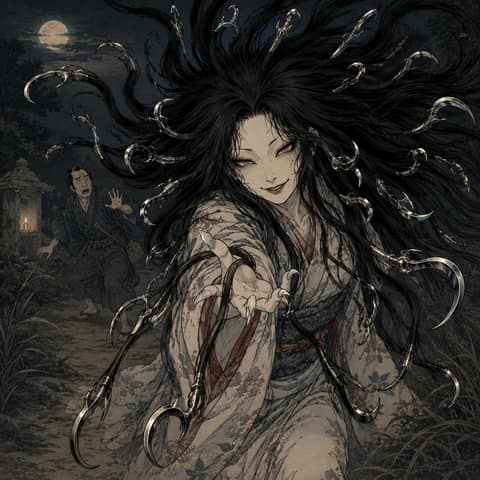
Hari-onago is a female yokai associated with the Uwajima region of southern Ehime. She looks like a beautiful woman, but the ends of her dishevelled hair curl into barbed, fishhook-like points. The Mizuki Shigeru Road account gives the reading *hari-onago* and places her around Uwajima: on a night road she smiles at a man, waits for him to smile back, then closes the distance and whips out the hooks in her hair to catch and drag him away. The fear lies less in a monstrous appearance than in the instant when an ordinary encounter becomes a trap. The documentary trail is short. Mizuki Shigeru’s *Zusetsu Nihon Yōkai Taizen*, catalogued by the National Diet Library, helped circulate the name through postwar yokai encyclopedias. The *Nihon Yōkai Daijiten* notes how closely the figure overlaps with Nure-onago from the same part of Ehime and raises the possibility that Mizuki sharpened those traits under the name Hari-onago. It is therefore best understood not as a major creature fixed in ancient texts, but as a night-road apparition from Nanyō whose present identity became clear through Mizuki’s retelling.

Resurrection Incense

Resurrection Incense

Uncommon

hahn-GOHN-koh

Canon-Conforming Incense Apparition

Household SpiritsUnknown

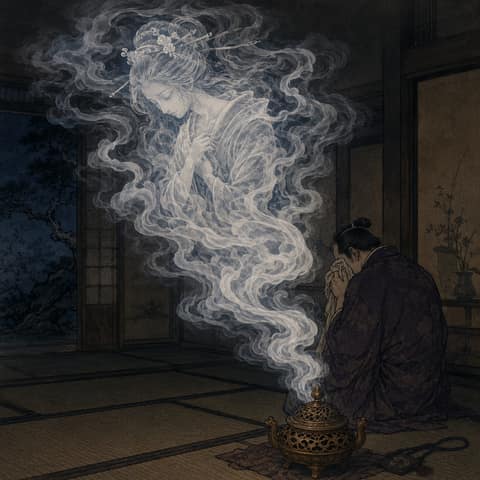
A legendary incense said to reveal the image of the dead within its smoke when burned. Rooted in Chinese anecdote literature, it spread in Japan through Edo-period yomihon, joruri and kabuki plays, and rakugo. Rather than a real substance, it functions as a symbolic, miracle-working incense in ghost tales, letting the bereaved glimpse the departed for a moment. Some stories call it an onmyoji’s secret remedy, but its actual existence is doubtful.

Hanzaki Daimyojin

Hanzaki Daimyojin

Rare

はんざきだいみょうじん

The Curse-Deity of Ryuzu no Fuchi: Hanzaki Daimyojin

Water YokaiOkayama

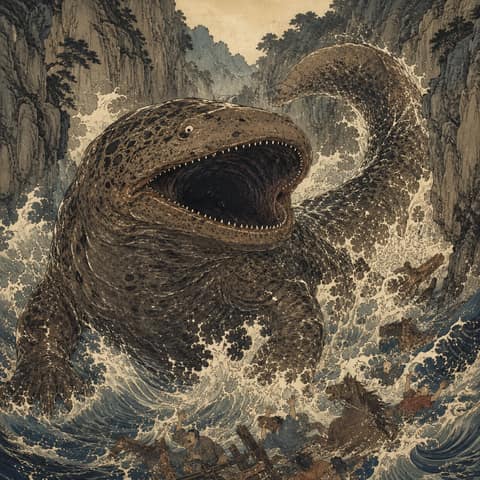
*Hanzaki Daimyojin* is the spirit of a monstrous Japanese giant salamander (*hanzaki*) passed down in Mukai-Yubara Village (present-day Yubara Onsen, Maniwa City, Okayama Prefecture) on the upper reaches of the Asahi River in Mimasaka Province. "Hanzaki" is an old name for the Japanese giant salamander in the Chugoku Mountains, said to derive from the belief that it would continue to live even if its body was torn in half (*hanbun ni saku*). It is told that a giant *hanzaki* reaching three *jo* and six *shaku* (about 10 meters) in length lived in a deep pool called Ryuzu no Fuchi, using its tail to knock people and horses into the depths to devour them . After it was slain, it laid a curse, and to appease it, a shrine was built where it was enshrined as "Hanzaki Daimyojin" (Great Deity Hanzaki). This is a classic example of a monster transforming into a god, and it lives on today in the Yubara Onsen area through the annual "Hanzaki Festival" held on August 8th .

Hannya

Hannya

Epic

Hannya

White Hannya in Aoi no Ue (Lady Rokujo's Demonic Aspect)

Oni / Giant Specter

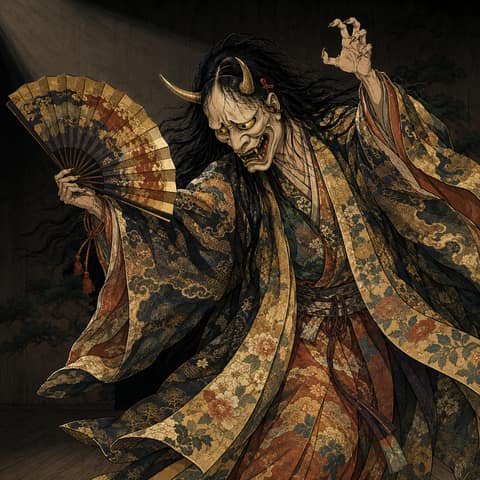
Hannya is a Noh mask for a female demon: two horns, gold-colored eyes, fangs, and a wide, split mouth convey rage, while sorrow still lingers in the expression. In the Noh plays Aoi no Ue, Kurozuka, and Dojoji, a Hannya mask is used to bring to the stage a woman turned demon through jealousy or resentment, or the vengeful spirit of a woman. It is a type of mask, not the name of one distinct being such as Yuki-onna or Kappa. The Nohgaku Performers' Association names Hannya among the representative masks for vengeful spirits, whether of the living or the dead. Its expression is not fashioned from anger alone. A description of the "Omi-uchi" Hannya in the Tokyo National Museum explains that the horns, gold-colored eyes, fangs, and split mouth signify rage, while the inverted-V upper eyelids and the disordered strokes of hair across the forehead carry sadness. The mask is frightening and poignant at once because, even as it inclines toward demonhood, it never wholly loses the trace of a human face. The word hannya originally means Buddhist wisdom. In Toriyama Sekien's Konjaku Gazu Zoku Hyakki, the entry begins by calling hannya the name of a sutra, then tentatively suggests that the name for a mask depicting a woman turned demon may derive from the phrase “hannya-goe” in the Noh play Aoi no Ue. The claim that the mask was made by Hannya-bō does not appear in Sekien's commentary; it belongs to a separate tradition about the name's origin. Hannya has a place in yokai encyclopedias because Sekien presented it as an independent illustrated subject in his 1779 Konjaku Gazu Zoku Hyakki. A Noh mask can be worn for several different roles, but Sekien's book presents Hannya as the name of a marvel alongside oni, Hashihime, and Shuten Doji. Hannya has moved between several cultural layers: Noh mask, female-demon role, Edo-period yokai image, and modern mask iconography.

Baku (Dream Eater)

Baku (Dream Eater)

Uncommon

ba-ku

The Baku of the Pillow

Divine SpiritsChinese in origin; nationwide in Japan (Edo-period dream-warding custom)

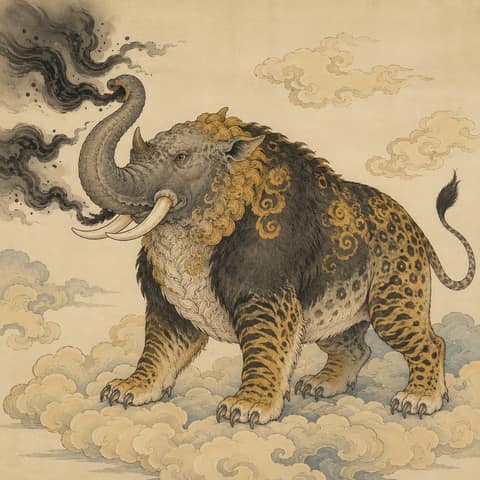
The Baku is an imaginary creature whose womb was the spirit-beast “mo” (貘) recorded in the Chinese classics, and which grew in Japan into something of its own: a beast that devours bad dreams. From of old it has been drawn as a composite creature pieced together from several animals — the trunk of an elephant, the eyes of a rhinoceros, the tail of an ox, the feet of a tiger, the body of a bear. This formula reaches back to “an elephant’s trunk, a rhino’s eyes, an ox’s tail, a tiger’s feet” in the preface that the Tang poet Bai Juyi attached to a screen, his Eulogy on the Mo Screen. Older still, the Shuowen Jiezi records it as “resembling a bear, yellow-black in color, dwelling in the land of Shu,” while Guo Pu’s commentary on the Erya reports that it “gnaws on copper, iron, and the stalks of bamboo.” This strange habit of eating iron is thought to reflect a real beast of Sichuan — the giant panda — and the Japanese name “baku” for the real animal (the tapir) was given later, because it resembled this legendary baku: a naming run in reverse. In China the mo was originally a beast that warded off evil — repelling plague and noxious influences. To sleep on a bed laid with its pelt was believed to fend off epidemics, and to hang up a picture of its form was to drive off evil. The notion of this spirit-beast reached Japan through the Collected Works of Bai Juyi, beloved reading ever since the Heian court, and by around the Muromachi period it had changed in character into “a beneficial beast that devours bad dreams and purges them away.” In the Edo period, picture-charms of the baku and “baku pillows” inscribed with the character for baku came into wide use, even among the common folk, as lucky charms that guarded peaceful sleep and kept evil at bay. The very opposite of the Western nightmare-demon that brings bad dreams to the sleeper, the baku is an auspicious beast that stands not on the side that steals dreams away, but on the side that eats bad dreams and makes them vanish.

Bake-kujira

Bake-kujira

Epic

bake-kujira

Bake-kujira, the Skeletal Whale on a Rainy Night

Animal Spirit of the SeaShimane

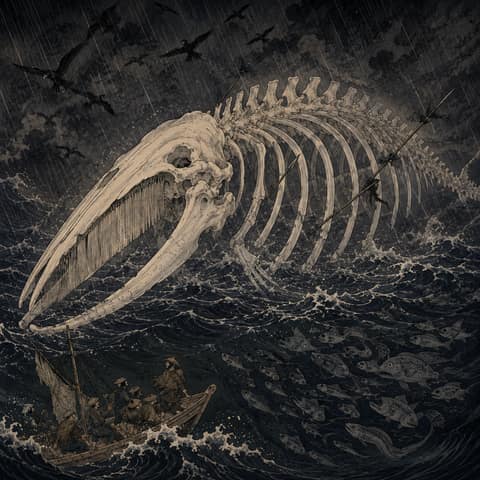
Bake-kujira appears on rainy nights as the immense white shadow of a whale. Up close, it has neither skin nor flesh—only a complete skeleton. In the story of the skeletal whale seen off Oki on a rainy night, fishers take the shape for living prey and launch their boats. Their harpoons meet no resistance, and only then do they realize that the whale is made of bone. Unfamiliar fish crowd the water, strange birds wheel overhead, and the sea seems to waver into another country. Bake-kujira is not a predatory fish that eats people. It is a whale that should already have been caught and consumed, returning before a coastal society as something still alive in its bones. This yokai owes its familiar outline less to a long tradition of early modern paintings than to modern yokai encyclopedias and the visual memory created by Mizuki Shigeru. Mizuki Shigeru's Zusetsu Nihon Yōkai Taizen and Mizuki Shigeru no Sekai Genjū Jiten placed the immense skeletal sea animal before a wide readership. A whale was both a gift from the ocean and a vast living creature put to death. Bake-kujira therefore gathers whaling, drifted whales, memorial rites, and the abundance of fish into a single image. Harpoons cannot touch the skeleton because it is no longer prey; it has become a sea spirit that looks back at the people who once hunted it. Bake-kujira differs from Funayūrei and Umibōzu even though all three belong to the sea. Funayūrei are human dead who approach ships, while Umibōzu rises as an enormous shadow. Bake-kujira is the spirit of an animal that once lived and was once taken as quarry. Its bones signify death, but also the fact that the dead do not disappear from a community's memory. Floating between Oki and Izumo, the skeletal whale reminds those who accept the sea's bounty that gratitude must be joined by awe.

Bake-jizo

Bake-jizo

Rare

ばけじぞう

Narabi Jizo of Kanmangafuchi Abyss, Whose Number Changes Every Time They Are Counted

Spirit/GhostTochigi

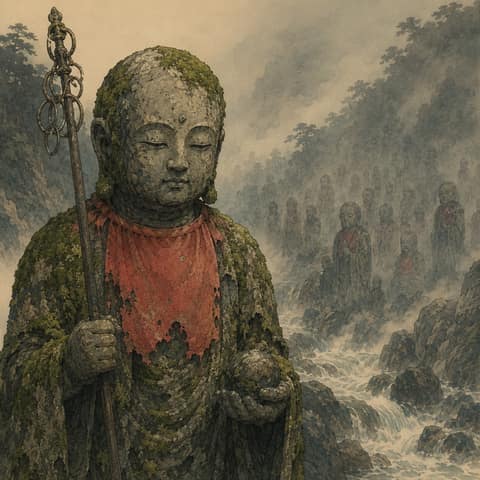
Bake-jizo (Ghost Jizo) is a group of Jizo statues lined up along the banks of Kanmangafuchi Abyss in the Daiya River valley of Nikko. Because "the number never matches when counted," they are called Bake-jizo, or Narabi Jizo (Lined-up Jizo). It is said that the count taken on the way there and the count taken on the way back will never match, making it impossible to know the exact number. Rather than being considered a yokai in the traditional sense, it is a "counting mystery" born in a place of faith—the sheer inexplicability of something that is clearly there but cannot be fully grasped by numbers has been spoken of as an anomaly. The group of stone Buddha statues lined up in this scenic spot formed by the lava of Mount Nantai, combined with the tranquility of the sacred ground, causes a dizziness of numbers in those who visit.

Bakezōri (Haunted Straw Sandal Tsukumogami)

Bakezōri (Haunted Straw Sandal Tsukumogami)

Uncommon

bah-keh-ZOH-ree

Tsukumogami Sandal Spirit

Animated Objects & UndeadJapanese folklore

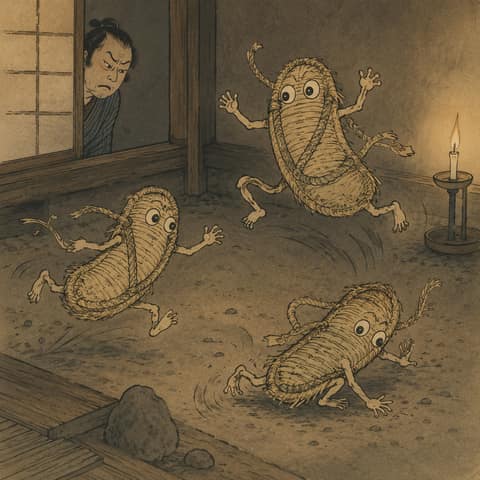
A tsukumogami said to arise when an old straw sandal gains a spirit. In folk belief it serves as a warning not to mistreat footwear. Early-modern images show sandals with arms and legs; in oral lore it is often confused with geta clogs. Yokai handbooks describe it making noises at night or singing, but regional encounter tales are scarce, and the stories tend to be didactic.

Bakeneko

Bakeneko

Common

bah-keh-NEH-koh

Bakeneko

Animal ShapeshiftersShimaneSaga

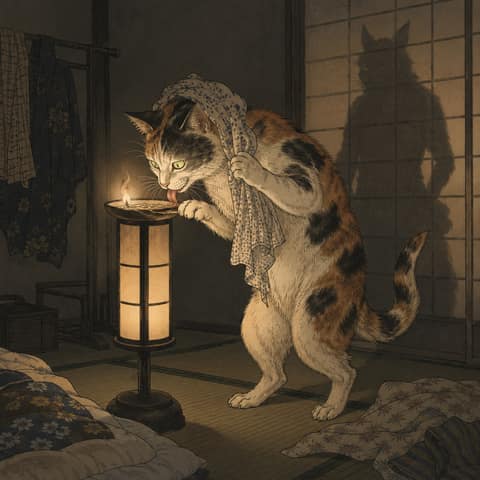
A domestic cat that has grown old and gained supernatural powers. Said to take human form, speak, manipulate the dead, cast curses, and more; often confused with the nekomata. Licking lamp oil is viewed as a sign of impending strangeness, and long-tailed cats were believed more likely to transform. As cities expanded, everyday cats took on a mystical aura, and Edo-period books and prints popularized the image.

Bake no Kawagoromo

Bake no Kawagoromo

Rare

ba-ke no ka-wa-go-ro-mo

The Dipper-Worshipping Fox of Transformation — Bake no Kawagoromo

Animal ShapeshiftersUnknown (a fox-transformation figure recorded in Sekien’s Hyakki Tsurezure Bukuro)

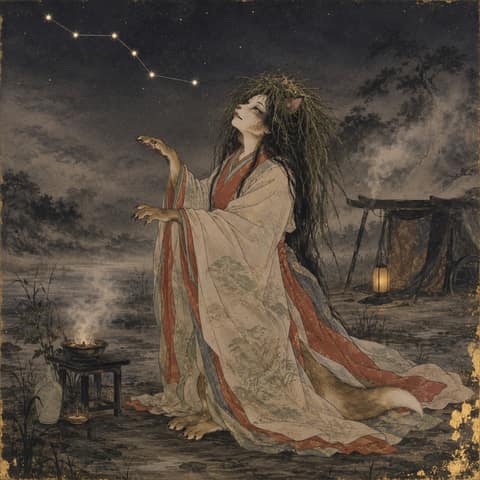
The Bake no Kawagoromo is a fox spirit drawn in the first volume of Toriyama Sekien’s picture-book Hyakki Tsurezure Bukuro. A fox that has lived three thousand years dons water-weed upon its head, bows in worship to the Big Dipper, and by this rite turns itself into a beautiful woman. In his caption Sekien writes, “A fox that has passed three thousand years, wearing algae and worshipping the Dipper, becomes a beautiful woman — surely this is what I have seen in the writings of China,” framing the whole as something mused within a dream. The Hyakki Tsurezure Bukuro is, by design, a book of tsukumogami — the spirits that dwell in worn-out tools and objects. A fox could slip in among these things only by virtue of its name. “Kawagoromo” means a garment of fur, and so reads almost as a piece of clothing, a “thing”; at the same time it sounds out the idiom “bake no kawa” — the skin of a disguise, which, once it peels away, lays the fox’s true form bare. Through this wordplay Sekien quietly smuggled a transforming beast, in truth an animal, into the ranks of the tool-spirits. For all that the name suggests the splendor of transformation, the creature carries no local legend tied to any particular place or person. It is, in the end, a fox known only through Sekien’s picture and caption — an image-born yokai that distills into a single illustration the age-old notion, inherited from China, that a fox grows able to become a beautiful woman as it ages.

Bakotsu

Bakotsu

Uncommon

Bakotsu

The Walking Bakotsu of Tosa

Tsukumogami / Skeletal YokaiKochi

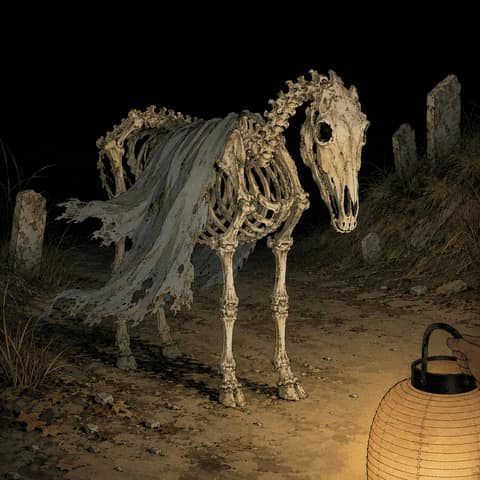
Bakotsu is a *mukuro* (corpse) yokai said to be the animated skeletal remains of a horse that burned to death in a fire, having absorbed eerie spiritual energy after being denied a proper burial. It is famously depicted in the *Tosa Obake Zoshi* (Tosa Yokai Scroll), produced in Tosa Province (modern-day Kochi Prefecture) during the mid-to-late Edo period. It possesses a bizarre and uncanny appearance: a gigantic, fully skeletonized horse standing upright on two legs, draped in tattered, threadbare rags around its waist. Among the many yokai traditions across Japan, it is extremely rare for a “horse skeleton” to move autonomously. Rather than being a malevolent, vengeful spirit that actively attacks or curses humans, Bakotsu embodies the regret of livestock meeting an untimely end and the sorrow of “beasts of burden” cast aside the moment they outlive their usefulness. Though an apparition that startles travelers on old night roads, it serves as a cautionary tale emphasizing the importance of *chikusho kuyo* (memorial services for animals) and the ethical duty to respect living creatures to the very end. Thus, it strongly reflects the localized folk beliefs and views on life and death of the Shikoku region.

Basan

Basan

Epic

BAH-sahn

Tradition-Faithful Iyo Type

Animal ShapeshiftersEhime

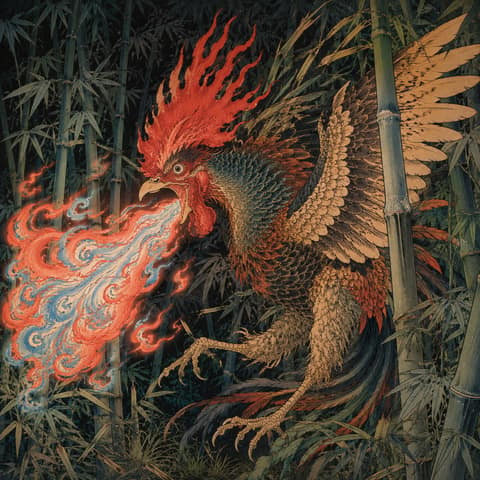
Basan is a phantom bird from Iyo, also called Basabasa or the Dog Phoenix. It sports a red comb and breathes vivid red fire, yet the flames are like foxfire—cold and unable to burn. Said to lurk in deep bamboo groves, it rarely shows itself. On late nights it may swoop over villages with a loud rustling of wings, only to vanish at once. It startles people but causes no harm. Edo-period curiosa and picture scrolls record its image and traits.

Banana-Plant Spirit

Banana-Plant Spirit

Rare

bah-SHOW-noh-SAY

Tradition-Faithful, Sekien Illustrated Edition

Natural Phenomena SpiritsNagano

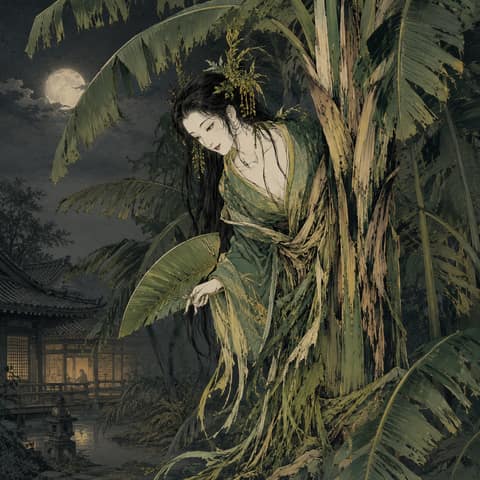
A spirit said to dwell in the leaves of the banana plant (basho), or the vital essence of an aged plant taking human form. Illustrated by Toriyama Sekien in Konjaku Hyakki Shui, whose notes cite Chinese anecdotes and the Noh chant-play Basho. Tales across Japan describe it appearing as a beautiful woman to test monks or startling travelers on night roads; many accounts say it rarely causes direct harm.

Batsu (Hiderigami)

Batsu (Hiderigami)

Epic

BAHT-soo (hee-DEH-ree-gah-mee)

Bibliographic Transmission Batsu (Hiderigami) of the Wakan Zukai Lineage

Deities & Divine SpiritsChinese tradition (transmitted to Japan through texts)

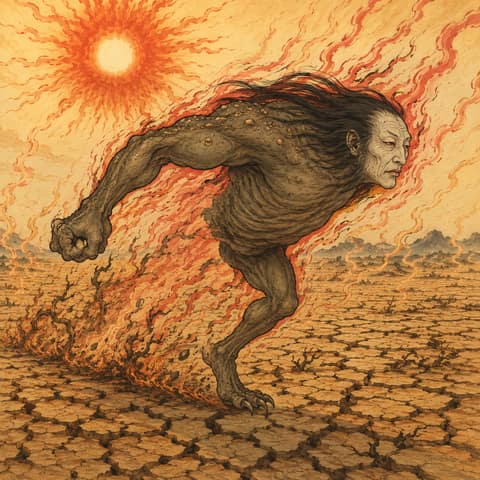
Batsu, known in Japan as the hiderigami or “drought spirit,” appears in Chinese classics as a being that brings drought. In Japan it became known via the Wakan Sansai Zue and Toriyama Sekien’s illustrations. As the goddess Ba (魃/妭) in the Classic of Mountains and Seas, she is the Yellow Emperor’s daughter who can halt rain. Later texts also depict a beastlike figure with a human face and a single limb on each side. Wherever it dwells, rain is withheld, and it is feared as a calamity god.

Paantu

Paantu

Legendary

Paantu

Paantu, the Mud-Clad Visiting Deity

Deity / Divine SpiritOkinawa

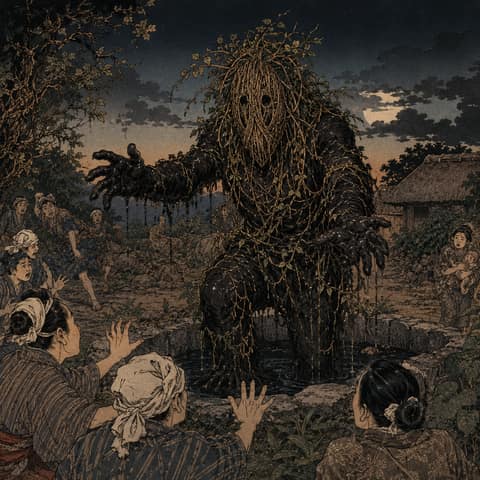
The Paantu is a masked visiting deity passed down in the folklore of Miyako Island, Okinawa. In the local Miyako dialect, "Paantu" refers to a demon or monster. This bizarre deity appears entirely covered in black mud, wrapped from head to toe in a vine known as the fish poison tree (Derris trifoliata), and wears a mask woven from plant fibers. It is believed to wander through the village, smearing mud on the people it encounters to cleanse them of the year's misfortunes. The Paantu is part of a lineage of visiting deities who periodically arrive from the otherworld—whether across the sea or beneath the earth—to drive away calamity and bestow bountiful harvests and blessings. Tradition holds that it only reveals itself during strictly designated seasonal festivals.

Fire-Quenching Crone

Fire-Quenching Crone

Rare

hee-KEH-shee-bah-bah

Sekien Iconography Edition

Half-Human BeingsEdo

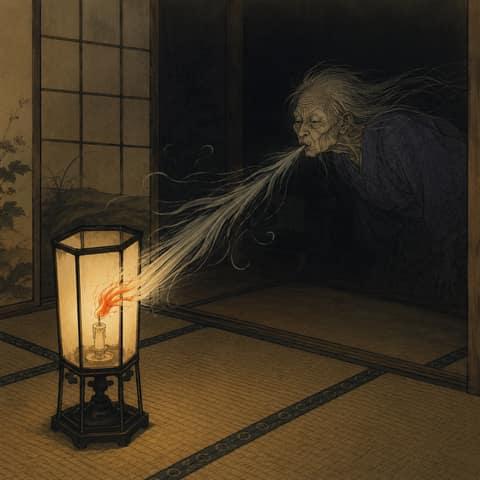
A yokai depicted by Toriyama Sekien in Konjaku Gazu Zoku Hyakki: an old woman who blows out lights. She is said to snuff lanterns, andon lamps, and candle flames from a distance with a single puff, interpreted as an ominous, yin presence that abhors the cheerful, yang nature of fire. Oral accounts are scarce, and scholars often view the figure as largely Sekien’s invention. Later books and picture chapbooks show name variants (“Fukkeshi Baba,” “Fukikeshi Baba”) and link her to tales of lamps going out at parties or on night roads.

Showing 1 - 24 of 81 yokai