🔤 Yokai by Kana

Find yokai in hiragana order

81 Yokai|12 Category|Page 3 of 4
Localization in Progress - More content available in Japanese version
View Japanese

Filter by hiragana row

Sort by: ReadingAscending
Fujiwara no Chikata’s Four Oni

Fujiwara no Chikata’s Four Oni

Uncommon

fooj-ee-WAH-rah no chee-KAH-tah no yohn-kee

Taiheiki Tradition Version: The Four Oni

Demons & GiantsMieIwate

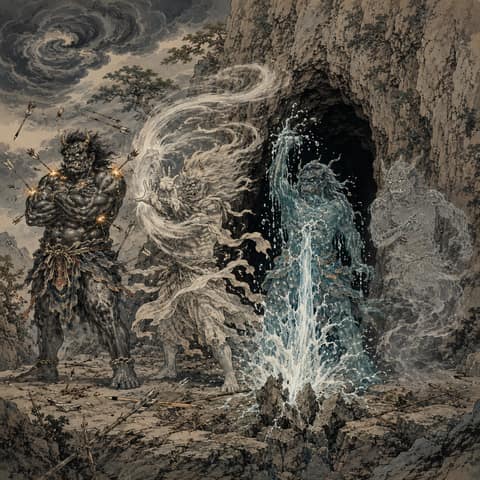
Four oni who served Fujiwara no Chikata, named in Book 16 of the Taiheiki. The Gold Oni had an invulnerable body that repelled weapons; the Wind Oni raised fierce gales; the Water Oni unleashed floods; and the Invisible Oni concealed its form and presence to strike by surprise. Chikata defied the imperial court with these four, but the warrior-poet Ki no Asao recited a waka that drove them off, leading to Chikata’s defeat. Some local traditions add Fire and Earth oni as variants.

Fujiwara-no-hirotsugu

Fujiwara-no-hirotsugu

Epic

fujiwara-no-hirotsugu

The Rebel Spirit That Foreshadowed the Goryo Belief

Spirit / GhostSaga

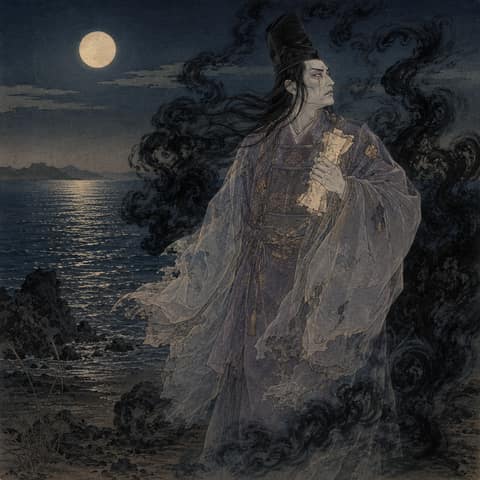
Fujiwara-no-hirotsugu was a figure who went down to Kyushu as Dazai no Shoni (Junior Assistant Governor-General of Dazaifu) during the Nara period, raised a rebellion in the 12th year of Tenpyo (740), and was defeated and killed. The "Shoku Nihongi" details how Hirotsugu submitted a memorial to remove Kibi no Makibi and the monk Genbo, raised an army, was defeated by the subjugation force, and executed. What is important in the context of yokai and divine spirits is that he was not merely a rebel, but was later spoken of as a "spirit of a political loser" linked to curses and Goryo (vengeful spirit) belief after his death. The spirit of Hirotsugu can be read as the prehistory of the Goryo belief that developed from the Heian period onwards. Like Prince Sawara, Sugawara no Michizane, Emperor Sutoku, and Taira no Masakado, there is a trend where the death of a politically defeated person is linked to disasters and curses, becoming an object of pacification and rituals. Hirotsugu, too, left his name in folklore at places like Kagami Shrine as a noble killed in the land of Kyushu. His anomalous nature lies where central political struggles and regional memories intersect. On this page, it is better not to conclude too strongly that Hirotsugu is an onryo (vengeful spirit), but to treat him carefully as a "historical figure who became an onryo." This is because the rebellion in the records, criticisms of political enemies, the connection with Genbo, the defeat and death in Kyushu, and the pacification in later generations form multiple layers. By adding him to YOKAI.JP's Goryo network, one can create an entry point into the political onryo of the Nara period that is hard to see through Sugawara no Michizane or Prince Sawara alone. The value of adding Hirotsugu lies in not letting the Goryo belief end only with the famous figures. While Sugawara no Michizane and Taira no Masakado are widely known, the sense of politically defeated individuals taking on divine aura had already sprouted before them. As an early example connecting the official records of the Nara period with later pacification folklore, Hirotsugu increases the depth of the onryo category. He is a figure who should be read including the memories of pacification left in the regions.

Fusuma

Fusuma

Uncommon

Fusuma

The White Cloth of the Night Road: Sado Fusuma

Dwelling / household objectSado Island, Niigata Prefecture (main form) / Tosa, Kōchi Prefecture (variant)

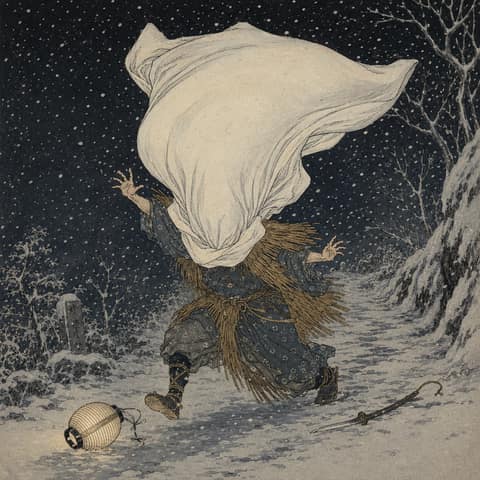
Fusuma is a cloth yokai said to fly through the night. The name comes from fusuma, an old word for bedding or a one-piece night covering found in classics such as The Pillow Book and The Tale of Genji; the yokai's name makes it sound as if that bedding itself had become uncanny. Its best-known home is Sado Island in Niigata Prefecture. There, a white cloth about the size of a wrapping cloth is said to fly without warning onto the head of someone walking alone at night or outside an inn, blocking sight and hearing and sometimes smothering the person to death. In Sado, even a famous Masamune blade cannot cut it; only teeth dyed black with kane, or ohaguro tooth dye, can bite through it. The custom that men on Sado also practiced ohaguro until the Meiji period is often connected to dealing with this apparition, but no primary source has been confirmed that directly proves a causal link. A tradition under the same name is also found in Tosa, Kōchi Prefecture. There the cloth is so vast that its edges cannot be seen and it wraps the whole body, while the methods of escape - smoking tobacco or calmly sitting down and waiting - differ sharply from the Sado type. One also often sees claims that Fusuma appears in Toriyama Sekien's Konjaku Gazu Zoku Hyakki, but this is a mistaken tradition: the creature in that book is Nobusuma, a flying-squirrel-like beast apparition, not a bedding-type Fusuma. Fusuma is not an Edo picture-scroll yokai. It should first be understood as a being lifted from local tradition by modern folklore studies through Sōgō Nihon Minzoku Goi (1955) and Yōkai Dangi (1956).

Futakuchi-onna (Two-Mouthed Woman)

Futakuchi-onna (Two-Mouthed Woman)

Epic

foo-tah-KOO-chee OHN-nah

Futakuchi-onna

Half-Human BeingsChibaTokyo

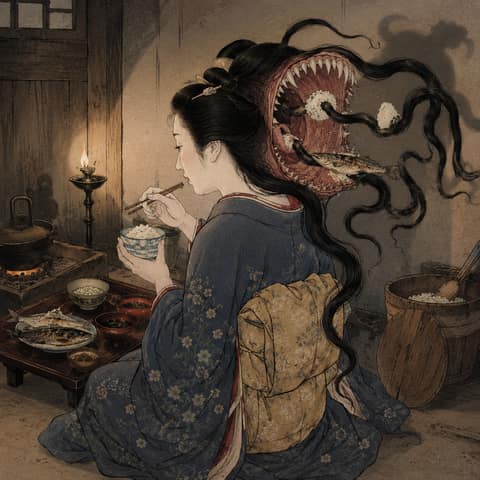
Futakuchi-onna is a yokai woman said to have a second mouth on the back of her head. She hides it under her hair, but when hunger strikes, her hair writhes like snakes and the rear mouth clamors for food on its own. Featured in strange-tale collections such as Ehon Hyaku Monogatari (1831), the legend often serves as a caution against extreme frugality and secretiveness. Outwardly she appears human, but at the nape a sharp-toothed mouth with a tongue is said to lurk.

布刀玉命

布刀玉命

Divine

ふとだまのみこと

岩戸に御幣を取り持つ祭具神・布刀玉命

神霊・神格ChibaTokushima

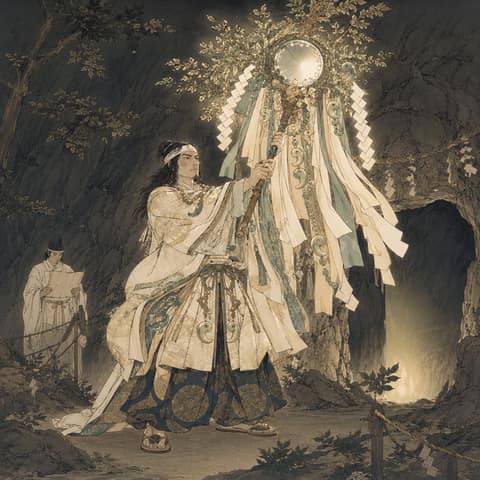
Futodama is the deity who held the *gohei* (ritual wand) before the Heavenly Rock Cave (Ama-no-Iwato) and is recognized as the ancestral god of the Inbe clan during the Descent of the Heavenly Grandson (Tenson Korin), governing ritual implements and industry. In the *Kojiki* (Ama-no-Iwato II), after the sun goddess Amaterasu-Omikami shut herself inside the cave, the deities Ame-no-Koyane and Futodama were summoned according to the plan of Omoikane. They performed divination using a deer shoulder bone from Mount Ame-no-Kaguyama and *hahaka* cherry wood, and prepared the offering of a *Sasaki* tree adorned with curved jewels, a mirror, and white and blue cloth. Futodama then took up these offerings as the grand *gohei*, establishing the ritual to open the cave alongside Ame-no-Koyane's *norito* (prayers). If Ame-no-Koyane is the deity of voice, Futodama is the deity of physical objects and ceremonial procedures. In Tenson Korin II, Futodama descended from heaven alongside Ame-no-Koyane, Ame-no-Uzume, Ishikoridome, and Tama-no-Oya as one of the Five Attendant Deities (Itsutomonoo), and is recorded as the ancestor of the Inbe clan. The official history of Awa Shrine identifies him as Ame-no-Futodama, the main deity of its Upper Shrine, describing him as the founding deity of all Japanese industries. The shrine further explains that he served closely by Amaterasu's side, was the ancestral god of the Inbe and Nakatomi clans who managed court rituals, and oversaw the creation of mirrors, jewels, cloth, weapons, and shrine architecture. The history of Oasahiko Shrine also states that his descendant Ame-no-Tomino-Mikoto came to Awa Province to plant hemp and paper mulberry, producing hemp cloth and cotton to lay the foundations of industry, enshrining Futodama as their guardian deity. Futodama's essence lies in the power to transform ordinary objects presented before the gods into the driving force of ritual and industry.

Futon-kabuse

Futon-kabuse

Rare

Futon-kabuse

Weight Falling on the Bed: Sakushima Futon-kabuse

Dwelling / household objectAichi

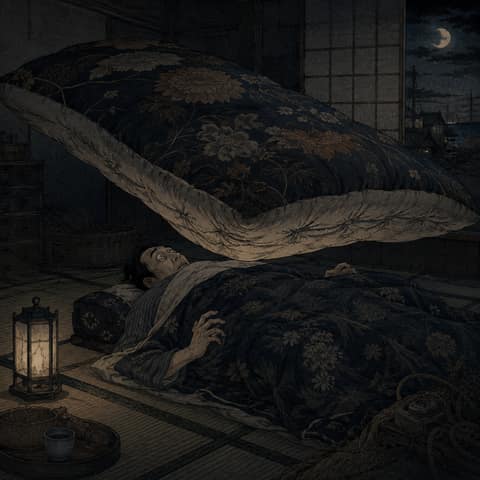
Futon-kabuse is a bedding apparition transmitted on Sakushima in Mikawa Bay, Aichi Prefecture. Without warning, a futon is said to float lightly onto the bed, cover a person, and smother them. Older records do not specify the exact time or place of appearance, nor the details of how to drive it away. Like the Fusuma of Sado and the Ittan-momen of Kagoshima, it survives in a short folklore report only as the basic pattern of bedding or cloth covering a person and causing suffocation. Its primary source is a field note by Segawa Kiyoko (1895-1984), who investigated fishing villages around Mikawa Bay; the record amounts to about a single line included in Yanagita Kunio's edited volume Kaison Seikatsu no Kenkyū (1949). It does not appear in Edo-period picture scrolls or books, nor in early modern local gazetteers. It is a local apparition recovered by modern coastal folklore studies. Originally a plain tradition told in a fishing community, it later gained its place beside Fusuma and Ittan-momen when yokai encyclopedias framed it as one of the "bedding-type" apparitions.

Fudo Myo-o

Fudo Myo-o

Divine

fudo-myoo

The Wrathful Avatar of Dainichi Nyorai

神霊・神格インド密教 Acalanatha 由来、空海が請来した渡来尊

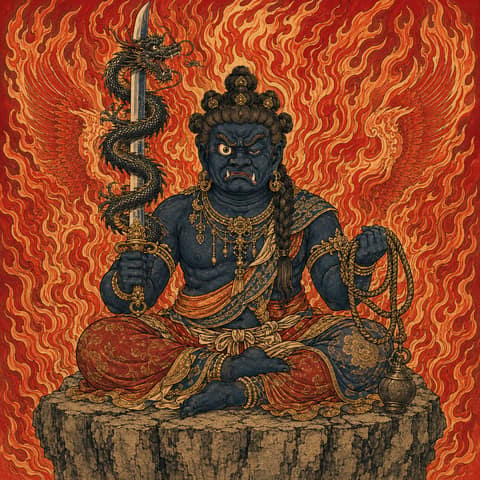
Fudo Myo-o (Acalanatha) is a core deity of Esoteric Buddhism and is extremely widely and deeply worshipped in Japanese folk religion as "Ofudo-san." Meaning "The Immovable Guardian" in Sanskrit, he is considered the avatar (Kyoryo Rinshin) of Dainichi Nyorai (Mahavairocana), the supreme Buddha in Esoteric Buddhism. Toward sentient beings who cannot be saved through gentle means, he deliberately assumes a terrifying, wrathful form to force them onto the righteous path—embodying the "ultimate state of compassion." True to his name, he symbolizes an unwavering resolve for enlightenment as solid as a boulder, serving as a vow for ascetics never to abandon the Buddhist path regardless of the harsh conditions. The sword in his right hand represents "wisdom" that severs worldly desires; the rope (kensaku) in his left hand signifies "compassion" that rescues people even if it means tying them up; and the roaring flames behind him denote the power to burn away all impurities. These are systematically conceptualized as instruments for salvation.

Funayūrei

Funayūrei

Epic

funayūrei

The Dan-no-ura Funayūrei That Ask for a Teigo

Aquatic SpiritsYamaguchiFukushima

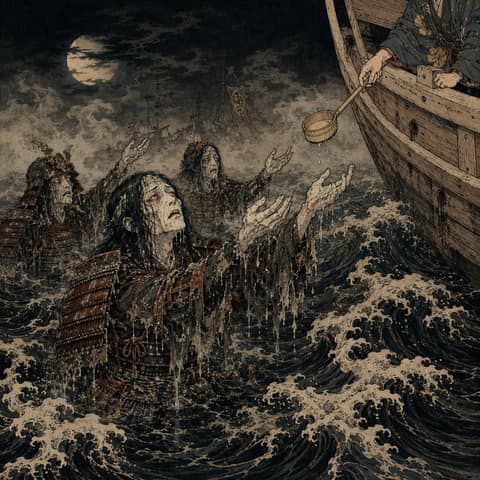
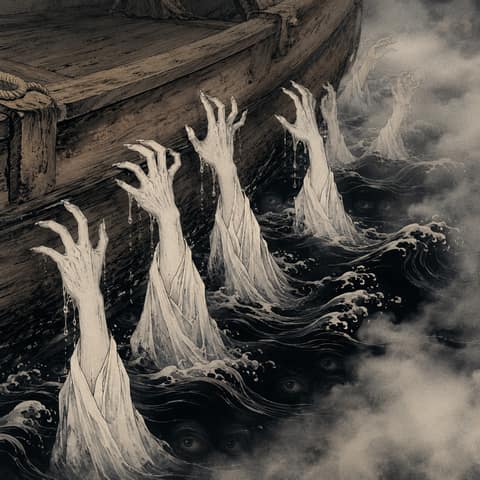
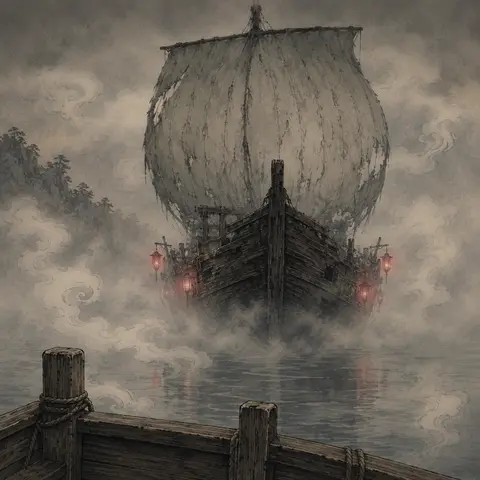
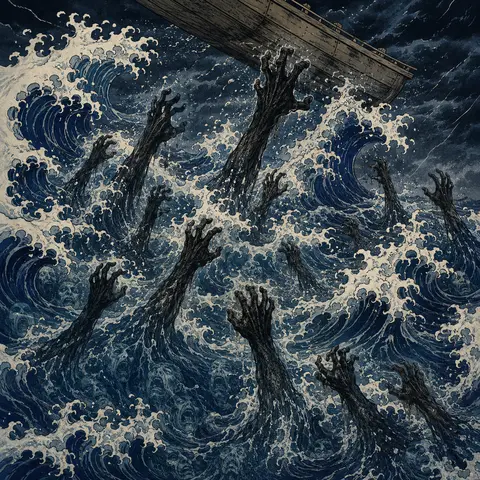
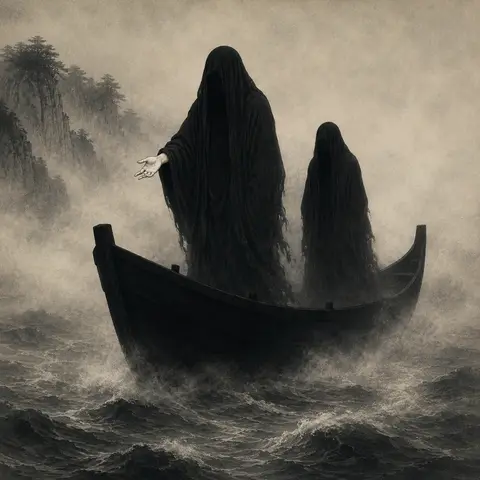
Funayūrei are maritime apparitions formed from the spirits of people who died by drowning or shipwreck. Depending on the region, they may appear as ghosts, phantom boats, eerie lights, or dark figures resembling Umibōzu. They most often emerge on stormy or fogbound nights, when they try to sink a vessel by ladling seawater aboard or confuse its course until it runs aground. Local defenses include offering a ladle with its bottom removed, throwing rice balls or ash, or meeting the ghosts with an unwavering stare. Mōjabune, Bōko, and Ayakashi are among the names applied to such spirits. Toriyama Sekien also depicted Funayūrei in Konjaku Gazu Zoku Hyakki.

Funayūrei

Funayūrei

Epic

funayūrei

Inada-Kase Boat Ghost

Aquatic SpiritsYamaguchiFukushima

Funayūrei are maritime apparitions formed from the spirits of people who died by drowning or shipwreck. Depending on the region, they may appear as ghosts, phantom boats, eerie lights, or dark figures resembling Umibōzu. They most often emerge on stormy or fogbound nights, when they try to sink a vessel by ladling seawater aboard or confuse its course until it runs aground. Local defenses include offering a ladle with its bottom removed, throwing rice balls or ash, or meeting the ghosts with an unwavering stare. Mōjabune, Bōko, and Ayakashi are among the names applied to such spirits. Toriyama Sekien also depicted Funayūrei in Konjaku Gazu Zoku Hyakki.

Funayūrei

Funayūrei

Epic

funayūrei

Murasa (Nigashio-Lodged of Tsuma Village)

Aquatic SpiritsYamaguchiFukushima

Funayūrei are maritime apparitions formed from the spirits of people who died by drowning or shipwreck. Depending on the region, they may appear as ghosts, phantom boats, eerie lights, or dark figures resembling Umibōzu. They most often emerge on stormy or fogbound nights, when they try to sink a vessel by ladling seawater aboard or confuse its course until it runs aground. Local defenses include offering a ladle with its bottom removed, throwing rice balls or ash, or meeting the ghosts with an unwavering stare. Mōjabune, Bōko, and Ayakashi are among the names applied to such spirits. Toriyama Sekien also depicted Funayūrei in Konjaku Gazu Zoku Hyakki.

Funayūrei

Funayūrei

Epic

funayūrei

Ugume (Kyushu West Coast Variant)

Aquatic SpiritsYamaguchiFukushima

Funayūrei are maritime apparitions formed from the spirits of people who died by drowning or shipwreck. Depending on the region, they may appear as ghosts, phantom boats, eerie lights, or dark figures resembling Umibōzu. They most often emerge on stormy or fogbound nights, when they try to sink a vessel by ladling seawater aboard or confuse its course until it runs aground. Local defenses include offering a ladle with its bottom removed, throwing rice balls or ash, or meeting the ghosts with an unwavering stare. Mōjabune, Bōko, and Ayakashi are among the names applied to such spirits. Toriyama Sekien also depicted Funayūrei in Konjaku Gazu Zoku Hyakki.

Funayūrei

Funayūrei

Epic

funayūrei

Mouren Yassa, the Vengeful Sea Ghost (Tales of Choshi and Kaijo District)

Aquatic SpiritsYamaguchiFukushima

Funayūrei are maritime apparitions formed from the spirits of people who died by drowning or shipwreck. Depending on the region, they may appear as ghosts, phantom boats, eerie lights, or dark figures resembling Umibōzu. They most often emerge on stormy or fogbound nights, when they try to sink a vessel by ladling seawater aboard or confuse its course until it runs aground. Local defenses include offering a ladle with its bottom removed, throwing rice balls or ash, or meeting the ghosts with an unwavering stare. Mōjabune, Bōko, and Ayakashi are among the names applied to such spirits. Toriyama Sekien also depicted Funayūrei in Konjaku Gazu Zoku Hyakki.

Funayūrei

Funayūrei

Epic

funayūrei

Namōrei, Black Little-Craft of Kosode

Aquatic SpiritsYamaguchiFukushima

Funayūrei are maritime apparitions formed from the spirits of people who died by drowning or shipwreck. Depending on the region, they may appear as ghosts, phantom boats, eerie lights, or dark figures resembling Umibōzu. They most often emerge on stormy or fogbound nights, when they try to sink a vessel by ladling seawater aboard or confuse its course until it runs aground. Local defenses include offering a ladle with its bottom removed, throwing rice balls or ash, or meeting the ghosts with an unwavering stare. Mōjabune, Bōko, and Ayakashi are among the names applied to such spirits. Toriyama Sekien also depicted Funayūrei in Konjaku Gazu Zoku Hyakki.

Furari-bi (Wandering Flame)

Furari-bi (Wandering Flame)

Rare

foo-RAH-ree-bee

Furari-bi

Natural Phenomena SpiritsJapanese folklore

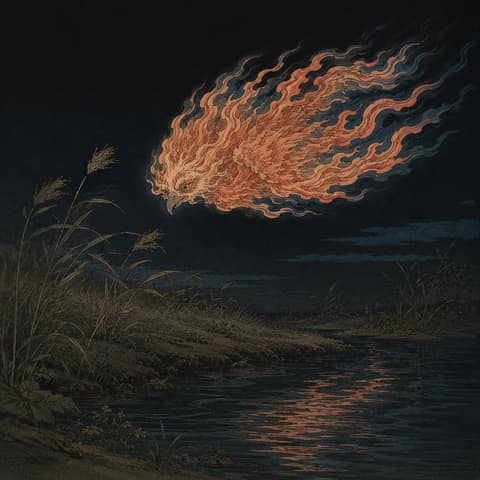
Furari-bi is a strange fire depicted in Edo-period yokai art, often shown as a bird wreathed in flames. Examples appear in Toriyama Sekien’s Gazu Hyakki Yagyo, Sawaki Suushi’s Hyakkai Zukan, and the anonymous Bakemono-zukushi. Explanatory notes are scarce, so its nature is unclear. Generally it is understood as a manifestation of unappeased spirits wandering as fire, with the birdlike visage serving as a symbolic form.

Furisode-no-kai

Furisode-no-kai

Rare

furisode-no-kai

The Furisode That Burned Edo: The Furisode Fire

Dwelling / ObjectTokyo

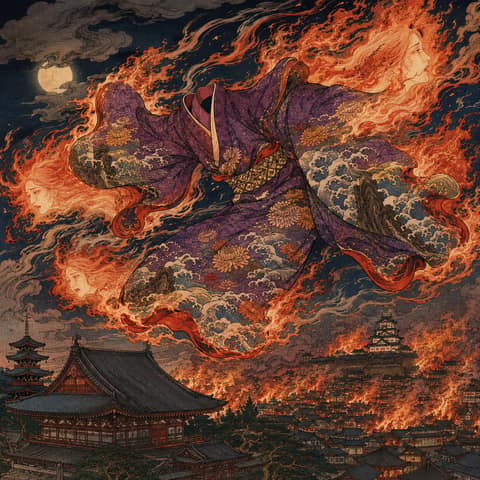
The *Furisode-no-kai* (Apparition of the Furisode / Furisode Fire) is an urban ghost story of Edo surrounding a single *furisode* (long-sleeved kimono) that is said to have successively claimed the lives of young girls. It is told that three girls who wore the same *furisode* died one after another on the exact same month and day of their respective years. When a temple tried to burn it to hold a memorial service, the burning *furisode* flew up in the violent wind, caught fire to the temple halls, and caused a massive conflagration that burned down most of Edo. This great fire is none other than the Great Fire of Meireki, which occurred in the first month of Meireki 3 (1657), burning most of the Edo cityscape, many daimyo mansions, and even the main keep of Edo Castle, resulting in an estimated 30,000 to 100,000 deaths; its popular name is the "Furisode Fire". The source of the fire is said to be Honmyoji Temple in Hongo Maruyama, and the tale of the *furisode*'s curse is inextricably linked to this legend of the fire's origin. It is simultaneously an apparition of an object that curses people, and an anomaly that condenses the memory of the disaster that burned the mega-city of Edo into a single garment.

Furu-Utsubo (Aged Quiver Spirit)

Furu-Utsubo (Aged Quiver Spirit)

Rare

FOO-roo OOT-soh-boh

Toriyama Sekien Iconography Standard

Animated Objects & UndeadJapanese folklore

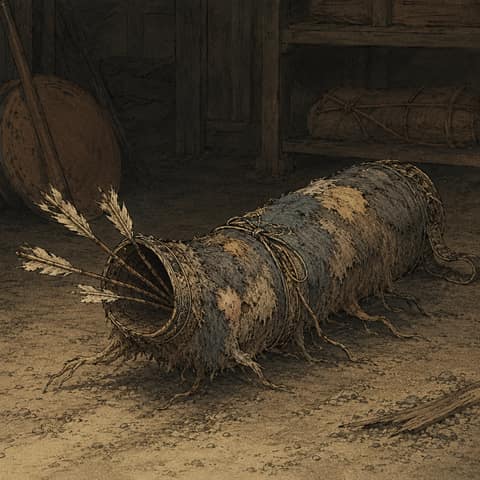
Furu-Utsubo is a tsukumogami—an animated household object—depicted by Toriyama Sekien in Hyakki Tsurezure Bukuro as a quiver (utsubo) that has aged into a wandering, anthropomorphic being. The quiver, a back-worn case for arrows, is shown moving under its own power after long years of use. In his caption, Sekien alludes to the warriors Miura-no-suke and Kazusa-no-suke who shot the “field fox” of Nasu Moor, hinting that an old quiver of theirs may have transformed. The image follows the lineage of weapon-bearing object-spirits seen in Muromachi-period Hyakki Yagyō picture scrolls.

Bunagaya

Bunagaya

Uncommon

Bunagaya

Bunagaya, Forest Spirit of Yanbaru

Mountain and Field ApparitionsOkinawa

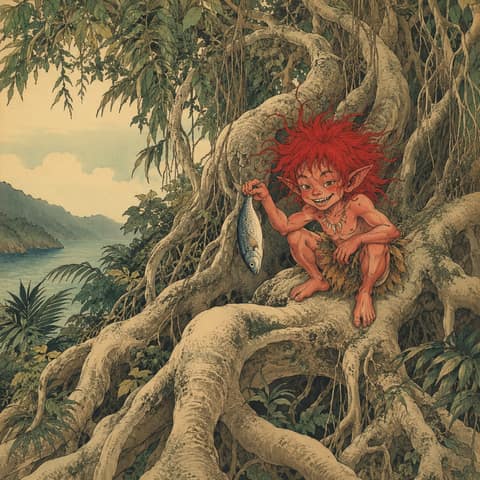
The Bunagaya is a spirit said to dwell in the forests of Yanbaru in the northern part of Okinawa Island, often described as a semi-naked child with red hair. It is widely considered to belong to the same lineage as the [Kijimuna](/en/yokai/kijimuna), but while the Kijimuna is a tree spirit that resides within old banyan (gajumaru) trees, the Bunagaya is characterized as a spirit dwelling in the forests and rivers themselves. It is particularly known for manipulating fire (Bunagaya fire), and the mysterious lights that appear like lanterns in the mountains at night were thought to be the work of the Bunagaya. Although it shares traits with the Kijimuna—such as bewitching humans, loving sumo wrestling, catching fish, and cursing those who damage trees—its activities are strongly tied to the deep forests and mountain streams of Yanbaru.

Furaku-Furaku (The Dangling Lantern Spirit)

Furaku-Furaku (The Dangling Lantern Spirit)

Rare

boo-RAH-boo-RAH

Sekien Plate Standard

Animated Objects & UndeadJapanese folklore

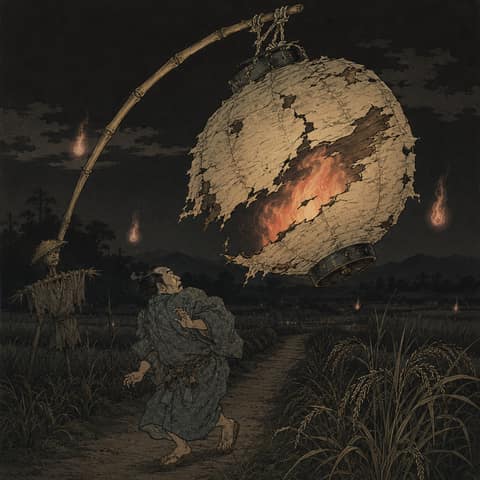
A lantern yokai depicted by Toriyama Sekien in Hyakki Tsurezure Bukuro. Tied to a bamboo pole, the torn lantern gapes like a mouth and droops over a path. The inscription hints it might be mistaken for a rice‑field lantern fire—or even foxfire—but Sekien groups it among animated tools, marking it as a tsukumogami, a lantern that has come to life. Sekien also notes the name as “不々落々,” though it is generally written “不落不落.”

Shibiru-biru (Buru-buru) – The Quiver Spirit

Shibiru-biru (Buru-buru) – The Quiver Spirit

Uncommon

boo-roo-BOO-roo

Shindanda (Tradition-Faithful)

Ghosts & SpiritsJapanese folklore

Shibiru-biru, commonly called Buru-buru, is a yokai personifying the omen of fear, depicted by Toriyama Sekien in Konjaku Gazu Zoku Hyakki. When a chill creeps in at the collar and gooseflesh prickles the nape at a sudden fright, it is said this spirit has attached itself. Also known as the Coward God (okubyō-gami) or Zozogami, it symbolizes how fear manifests as bodily sensation. Its form and provenance are undefined, resembling a deified concept of dread.

Bungo Kawatarō

Bungo Kawatarō

Uncommon

bun-go no kawa-ta-rō

Bungo Kawatarō, the Hairy Kappa of Bungo

Water spiritOita

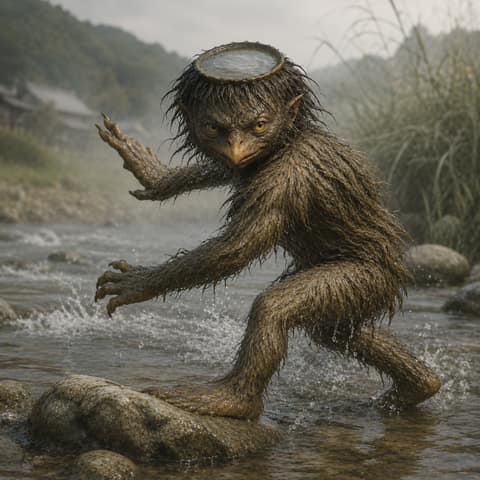
The Bungo Kawatarō is a kind of kappa handed down in the Bungo region of Kyushu—present-day Ōita Prefecture. Across Kyushu the kappa is commonly called "kawatarō," and Bungo Kawatarō is simply the local name for it. It lives in rivers and deep pools, bearing on its head a dish brimming with water. Its body is covered in hair and resembles a monkey, yet it is also said to have a beaklike mouth and a shell. Fond of sumo and underwater mischief, it steals the day’s catch on the one hand, while on the other—if a promise is kept—it imparts knowledge of irrigation and medicine: the two-sided nature so characteristic of the kappa. Should the water in its dish be lost, it was believed to lose its strength.

Heiroku

Heiroku

Rare

HAY-roh-koo

Iconography-Concordant Version

Animated Objects & UndeadJapanese folklore

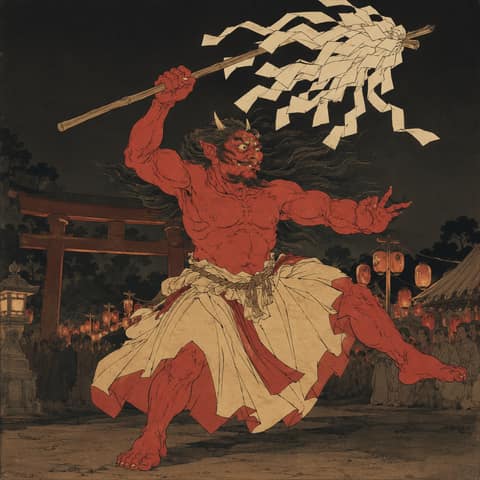
Heiroku is a yokai depicted by Toriyama Sekien in Hyakki Tsurezure Bukuro. Shown bare-chested and rough-hewn, he brandishes a gohei (shinto paper streamer wand) in his right hand. Sekien’s caption—“In the flower capital, shrines lack fixed rites…”—hints at disorder in worship and public unrest, though details are unclear. The image likely draws on Muromachi-period Night Parade scrolls showing a red, oni-like figure with a gohei. Later readers sometimes interpret Heiroku as a spirit inhabiting the gohei or a personification of festival turmoil.

Betobeto-san

Betobeto-san

Epic

betobeto-san

The Footsteps Echoing on the Night Road

Mountain/Field YokaiNaraShizuoka

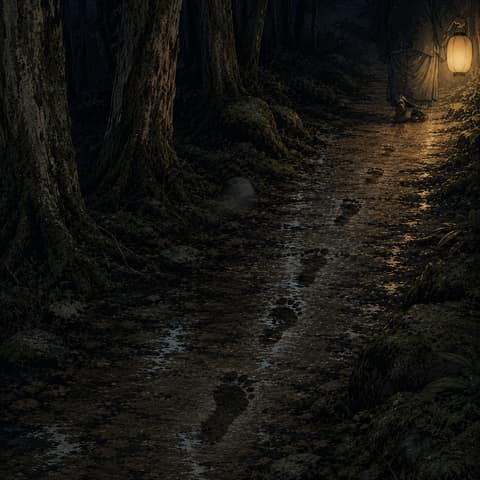
Betobeto-san is a night-road yokai that never reveals its form, accompanying people from behind solely through the sound of footsteps. Widely known primarily around Uda District in Nara Prefecture, it is said that while walking down a dark road, one might hear wet, smacking footsteps—"beto-beto" or "peta-peta"—trailing behind them, yet turning around reveals no one. The terror it induces does not stem from a grotesque appearance, but from the fact that the distance of the footsteps never changes. Neither catching up nor falling behind, the footsteps perfectly match the person's stride, forcing the walker to carry an invisible companion on their back. Rather than a yokai that inflicts harm, Betobeto-san is an anomaly of the boundary that can be safely passed by showing courtesy to the unseen. It is said that if one calls out, "Betobeto-san, please go ahead" (Betobeto-san, osaki e okoshi) and yields the path, the footsteps will move to the front and eventually disappear. This etiquette demonstrates the folkloric wisdom of not eliminating fear through force, but acknowledging the other's existence and yielding the right of way. While Shigeru Mizuki's illustrations gave it a round, friendly appearance, the original Betobeto-san is a formless presence born from the sounds of night roads, wet soil, and the emptiness behind one's back. There is a vast distance between this yokai's visualized modern character form and the formless folkloric experience it originated from. Though it gained a small body in pictures, the core of the legend remains the footsteps approaching from behind. Therefore, to truly understand Betobeto-san, rather than looking for its figure, one must imagine the sensation of gaining an extra set of walking sounds on a dark, lonely road.

Benzaiten

Benzaiten

Legendary

べんざいてん

Default

Deities & Divine SpiritsKanagawaShiga

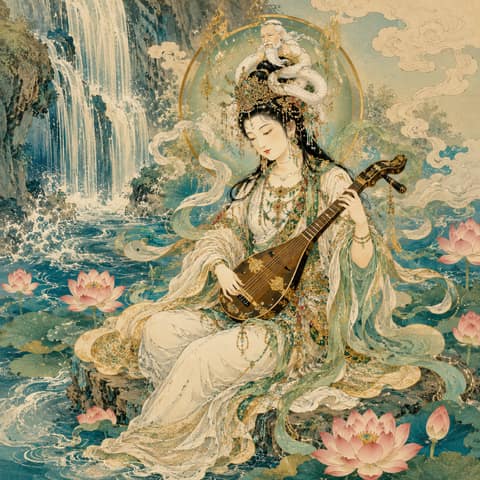
Benzaiten (also spelled Benten) is a Buddhist tutelary deity originating from the ancient Indian Hindu goddess Sarasvatī, who underwent a unique evolution in Japan from the Middle Ages onwards. The Sanskrit name "Sarasvatī" was translated into Chinese scriptures as "Benzaiten" (goddess of eloquence). The original Sarasvatī was the goddess of music, arts, language, and rivers; after being adopted by Buddhism, she was venerated as a protector deity in texts like the Lotus Sutra and the Golden Light Sutra. In Japan from the Kamakura period onwards, she merged with Ugajin, an indigenous human-headed snake deity, to form the unique divine figure of Uga-Benzaiten. This marked the decisive turning point for her transformation into a deity of wealth and fortune, reflected in the change of the kanji used for her name from "Benzaiten" (goddess of eloquence) to "Benzaiten" (goddess of wealth). She has major sanctuaries centered around the Three Great Benten Shrines of Japan (Enoshima Shrine in Kanagawa, Hogon-ji on Chikubu Island in Shiga, and Itsukushima Shrine in Hiroshima), as well as Zeniarai Benzaiten Ugafuku Shrine in Kamakura and Tenkawa Daibenzaiten-sha in Nara. In the Edo period, she was widely revered as the sole goddess among the Seven Lucky Gods. Today, she remains a vital subject in folklore and yokai studies, surrounded by popular beliefs involving her serpent nature, wealth-bringing attributes, and taboos against couples visiting her shrines.

Hoakari

Hoakari

Divine

ほあかりのみこと

Hoakari, the Fierce Child God Who Summons Storms

Deities / Divine SpiritsHyogo

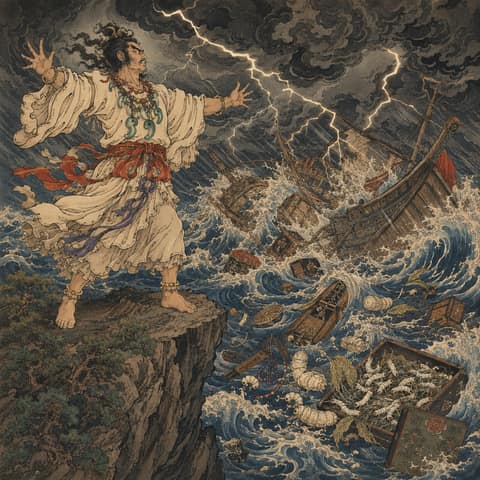
Hoakari-no-Mikoto is an Amatsukami placed in the lineage of the heavenly grandchild. In Tango, he is spoken of as an ancestral deity who brought cultivation and agriculture, while in Harima, he is portrayed as a fierce, wild child-god who rebelled against his father and caused storms. In the *Kojiki*'s account of the Tenson Korin, among the two deities born from the union of Ame-no-Oshihomimi and Takagi-no-Kami's daughter, Yorozuhata-Toyoakitsushi-Hime, Ame-no-Honoakari is mentioned first, followed by Hikoho-no-Ninigi-no-Mikoto. This positioning, connecting the bloodline of Amaterasu-Omikami's child with the lineage of Takamimusubi, leads to Hoakari being read as the "God of Light" appearing just before the descent of the heavenly grandchild. According to the history of Kono Shrine, the chief shrine of Tango, its principal deity is Hikohoakari-no-Mikoto, also known as Amaterasu-Kuniteru-Hikohoakari-no-Mikoto, and is recorded as the brother deity of the heavenly grandchild Ninigi-no-Mikoto. Furthermore, he is said to have received the Okitsu-kagami and Hetsu-kagami mirrors from the heavenly ancestor, descended to Kanmurijima, and spread sericulture and rice cultivation to Tango and Tanba. On the other hand, in the Shikama District section of the *Harima no Kuni Fudoki*, Hoakari appears as the child of Onamuchi-no-Mikoto. Enraged at being abandoned on Mount Inedate, he raised wind and waves, capsizing his father's ship. The scattered ship's gear and cargo became the names of the hills around Himeji, and the place where the silkworms (*kaiko*) fell connected to the name Himemichio-ka, which eventually led to the name of Mount Himeyama. What is important here is not to force these into a single, linear lineage. Ame-no-Honoakari of the *Kojiki*, Hikohoakari of Kono Shrine, and Hoakari of Harima, while sharing the same divine name, each bear the roles of heavenly light, descent upon the sea and agriculture, and the creation of place names through anger, respectively. Confining Hoakari to just one origin story actually makes his figure thinner. It is only when the heavenly light, the agriculture of Tango, and the storms of Harima overlap that the depth this divine name bore in various parts of ancient Japan becomes visible.
Showing 49 - 72 of 81 yokai