🔤 Yokai by Kana

Find yokai in hiragana order

81 Yokai|12 Category|Page 2 of 4
Localization in Progress - More content available in Japanese version
View Japanese

Filter by hiragana row

Sort by: ReadingAscending
Hiko-san Buzenbō

Hiko-san Buzenbō

Legendary

Hiko-san Buzenbō

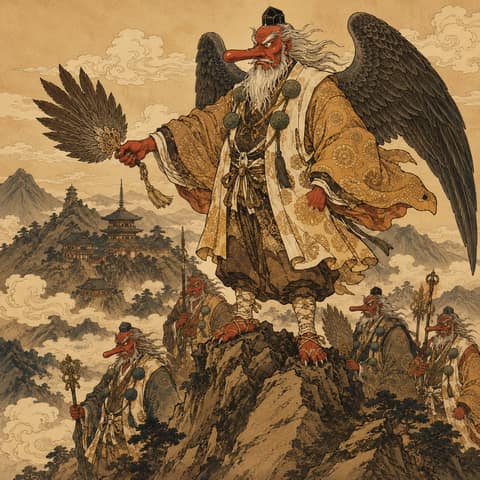
Chief of the Tengu of Kyūshū — Hiko-san Buzenbō

Mountain & Wilderness SpiritsFukuoka

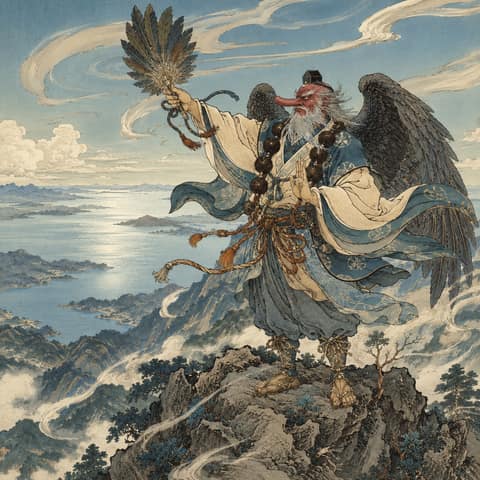
Hiko-san Buzenbō is a great tengu enthroned on Mt. Hiko (Hikosan) in Buzen Province, and is held to be the chief—the head—of the tengu of Kyūshū. Counted among the Eight Great Tengu, he is chanted in the Muromachi Noh play Kurama Tengu as "in Tsukushi, the Buzenbō of Hikosan." Hikosan is the foremost Shugendō sacred site of northern Kyūshū, counted—together with the Dewa Sanzan and Ōmine—among the three great centers of Shugendō in Japan. The first textual appearance of his name and seat is in the Kamakura-period engi the Hikosan Ruki (1213), where Buzenbō is recorded as the eighteenth of Hikosan's forty-nine grottoes, the "Buzen-kutsu." Buzenbō is enshrined at what is today Takasumi Shrine (Soeda, Fukuoka, called "Buzenbō" until the Edo period), and as a tengu of both reward and punishment—visiting chastisement upon the greedy, protection upon the upright—he has struck deep roots in the mountain faith of Kyūshū.
Hichigee

Hichigee

Rare

hichigee

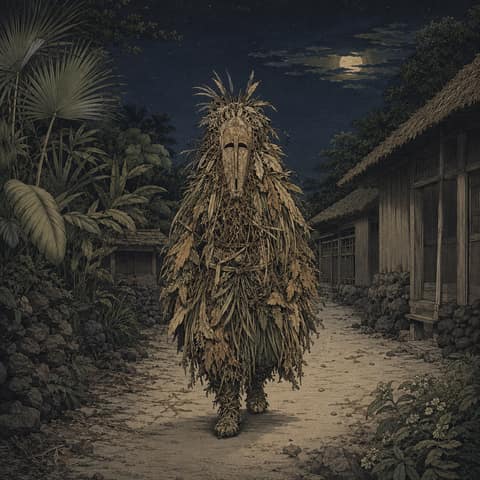
The Visiting God Touring the Island at the Turn of Seasons: Hichigee

Gods / SpiritsKagoshima

*Hichigee* (or *Hicchigee*) refers to the sacred time of *setsugawari* (change of seasons) transmitted in the Tokara Islands of Kagoshima Prefecture, as well as the visiting divine spirit itself that arrives during that time. In the Tokara Islands, it is believed that gods cross over to the islands on the turning points of the lunar calendar, and people spend these days with a sense of awe and restraint. According to Naotomo Inagaki's *Toshima Village Journal*, the visiting god *Boze* that appears during the Bon festival on Akusekijima was originally the masked god *Hichigee* who appeared on the night of the winter *setsugawari*, and the traces of what once appeared across the Tokara islands remain solely on Akusekijima. In other words, *Hichigee* is an ancient layer of the visiting god belief that serves as the matrix for *Boze*.

Hitodama (Human Soul Fire)

Hitodama (Human Soul Fire)

Epic

hee-toh-DAH-mah

Hitodama (Traditional Tale Version)

Ghosts & SpiritsVarious regions across Japan

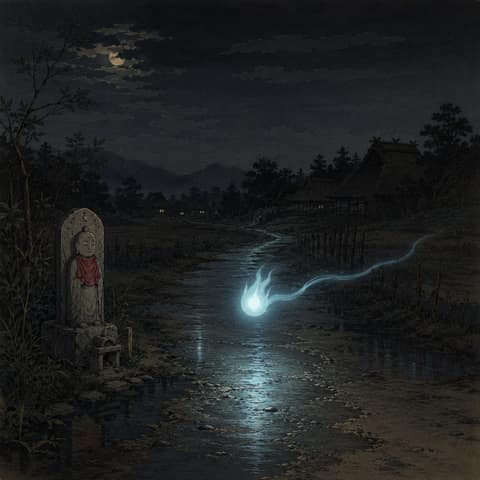
Hitodama are small, floating balls of light seen at night, long interpreted as souls that have left the human body. Reports describe bluish-white, orange, or red hues, often trailing a tail and drifting low to the ground. While often confused with onibi or kitsunebi, hitodama specifically denote the luminous manifestation of a human soul and are linked to death and liminal moments. They appear frequently in classical literature, early modern essays, and regional lore, with sightings continuing into modern times.

Hitotsume-kozou

Hitotsume-kozou

Epic

hee-TOH-tsu-meh koh-ZOH

The One-Eyed Boy

YokaiAcross Japan (Edo, Aizu, Tanba, Bizen, etc.)

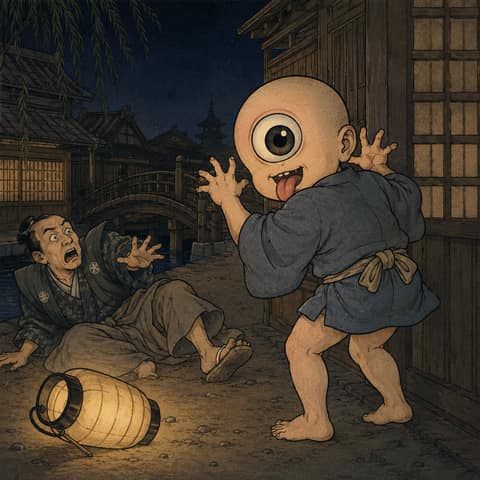
A yokai appearing as a shaven-headed boy with a single large eye in the center of his forehead. More prankster than predator, it startles people by popping up suddenly and is often portrayed with humor. A folk pun led to the belief it dislikes beans, which later shifted into depictions of it favoring tofu. It appears in Edo-period picture scrolls and essays, and is often encountered outdoors or by the roadside.

Hienma

Hienma

Rare

hee-EN-mah

Didactic Tale, Classical Iconography Adherent

Half-Human BeingsEdo period

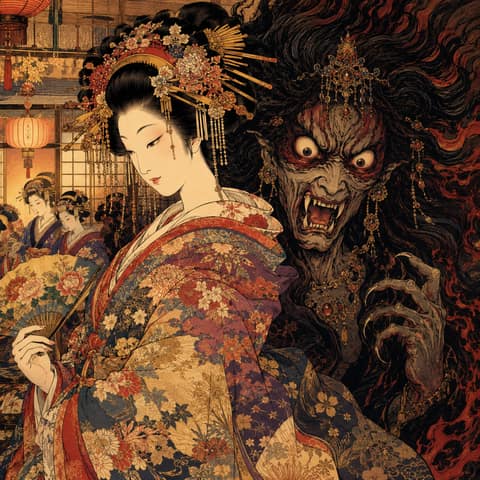
A yokai named in the Edo-period collection Ehon Hyaku Monogatari. Framed as a Buddhist admonition, it serves as a metaphor for the folly of being ensnared by a woman’s allure. Her outward beauty is likened to a bodhisattva, while her inner nature is as fearsome as a yaksha. Men whose hearts are unsettled by her are warned to lose their homes and ruin themselves. The name can be read as “calamity flying in on karmic ties,” and it has been linked to folk beliefs about women born in the year of Hinoe-uma (the fiery Horse).

Kagutsuchi

Kagutsuchi

Divine

kagutsuchi

The Fire God Who Spawns Death and Rebirth

Deity / Divine SpiritKyotoShizuoka

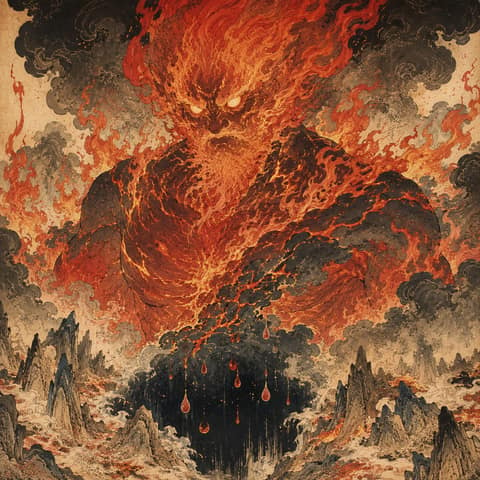
Kagutsuchi (Hinokagutsuchi-no-kami) is the personification of fire, a fierce deity whose very birth brings about death and rebirth. In the "Kojiki," Izanami dies after her genitals are burned giving birth to the fire god Kagutsuchi, and the enraged Izanagi slashes Kagutsuchi to pieces. From the blood and body parts of the slain god, even more deities are born. Fire is essential for life, but in the context of childbirth, it is dangerous enough to lead the mother goddess to her death. This duality makes Kagutsuchi not just a god of fire, but a turning point in mythology. The "Nihon Shoki" also contains variant traditions regarding the birth of the fire god and the death of Izanami. Throughout the Kiki mythology, fire is treated as a force that connects the end of creation with the beginning of Yomi (the underworld). Following Kagutsuchi, the story progresses to the visit to the underworld, ritual purification (misogi), and the birth of the Three Precious Children. In other words, the fire god is an entity that temporarily destroys the order of the world's creation, triggering a chain of death, defilement, purification, and the birth of the sun goddess. In the yokai guide, while treated as a divine spirit, he has strong connections to deities of calamity, fire prevention beliefs, and mountain worship. In later beliefs, Kagutsuchi is worshipped under names like Homusubi-no-kami as a god of fire prevention and protection against fires. The Atago belief centered at Mt. Atago in Kyoto and the Akiha belief represented by Akihasan Hongu Akiha Shrine are major pillars of folk religion where people fear fire yet pray to it for protection. It is not a contradiction that the god who creates fire also becomes the god who quells it. Entrusting uncontrollable power to the deity of that very power is the depth of Japanese fire worship. Compared to related fire anomalies, Kagutsuchi operates on an entirely different scale. While Kitsunebi (foxfire) and Shiranui are mysterious lights seen by human eyes, Kagutsuchi is a fire that alters the structure of the mythological world. He is not a ghost story about seeing fire, but the catalyst through which the land of the dead, ritual purification, and the birth of the sun goddess continuously unfold. Therein lies his high rank as a divine spirit.

Hihi (Demon Baboon)

Hihi (Demon Baboon)

Epic

HEE-hee

Hihi (Traditional Accounts)

Animal ShapeshiftersNagano

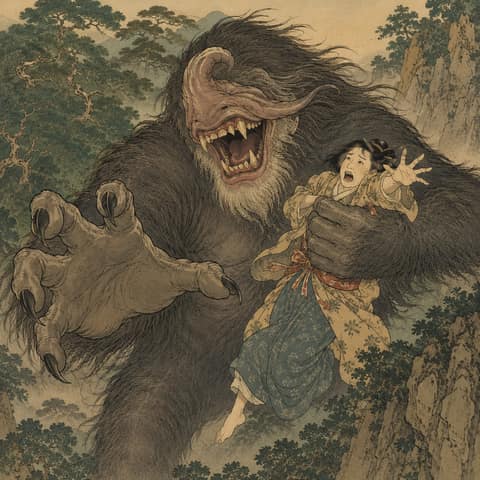
A yokai resembling a large monkey said to appear in the mountains, often described as an aged monkey that has transformed. It possesses formidable strength and is known in many tales to attack people, especially abducting women. Across regions it is said to burst into loud laughter at the sight of humans; its long lips curl upward until they cover its eyes. Edo-period picture scrolls and encyclopedias depict it as big-bodied with black fur. Some explain the name as imitating its laugh, and it is sometimes confused with other mountain beings like yamawaro.

Himamushi Nyūdō

Himamushi Nyūdō

Rare

HEE-mah-moo-shee nyoo-DOH

Toriyama Sekien Iconography Reference

Household SpiritsEdo period

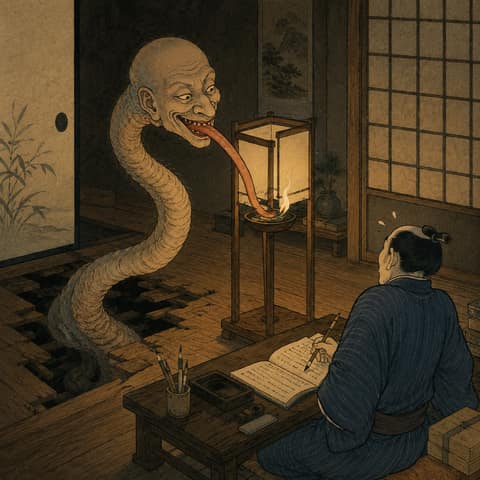
A yokai depicted by Edo-period artist Toriyama Sekien in Konjaku Hyakki Shūi. It rises from beneath the floorboards, licking the oil of an andon lamp and disrupting night work. Sekien notes it as the spirit of someone who shirked duties in life, becoming a “Himamushi Night Nyūdō” after death to lick lamp oil and hinder late-night tasks. The name is linked to a visual wordplay on “Hemamushi-nyūdō,” commonly read as a moral against laziness and sloth.

Hyakume (Hundred-Eyed Demon)

Hyakume (Hundred-Eyed Demon)

Rare

HYAH-koo-meh

Iconographic Origin, Modern Interpretation

Half-Human BeingsJapanese folklore

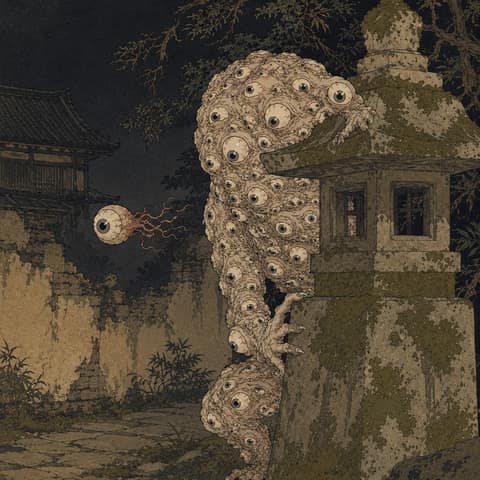
A yokai covered with innumerable eyes. It shuns bright daylight and is said to appear mainly at night. Some accounts claim that when it reveals itself, one of its eyes detaches and trails the witness. Illustrations sometimes show eyes covering the mouth; its diet is unknown. The name and image became standardized through late Edo to Meiji-era paintings of “Hyakume” and later modern yokai encyclopedias.

Hyōsube

Hyōsube

Uncommon

hyō-su-be

Hyōsube, the Hairy Riverside Kappa of Kyushu

Water spiritSagaKumamoto

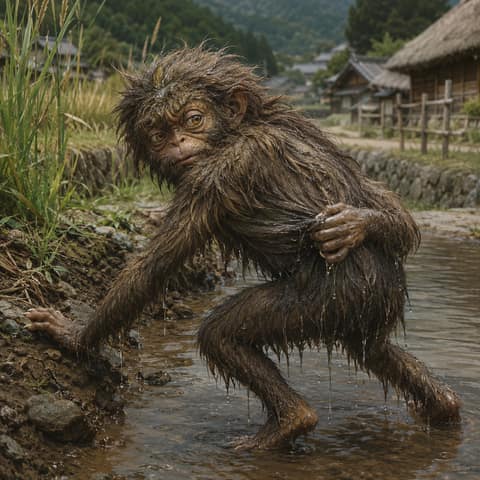
Hyōsube is a hairy, water-dwelling yokai found throughout the Kyushu region. Counted as kin to the kappa—or at least a close relative—it is said to move back and forth between the rivers and the mountains around the equinox. Its name is traced to its birdlike cry of "hyō-hyō." It is fond of eggplant, and in some areas the custom of offering the season's first eggplant still survives. The best-known stories tell of it slipping into a household bath to soak, leaving the water afterward thick with floating body hair; anyone who lays eyes on it, they say, falls ill with fever.

Hyousunbo

Hyousunbo

Rare

Hyousunbo

The River Kappa of Hyuga: Hyousunbo

Water ApparitionsMiyazaki

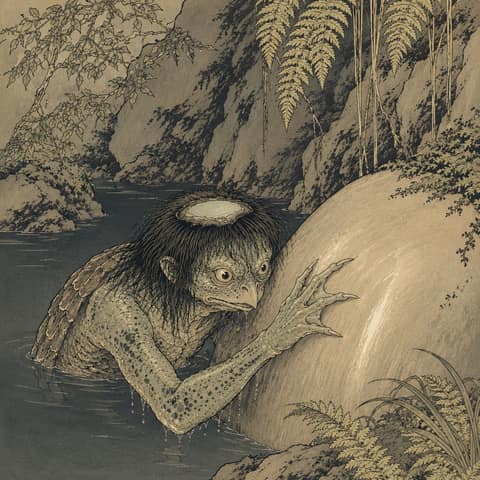
Hyousunbo is a type of kappa transmitted primarily in the Hyuga region of Miyazaki Prefecture and across southern Kyushu. Its name is said to derive from the "hyoi, hyoi" sound it makes while swimming in the water, and it corresponds to the "hyosube" dialectal family used to refer to kappa throughout Kyushu. It lived near the water and was feared as a malicious trickster that dragged children swimming in the river to their deaths. Legend says it lived in the Shiiya River flowing through the Warabi district of Togo-cho in Hyuga City, and is famous for making a promise with the villagers: "I will not take the lives of the river's children until a certain rock rots away completely." The hyousunbo touched the rock so many times to check its decay that the rock became smooth and polished as if rubbed, earning it the name "Hyosubo Rock" (later buried during river improvement works). This folklore is accompanied by the belief in seasonal migration—living in the river from spring to autumn and moving to the mountains in winter—and it is said that sumo matches dedicated to the water god were held every year at the Suijin-buchi (Water God's Abyss) of the Tsuboya River. Among the southern Kyushu lineage that calls kappa "garappa" or "kawantaro," the hyousunbo is a water apparition unique to Hyuga, possessing specific legends of a promise and a rock.

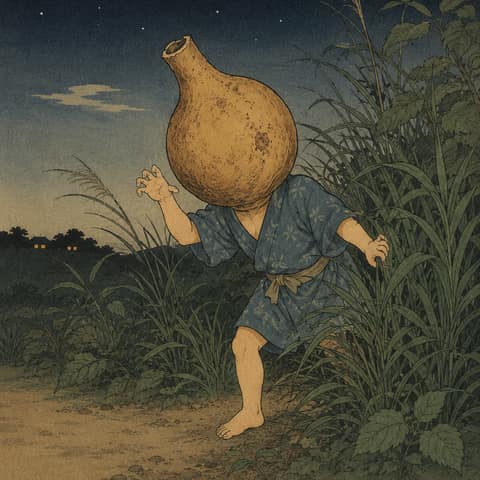
Hyōtan Kozō (Gourd Boy)

Hyōtan Kozō (Gourd Boy)

Rare

HYOH-tahn koh-ZOH

Iconographic Tradition–Tsukumogami Interpretation

Animated Objects & UndeadJapanese folklore

A yokai based on a gourd, depicted by Toriyama Sekien in Hyakki Tsurezurebukuro. It appears as a boy with a gourd for a head and is often paired with Nyūhai-bō. Beyond Sekien’s illustration, little is recorded about its traits. It is generally interpreted as a tsukumogami—an elaborately prepared and long-used gourd (fukube or hisago) that has acquired spirit power. The name and design likely draw on earlier gourd monsters in Hyakki Yagyō picture scrolls.

Hiyori-bō (Fair-Weather Monk)

Hiyori-bō (Fair-Weather Monk)

Rare

hee-YOH-ree-boh

Sekien’s Illustrated Edition: Hiyori-bō

Weather & Calamity SpiritsIbaraki

A yokai depicted by Toriyama Sekien in Konjaku Gazu Zoku Hyakki, said to preside over clear weather. It appears on sunny days and not in the rain. Beyond Sekien’s notes, verified folk reports are scarce and oral traditions remain uncertain. Scholars have linked it to teru-teru bōzu, but no definitive source confirms this origin. Its name is discussed in relation to regional weather-prayer terms like “hiyori-bōzu.”

Hira-san Jirōbō

Hira-san Jirōbō

Legendary

Hira-san Jirōbō

The Second-Seat Great Tengu — Hira-san Jirōbō

Mountain & Wilderness SpiritsShiga

Hira-san Jirōbō is a great tengu who strikes his roots into Mt. Hira in Ōmi Province; within the forty-eight tengu and the Eight Great Tengu, his name stands in the second seat (rank two), next after Atago-san Tarōbō. Drawn as a long-nosed great tengu, he is held to command the mountain air and the wind and to govern the tengu beneath him. Based in the Hira range that towers along the western shore of Lake Biwa, the tengu of this mountain appears by name in medieval texts. The Hirasan Kojin Reitaku, written by Keisei in the first year of Enō (1239), records a dialogue with the aged tengu (the "old man") of Mt. Hira, conveying that Hira had long been conceived as a sacred mountain where tengu dwell. Within the tengu hierarchy headed by Atago Tarōbō, Jirōbō, as the second seat, has often been spoken of in a pair with Tarōbō.

Bishamonten

Bishamonten

Legendary

びしゃもんてん

The Armed God of Fortune and Bearer of Six Stages of Multifaceted Faith: Bishamonten

Divine Spirit / DeityNara

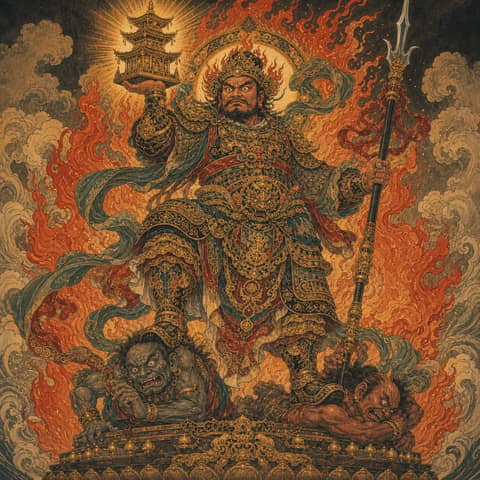
Bishamonten is a Buddhist tutelary deity originating from Vaiśravaṇa, an alternate name for Kubera, the god of wealth and guardian of the north in ancient Indian mythology. He is identified with Tamonten, the northern guardian among the Four Heavenly Kings . Transmitted to Japan via Central Asia and China during the Nara and Heian periods, he is widely revered through iconography depicting him in the guise of a Tang-dynasty military commander wearing armor, holding a treasure pagoda and a jeweled baton (or halberd), and standing upon a trampled demon (jaki). Major sites of enshrinement include Shigisan Chogosonshi-ji in Nara Prefecture (the origin of Prince Shotoku's prayer for victory over Mononobe no Moriya and the Tiger/Tora faith), Kurama-dera in Kyoto (housing a national treasure standing statue of Bishamonten from the early Heian period), and Todai-ji in Nara (the Bishamonten statue in the Great Buddha Hall) . The Shigisan Engi scrolls recount that Prince Shotoku, during his campaign against Mononobe no Moriya, received a secret treasure of victory from Bishamonten on the year, day, and hour of the Tiger. This established Bishamonten's association with military victory, martial fortune, and the tiger. During the Sengoku period, Uesugi Kenshin believed himself to be the reincarnation of Bishamonten, raising the "Bi" (毘) banner, while other warlords like Takeda Shingen, Toyotomi Hideyoshi, and Tokugawa Ieyasu also prayed to him as a guardian deity of victory. Incorporated into the Seven Lucky Gods in the late Muromachi period, he remains widely worshipped today as a deity granting worldly benefits such as "abundant harvests, business prosperity, family safety, longevity, worldly success, and luck in winning."

Byakko (White Tiger)

Byakko (White Tiger)

Divine

Byakko

Byakko, the White Tiger, Guardian of the West

Animal TransformationsNara

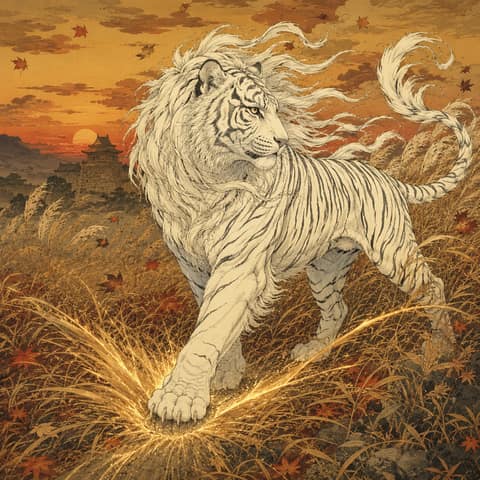
Byakko, the White Tiger, is one of the Four Symbols that guard the west, the divine beast that shapes the seven western lunar mansions of the heavens into the form of a tiger. In the Five Phases it is assigned to Metal, in the five colors to white, and in the seasons to autumn, and it is represented as a fierce white-furred tiger. Arising from Chinese astral and Five Phases thought, the Huainanzi's "Treatise on the Patterns of Heaven" makes the beast of the west the White Tiger. After it was received into ancient Japan, it formed a pair with the Azure Dragon and was depicted as a marker of directional protection and of wards.

Byōbu-Nozoki (Screen-Peeker)

Byōbu-Nozoki (Screen-Peeker)

Rare

BYOH-boo no-ZOH-kee

Iconographic Tradition–Conforming Version

Animated Objects & UndeadJapanese folklore

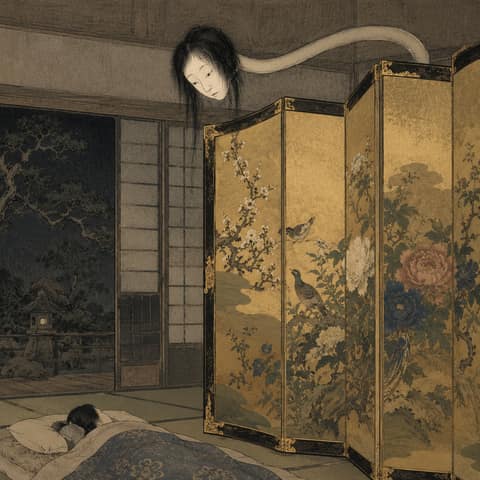
A yokai illustrated by Edo-period artist Toriyama Sekien in Konjaku Hyakki Shūi. It is said to spy on human affairs from behind a folding screen (byōbu), peeking even over a seven-shaku-tall screen. Some regard it as a visual invention drawing on Chinese classical anecdotes, while others interpret it as a tsukumogami—an aged screen that transformed after long years of witnessing bedroom secrets. It lacks strong place-based lore, with its identity largely defined by pictorial sources.

Biwa Bokuboku

Biwa Bokuboku

Epic

BEE-wah BOH-koo-BOH-koo

Canonical Iconography

Animated Objects & UndeadJapanese folklore

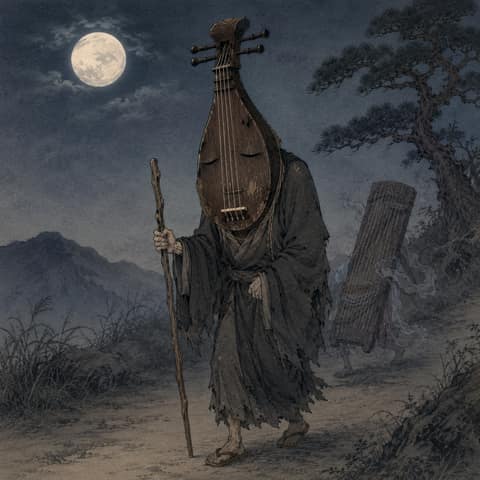
A tsukumogami in which a spirit inhabits a biwa lute and appears as a blind minstrel (zatō). Illustrated by Toriyama Sekien in Hyakki Tsurezure Bukuro, it bears a human body with the biwa’s pegbox as its head and leans on a staff. The name is said to allude to the famed instrument “Makiba,” and reflects the belief that old tools, after long use and the passage of time, awaken into autonomous beings. It adopts the guise of a blind musician, a classic image linking music and mendicant monks, and stands as a textbook case of a tool taking human form.

Poverty God

Poverty God

Uncommon

BEEN-boh-gah-mee

Classical Folktale-Concordant

Household SpiritsAcross Japan

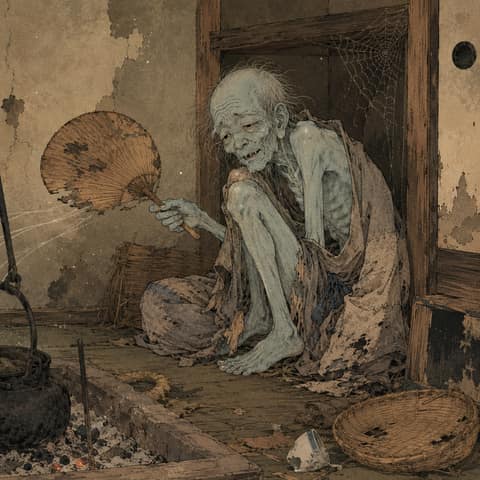
A deity said to attach itself to homes or people and drag their fortunes down. Often depicted as a gaunt, grimy old figure with a pallid face, holding a plain paper fan. Folklore claims it favors idleness and disorder while disliking thrift, diligence, and cleanliness. It lurks in closets or the corner of the tatami room, and some say it likes miso. Rather than brute expulsion, traditions advise courteous sending-off, reforming one’s habits, or making the home inhospitable to it.

Fujin

Fujin

Legendary

ふうじん

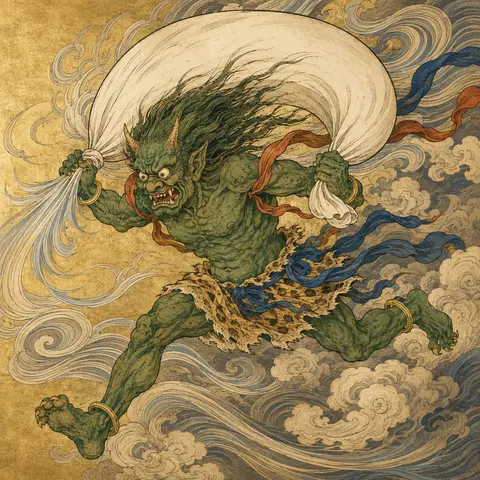
Green Demon with a Wind Bag - Fujin

Divine Spirits / DeitiesTatsuta Taisha (currently Sango-cho, Ikoma-gun, Nara Prefecture, the main shrine of the ancient Fujin Festival) / Kazemiya (currently Ise City, Mie Prefecture, a Betsugu of the Inner Shrine of Ise Jingu) / Kennin-ji (currently Higashiyama-ku, Kyoto City, Kyoto Prefecture, houses Tawaraya Sotatsu's "Fujin and Raijin Folding Screens")

A deity in Japanese mythology who presides over the wind. The primary enshrined deity is Shinatsuhiko-no-Kami (Shinatsuhiko, Shinatsuhiko-no-Mikoto), recorded in both the *Kojiki* and the *Nihon Shoki* as a god born between Izanagi and Izanami. In iconography, Tawaraya Sotatsu's "Fujin and Raijin Folding Screens" (circa 1620s, formerly held by Kennin-ji in Kyoto, now a National Treasure) is the definitive version, and the design of a green demon-god holding wide a wind bag (of Hellenistic origin) with both hands became the standard thereafter. Depicted as a pair with Raijin (Takemikazuchi/Raiko), they are worshipped nationwide as ambivalent deities presiding over storms, rich harvests, pestilence, and "wind sending" (warding off disease). Major worship sites include Tatsuta Taisha (Sango-cho, Nara Prefecture, the main shrine of the state-sponsored Fujin Festival since ancient times), Kazemiya (a Betsugu of the Inner Shrine of Ise Jingu), and Suwa Taisha.

Fūri (Wind Tanuki)

Fūri (Wind Tanuki)

Uncommon

FOO-ree

Bibliographic-Transmission Composite (Edo Natural History Lineage)

Animal shapeshiftersImported from China (accounts found across Japan)

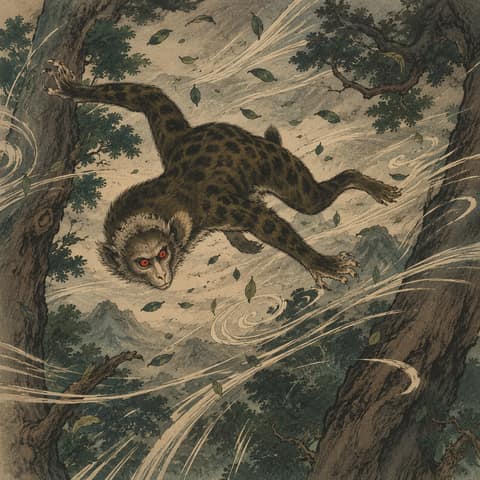
Fūri is the name of a beastly yokai found in Chinese natural histories and zhiguai records, with scattered mentions in Edo-period Japanese essays and natural studies. Descriptions vary: it is likened to a small monkey, marten, tanuki, or hare; said to have a short tail, red eyes, and mottled yellow-green or dark fur. It is rumored to whip up sudden gusts to startle people and livestock, or to appear without warning and leave scratches. Its existence is doubtful, and identifications differ widely by region and source.

Fukurokuju

Fukurokuju

Legendary

ふくろくじゅ

Three-Stars-in-One Long-Headed Deity, Fukurokuju

Divine Spirit / DeityChina (Daoist Three Star Belief) / Introduced in the Muromachi Period / Shichifukujin Pilgrimage Sites in Kanto & Kinki (Zen & Obaku Sect Temples)

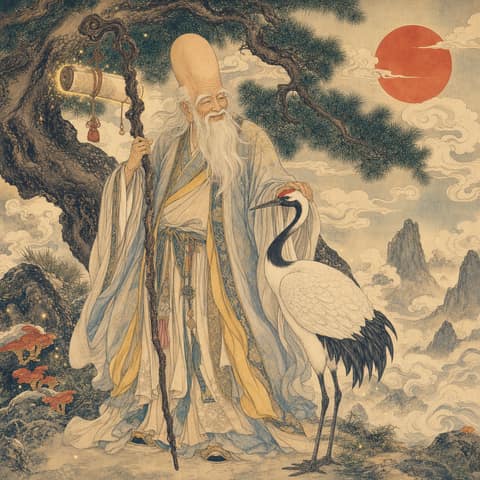
A deity of longevity, wealth, and prosperity of descendants originating from the Daoist belief in the Three Star Gods. His true form is the incarnation of the Old Man of the South Pole (Canopus), and it is also said that he manifests in the guise of the Song dynasty Daoist Tiannanxing. His iconic image features a short stature with an abnormally elongated head, a long white beard, and a staff with a scroll tied to it, accompanied by a crane (and sometimes a turtle). Representing the three virtues of fuku (prosperity of descendants), roku (wealth and rank), and ju (health and longevity) in a single body, he was incorporated into the Seven Lucky Gods (Shichifukujin) during the late Muromachi period. Because he shares the same origin as Jurojin (both being the Old Man of the South Pole), this redundancy became an issue during the Edo period, and there were times when Jurojin was replaced by deities such as Kisshoten, Fukusuke, or Inari.

Fukuro Mujina (Bag Badger)

Fukuro Mujina (Bag Badger)

Rare

FOO-koo-roh MOO-jee-nah

Annotated Iconography Edition (Seiyan-Toriyama Based)

Animated Objects & UndeadEdo period

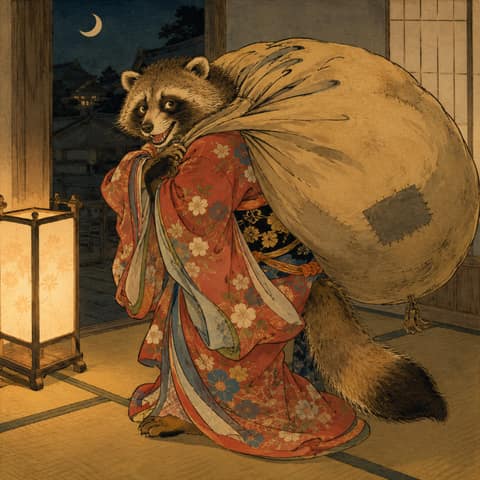
A yokai depicted by the Edo-period artist Toriyama Sekien in his Hyakki Tsurezure Bukuro. It appears as a female badger (mujina) carrying a night-duty bag, but given the book’s focus on tool-spirits, many read the bag itself as the true body. The design satirizes the saying “ana no mujina no nao o suru,” which warns that judging what you haven’t seen is difficult, and likely reworks a court-lady figure carrying a bag found in earlier night-parade scrolls.

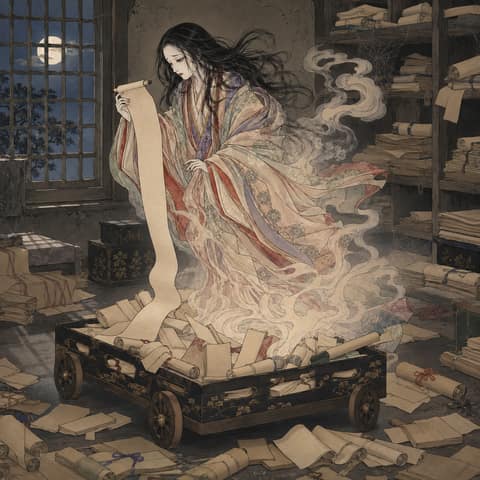
Fuguruma Yōhi (Letter-Carriage Enchantress)

Fuguruma Yōhi (Letter-Carriage Enchantress)

Rare

FOO-goo-ROO-mah YOH-hee

Iconographic Edition, Sekien Toriyama Source

Animated Objects & UndeadEdo period

A yokai depicted in Toriyama Sekien’s Hyakki Tsurezure Bukuro. Named after the document cart (fuguruma) used to carry letters, it is understood as the embodiment of attachment and passions accumulated in old love letters. Shown as a woman holding a scroll, it is a creative yokai inspired by Tsurezuregusa section 72 (“The Letters on the Cart”), widely interpreted as a tsukumogami in which the spirit of love letters fuses with that of an object.

Showing 25 - 48 of 81 yokai