Traditional Yokai Encyclopedia

Yokai passed down through the ages

486 Yokai|12 Category|Page 21 of 21
Localization in Progress - More content available in Japanese version
View Japanese
Sort by: NameAscending
Ōmine Zenkibō

Ōmine Zenkibō

Legendary

Ōmine Zenkibō

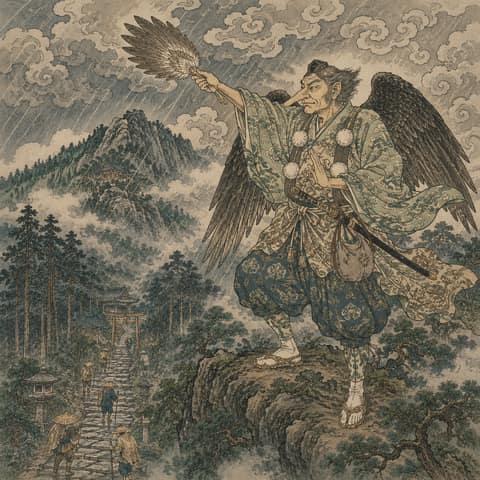
The Dharma-Guarding Tengu Turned from an Oni — Ōmine Zenkibō

Mountain & Wilderness SpiritsNara

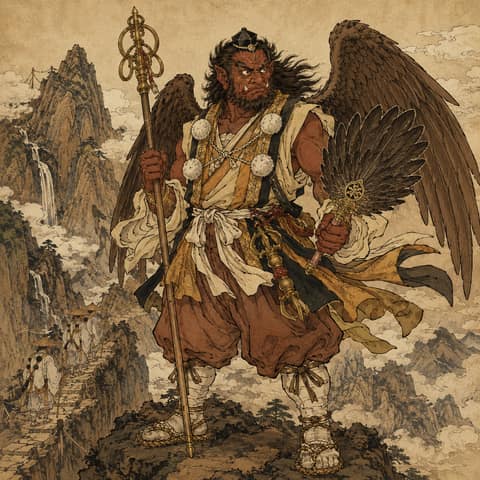
The essence of Ōmine Zenkibō lies in the structure of rebirth: "an oni turning into a tengu." It is a tale that embodies the heart of Shugendō in a single being. His source lies in the old tales of En no Gyōja and the oni. The oldest extant text depicting En no Ozunu is the Nihon Ryōiki (early Heian), which portrays him as a thaumaturge who flew through the air commanding demons. The Konjaku Monogatarishū, Book 11 carries the tale of En no Gyōja having demons build a bridge across the mountains, showing the fixing of the image of En no Gyōja as one who commands demons. Zenki was originally a violent oni who carried off human children. En no Gyōja captured him with the secret rite of Fudō Myōō and reformed him into an attendant. By one account, En no Gyōja hid the youngest child of the Zenki couple in an iron cauldron and, through the grief of having one's own child taken, brought them to realize the sin of carrying off the children of others. The reformed Zenki and Goki became dharma-protecting oni and supported En no Gyōja's practice. This Zenki, sublimated into a great tengu at the end of long austerities, is Ōmine Zenkibō. This plot, of a violent being turning into a guardian of the Buddhist law, shows most clearly that the dread of a child-snatching tengu and the faith in a tengu who guards people share a single root. The Ōmine on which Zenkibō sits is the holy ground of Shugendō. The Ōmine training ground founded by En no Gyōja, and the Ōmine Okugake-michi registered as World Heritage, is a perilous route that ascetics still tread at the risk of their lives, and Zenkibō was conceived as its guardian. He is chanted as "the band of Zenki of Ōmine" in the Muromachi Noh play Kurama Tengu, and stands among the forty-eight tengu of the Tengu-kyō (some sources give "Nachi Takimoto Zenkibō"). And the heaviest single point of this lore is that the bloodline of Zenki is said to live on into the present. Of the five lodges kept by the five children of Zenki and Goki, only the Onakabō of the Gokijo family remains today, and the present-day Gokijo Yoshiyuki continues to receive the ascetics of the Ōmine Okugake-michi. This genealogy is hard to source explicitly in old documents and is transmitted as the oral lore of the surviving lodge; yet this real continuity—descendants of a reformed oni guarding the path of Shugendō beyond thirteen hundred years—makes Ōmine Zenkibō not a mere legend but a symbol of living faith. Chigiri Kōsai of tengu scholarship, too, placed him within the system of the great tengu of the many mountains.
Ōyama Hōkibō

Ōyama Hōkibō

Legendary

Ōyama Hōkibō

The Great Tengu of the Transferred Seat — Ōyama Hōkibō

Mountain & Wilderness SpiritsKanagawa

The core of Ōyama Hōkibō lies in a tale of succession to a seat within the tengu world—the "seat transfer." Yet the Mt. Ōyama on which he sits was a sacred mountain established in antiquity, without need of the transfer legend. The Engishiki Jinmyōchō (927) ranks the Afuri Shrine among the official shrines of Sagami Province, showing that Ōyama's divinity was recognized by the ancient state. On the Buddhist side, the Ōyama-dera engi emaki depicts how Rōben—carried off by an eagle and raised in Nara—opened Ōyama-dera and enshrined Fudō Myōō (the Sagami version; a different work from the engi of Hōki's Daisen-ji). And in early-modern times the official gazetteer the Shinpen Sagami no Kuni Fudoki-kō (1841) conveys the summer ascent season and the bustle of pilgrims from many provinces. The manners of pilgrimage—purifying oneself at the waterfalls under a sendatsu's guidance before climbing—and the Ōyama confraternities everywhere: this density of faith gave Hōkibō, the successor tengu, the character of a guardian watching over the common people. The seat-transfer tradition overlays this sacred-mountain history. According to the arrangement of Chigiri Kōsai of tengu scholarship, Sagami Ōyama originally had a great tengu named Sagamibō. But when the Retired Emperor Sutoku—defeated in the Hōgen Rebellion (1156) and exiled to Sanuki—passed away, Sagamibō removed to Shiramine in Sanuki to console and guard his bitter spirit (= Shiramine Sagamibō). The one who succeeded to the vacant seat of Sagami Ōyama was Hōkibō, come from Mt. Daisen in Hōki. This symmetrical transfer—"Sagamibō to the west, Hōkibō to the east"—is a Chigiri-derived arrangement lacking explicit sources in the classical literature, and should be read not as historical fact but as lore that mirrors the notion that a tengu's seat is succeeded through mountain and bond (en) rather than being a fixed individual. Chanted as "Hōkibō of Ōyama" in the Muromachi Noh play Kurama Tengu, and standing among the forty-eight tengu of the Tengu-kyō, his seat continues to be remembered, together with this distinctive engi, as one of the Eight Great Tengu.

尻目

尻目

Rare

しりめ

夜道で光る尻の一眼・尻目

人妖・半人半妖Kyoto

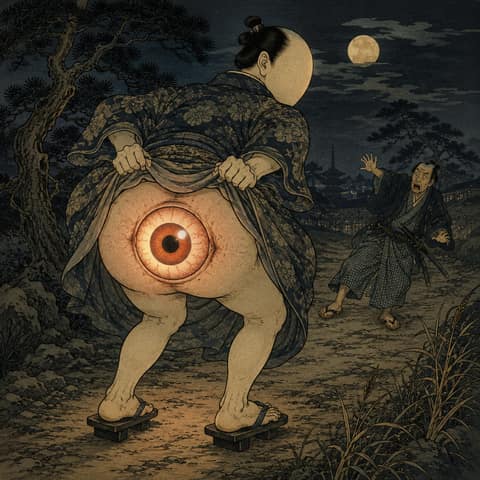
Read as a glowing single eye on a buttock on a night road, the Shirime touches upon the core of yokai expression despite being an extremely short tale. Appearance, disrobing, exposure, luminescence, and flight. If one extracts only the plot, it ends in a few lines. Yet within those few lines, the fundamental human recognitions of looking at another person, looking at a face, and looking at eyes are sequentially betrayed. The scene where a samurai is hailed on a night road to Kyoto and shown a strong light from a single eye on a buttock is not a tale of combat, but a ghost story that uses the gaze itself as a weapon. The first trick is the lack of a face. Yokai of the Noppera-bo lineage erase the face, the center of humanity. Without a face, one cannot read the other's emotions, the intent behind their words, or the presence of hostility. The Shirime builds upon this unease of facelessness and shifts the eye to yet another location. This is why it is explained as a variant of the Noppera-bo: the eyes that should be on the face are lost and placed on the buttocks, the most defenseless and laughter-inducing part of the body. Here, terror and comedy become inseparable. The second trick is the destruction of etiquette. Being called out to by a stranger on a dark road is unsettling enough, but when the other party suddenly strips off their kimono, the scene drops from the tension of the warrior class to an obscene farce. However, in the very next instant, that farce reverses into the bizarre through the glowing eye. The Shirime is not interesting because it is vulgar. It is terrifying because it transforms a vulgar gesture into an "eye" that stares back at the human. Not only are you shown something you shouldn't see, but you are stared back at from that very spot. This reversal constitutes the Shirime's decisive strike. The third trick is its brevity. The Shirime has almost no birth tales, no extermination tales, and no long curses. It is not weak because of this; rather, it is perfectly suited for a single illustration. Small yokai preserved in picture scroll materials are remembered not for the depth of their narrative, but for their visual iconography, where meaning arises the moment they are seen. The Shirime is typical of this; before hearing an explanation, the mere composition of an eye on a buttock captures the reader. This yokai clearly demonstrates that yokai iconography sometimes travels faster than the narrative. The setting of the night road heading to Kyoto also supports the Shirime's function. The entrances and crossroads of a city are boundaries where the known and the unknown, the order of day and the anxiety of night switch places. When called out to there, a person first searches for the other's face. The very act of searching for the face becomes the Shirime's trap. The moment one understands that there is no face and no gaze, the eye returns from an entirely different place. Therefore, while being a yokai of Kyoto, the Shirime is remembered not for the historical pedigree of famous places, but as a sudden ambush in the middle of the road. The reason the Shirime became well-known again in yokai introductions after Mizuki Shigeru is also because the speed of its imagery aligns well with modern media. Yokai encyclopedias like Mizuki Shigeru's "Illustrated Encyclopedia of Japanese Yokai" transposed fragments of regional folklore and classical picture scrolls into a format where modern readers can search, compare, and remember them as pictures. The Shirime carries no moral lesson, speaks no ethics, and survives solely through a single bizarre bodily arrangement. Precisely because of this, it is easily transplanted into overseas yokai introductions and gaming reception. Fearing the Shirime does not mean fearing that something will attack. It means fearing that the arrangement of the world will instantly become wrong. A face has no face, a buttock has an eye, and that eye glows. The samurai flees not because he is a coward, but because the opponent he should cut down with his sword is not there. The Shirime appears not as an enemy, but as an accident of perception. In the darkness of the night road, the order of the body is turned inside out. Just through that comical and cruel instant, the Shirime is sufficiently a yokai. In that sense, the Shirime does not end as a vulgar whimsical fantasy. It is a yokai that bends human confidence in seeing the world correctly at the shortest possible distance. The speed of that distortion is precisely the power of this small yokai.

山地乳

山地乳

Uncommon

やまちち

奥州山中に寝息を吸う獣・山地乳

動物変化奥州 (現·東北地方、具体地未詳)

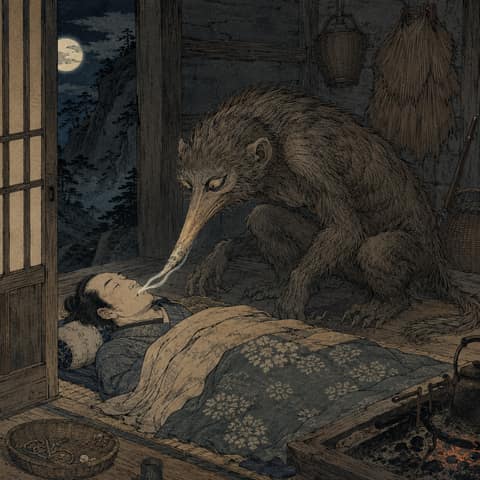
When reading the Yamachichi, the most important thing is not to overinflate this yokai as a "well-known local legend." The core material is the "Ehon Hyaku Monogatari", which tells of its transformation from an old bat to a Nobusuma and then to a Yamachichi, alongside the strange effect of sucking sleeping breath. Precisely because it is a yokai with scarce materials, accurately placing its appearance, actions, and conditions makes its outline clearer. The appearance of the Yamachichi is a mountain beast resembling a monkey with a pointed snout. It does not shapeshift into a human like a fox or a tanuki, nor does it lure people with human speech like a Yama-uba. It remains a beast, drawing near to the breathing of a sleeping human. Breathing is the entering and exiting of life, and sleeping breath is the sound of defenseless life. Because the Yamachichi sucks that sound, its terror lies not in claws or fangs, but in the sensation of life being drained in the vulnerable gap of sleep. However, the tale of the Yamachichi is not a simple blood or spirit-sucking story. If someone is watching, the person whose breath is sucked gains a long life. If no one watches, they die the next day. This condition is mysterious; the eyes of a third party determine whether the anomaly harms or saves the human. The structure where the monster's power is reversed by being seen is also the charm of Hyaku Monogatari (Hundred Tales) style storytelling. The triangular relationship of the person in the bedroom, the sleeper, and the watcher establishes the small narrative of the Yamachichi. Its location is said to be Oshu, but Oshu here is a broad regional name and should not be shrunk down to a single modern point. Using Mutsu Province as a receptacle for the ancient place name is to indicate the scope of Oshu found in literature, not to assert it as solely a yokai of Fukushima Prefecture. Rather than a precise point on a map, the Yamachichi is a yokai spoken of within the sense of distance of "the mountains of Tohoku." If connections are to be drawn, it is closest to the Nobusuma and the Satori. The Nobusuma appears in the text as the preceding stage of the Yamachichi, supporting the Yamachichi's position as an aged form. The Satori shares an interpretive intersection, as the text states, "Deep in the mountains, this is called satori-kai," but the mind-reading Satori and the breath-sucking Yamachichi are not identical. By lining them up while maintaining this difference, we can see the subtle divergence concerning breathing, thinking, and sleeping among the beast yokai of the mountains and fields.

舌長姥

舌長姥

Uncommon

したながうば

荒野の破屋に舌を伸ばす姥・舌長姥

人妖・半人半妖NiigataTokyo

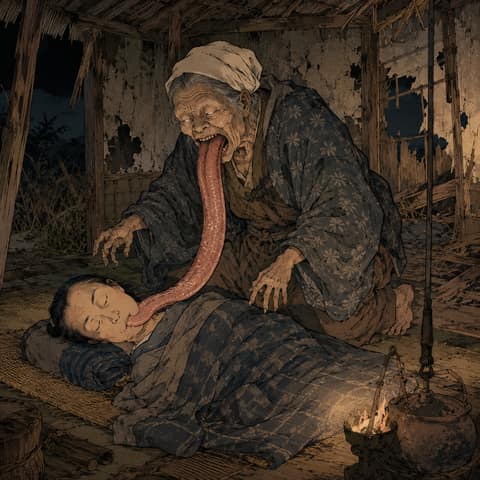
When viewed as a hag extending her tongue in a ruined shack in the wilderness, the terror of the Shitanaga-uba lies less in the monster's appearance itself and more in the moment hospitality flips into predation. The travelers, conditioned by nightfall, getting lost, and fatigue, search for a house and believe they are saved by the old woman's invitation. However, the night's lodging is not a safe zone of the human community, but a trap waiting in a closed room for them to fall asleep. In the scene where the tongue extends to the sleeper, the everyday and soft action of "licking"—rather than the use of blades or claws—transforms into the violence of obliterating the flesh, producing a tactile terror much closer than the red face of Shu-no-banbo. This hag monster's outline becomes clearest when working as a pair with Shu-no-banbo. In the setting of the journey from Echigo to Edo, the Shitanaga-uba is placed inside the house, while Shu-no-banbo acts as a voice from the outside. It is the Shitanaga-uba whose name is called first, and Shu-no-banbo appears saying, "Shall I help?" In other words, the Shitanaga-uba is not a mere servant, but one of the principal culprits moving in front of the prey. If Shu-no-banbo is a yokai of sight, the Shitanaga-uba is a yokai of touch, and the two terrors mesh seamlessly within the same night. While the story connects Echigo Province and Edo on the map, pinning the Shitanaga-uba down solely as a "yokai of Niigata Prefecture" misses the core of the tale. What is important is that an unnamed wasteland opens its jaws halfway between a known land and a known city. The ending, where the house vanishes, suggests the possibility that the anomaly's dwelling was not permanently there, but rose up for just one night to absorb the travelers. Thus, on this page, Echigo Province is listed as the story's starting point, Edo as the destination, and "Unknown" side-by-side as the limit of her origin. In later yokai culture, while Shu-no-banbo stands out by gaining the iconography of a red face and large mouth, the Shitanaga-uba is easily compressed into the short name "the old woman with the long tongue." Yet, that very compression is the strength of this yokai. The moment you hear her name, you know her shape, and the moment you know her shape, you know what she will do. She is not a flashy protagonist, but an anomaly that lingers in the reader's bodily senses through the minimal elements of an inn, sleep, and a tongue.

芝右衛門狸

芝右衛門狸

Epic

しばえもんだぬき

芝居を愛した淡路の名狸・芝右衛門狸

動物変化HyogoOsaka

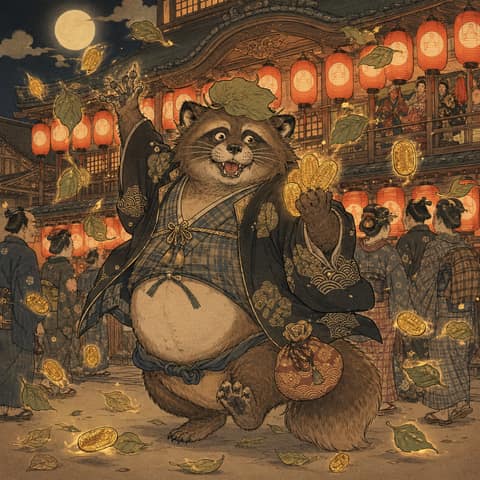
When reading about the Shibaemon-tanuki, the first thing to note is that his "love for theater" is not a mere decoration. Many bake-danuki deceive people, use leaves that look like coins, and distort human senses on mountain roads or street corners. Shibaemon has this power too, but his destination is neither a treasure house nor a mansion; it is the theaters of Dotonbori. In other words, this tanuki shape-shifts not to steal, but to watch. He is drawn to human performing arts, attempting to slip into the audience. The softness and danger of Shibaemon's story lie in this depiction of an outsider drawn to human culture. The magic of turning leaves into money is the most well-known economic illusion in tanuki folklore. The moment mountain leaves become town currency, the contract between nature and human society is swapped. However, in the theater, suspicion arises when leaves are found mixed into the admission fees. Shibaemon's magic can entertain people temporarily, but it breaks down at the point of accounting. When a guard dog is placed there, the illusion is forced back into a physical problem. The tragedy of being barked at, chased, and reverting to the form of a tanuki shows that his magic could not completely slip through the gates of society. In the legends where he is accompanied by his wife, Omasu, the tragedy deepens. Omasu loses her life by confusing the illusion of a feudal lord's procession with reality, and Shibaemon heads to the theater carrying that loss. Here, watching the play is both an act of entertainment and an act of fulfilling a promise to the dead. Therefore, Shibaemon's end is not just a comical tale of failure. Laughter and tears, the lightness of disguise and the weight of mourning overlap in one plot, drawing the tanuki's story closer to the story of the performing arts itself. The plot seen in the "Ehon Hyakumonogatari" and the local Shibaemon faith in Sumoto do not share the exact same context. In the former, the old tanuki appears as a non-human intellectual telling ancient tales to the human Shibaemon; in the latter, he rises as a famous tanuki commuting from the mountains of Awaji to the theater districts of Osaka. What connects them, however, is the tanuki's deep involvement with the "storytelling" and "spectacle" of human society. A tanuki who imparts knowledge, a tanuki who watches plays, a tanuki revered by actors after death. Through this continuity, Shibaemon, despite being a monster of the wild, is pulled strongly toward the side of words and the stage. The development of his enshrinement at Nakaza and Sumoto Hachiman Shrine after death changes Shibaemon from a "slain monster" to a "re-welcomed guardian." For the theater, he was an outsider who wanted to enter the audience, a patron who might have been killed by mistake, and eventually a god who protects the stage. The shrine returning to Sumoto acts as a device reconnecting this story to its homeland. The round trip of a Mikuma mountain tanuki traveling to an Osaka theater and finally returning to Awaji connects Awaji's local folklore to the memories of urban performing arts. If Danzaburo-danuki of Sado is spoken of as a great boss of wealth and illusion, and Kinchō of Awa as a famous tanuki of honor and battle, then Shibaemon stands out as the "audience tanuki." He does not merely threaten humans from the outside; he desires to see the stages humans create. Because that desire was shattered by a dog and then saved by faith, the Shibaemon-tanuki feels remarkably human even among bake-danuki. More than his power to shape-shift, it is his desire to see, hear, and enjoy that shines through as the defining trait of this famous tanuki.

Showing 481 - 486 of 486 yokai