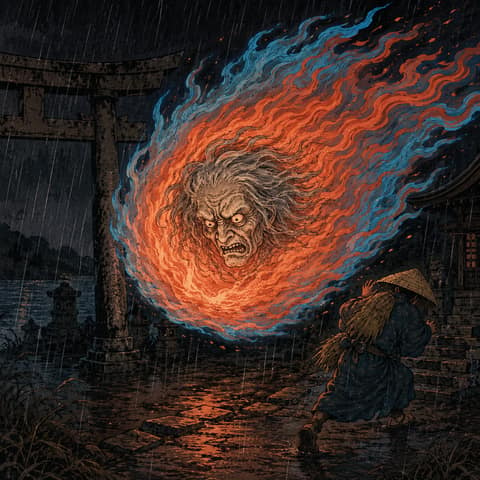
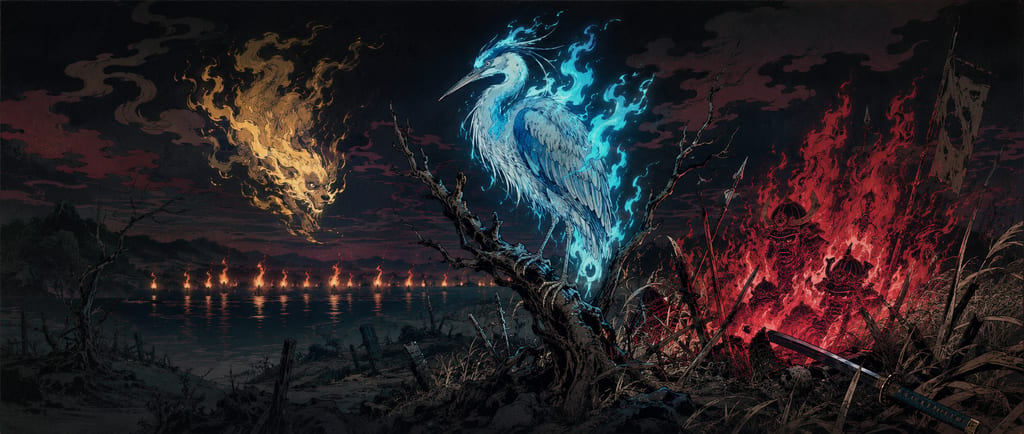
Sōgenbi is a monk’s ghost light associated with Mibu-dera in Kyoto and depicted by Toriyama Sekien in the *Gazu Hyakki Yagyō*. It is recognised by the tormented face of a monk floating inside a ball of fire. The name is also written Sōgen-bi, “Sōgen’s fire,” after the monk at the centre of the tale. In Toriyama Sekien’s *Gazu Hyakki Yagyō*[1], the apparition is not an anonymous glow: the face enclosed by flame makes the fire the visible fate of a person. According to the legend, Sōgen served at Mibu-dera’s Jizō Hall but stole lamp oil and offerings from the temple. After death, karmic punishment turned him into a will-o’-the-wisp. In the line of tales preserved in the *Edo Kaidan-shū*, including *Shin Otogi Bōko*[2], Sōgenbi is not a natural light but a sacred lamp defiled by theft and returned as punishment. Vengeful spirit, flame and temple ground meet in a distinctly Kyoto apparition.
Folklore & Legends
The image now most closely associated with Sōgenbi was fixed by Toriyama Sekien’s *Gazu Hyakki Yagyō*. Sekien often compressed an older tale, a place-name and verbal play into a single design. Here, the human face inside the fire tells the viewer that this ghost light is the final condition of a particular person. The National Diet Library Image Bank’s account of Sekien[3] places the 1776 *Gazu Hyakki Yagyō*, his first book in the series, at the beginning of a new phase in early modern yokai imagery.
Behind the picture lies the karmic tale of the monk Sōgen at Mibu-dera in Kyoto. Mibu-dera is a Risshū temple founded in 991 and known for devotion to Jizō and its Setsubun observances. As the temple’s official history[4] explains, it has long drawn worshippers seeking protection from misfortune and placing their faith in Jizō. The legend reverses the purpose of its sacred lamps: Sōgen steals the oil and offerings meant to sustain prayer, and after death the stolen light consumes him.
Among Japanese ghost lights, Sōgenbi stands close to Ubagabi and Kazenbō. Ubagabi is linked to an old woman who stole oil from a shrine; Kazenbō is the fiery spirit of a monk unable to find rest at a Kyoto burial ground. Sōgenbi joins both patterns, bringing together stolen oil, a corrupt monk, sacred precincts and fire after death. Modern reference works such as Murakami Kenji’s yokai dictionary[5] are therefore best read as distinguishing it from a generic fireball: this is the named spirit fire of Sōgen from Mibu-dera.
Seen as a ghost light born from the lamps of Mibu-dera, Sōgenbi is frightening not because a fire suddenly starts, but because the man who stole sacred light is made into fire himself. Temple lamps illuminate the Buddha and sustain prayer for the living and the dead. Stealing their oil or offerings is therefore more than the theft of an object: the offender takes light from a place of worship. Sōgenbi is that stolen radiance turned back upon the thief, burning the monk’s face as it drifts through the night.
Sekien’s design is powerful because the fireball is never anonymous. The Sōgenbi in *Gazu Hyakki Yagyō*[1] places a face inside the flame and makes the viewer ask whose fire it is. Unlike a distant Kitsunebi or Shiranui, it traps the likeness of a sinner in the light. Sōgenbi is therefore closer to an onryō than to a natural ghost-light phenomenon, yet remains a ghost unable to lose the last trace of its human face.
Mibu-dera is essential to the apparition. The temple is now widely associated with the Shinsengumi and Mibu Kyōgen, but the Sōgenbi story brings its Jizō Hall, sacred lamps and monastic discipline to the foreground. Unlike a fire wandering over mountains or sea, this one is born from the ethical order within a temple. It can be read as a member of the religious community who betrayed its trust and can no longer leave the grounds.
Sōgenbi connects in three directions. It resembles Kazenbō as the fiery spirit of a Kyoto monk, Ubagabi as a punishment involving stolen oil and sacred light, and the wider category of onryō as a dead person whose unresolved condition persists as calamity. At the centre of that triangle, Sōgenbi becomes more than a fire yokai: it is a compact Kyoto ghost story in which temple, wrongdoing and punishment after death burn together.
Character Profile
This section is our own creative profile for storytelling. It is not historical fact or scholarship.
A monk’s anguished face drifts inside the flame. Rather than attacking travellers, it returns night after night as the quiet spectacle of punishment for defiling a temple lamp.
Compatibility
Best read alongside Kazenbō, Ubagabi, onryō and temple ghost stories, as a karmic tale in which one named person’s wrongdoing becomes fire rather than as an unexplained natural light.
Abilities
Become a will-o’-the-wispHold a human face within the flameMake the karma of stolen lamp oil visibleRemain bound to temple groundsDrift through the night as vengeful fire
Weaknesses
Where sacred lamps and offerings are properly protected, the apparition can expose Sōgen’s wrongdoing but holds little power beyond it. Its identity also fades when separated from the story and setting of Mibu-dera.
Habitat
The grounds around Mibu-dera in Yamashiro Province, especially the legendary setting of the Jizō Hall whose lamp oil and offerings Sōgen stole.