
叢原火壬生寺の悪僧が燃える怨火・叢原火
そうげんび
Detailed Description
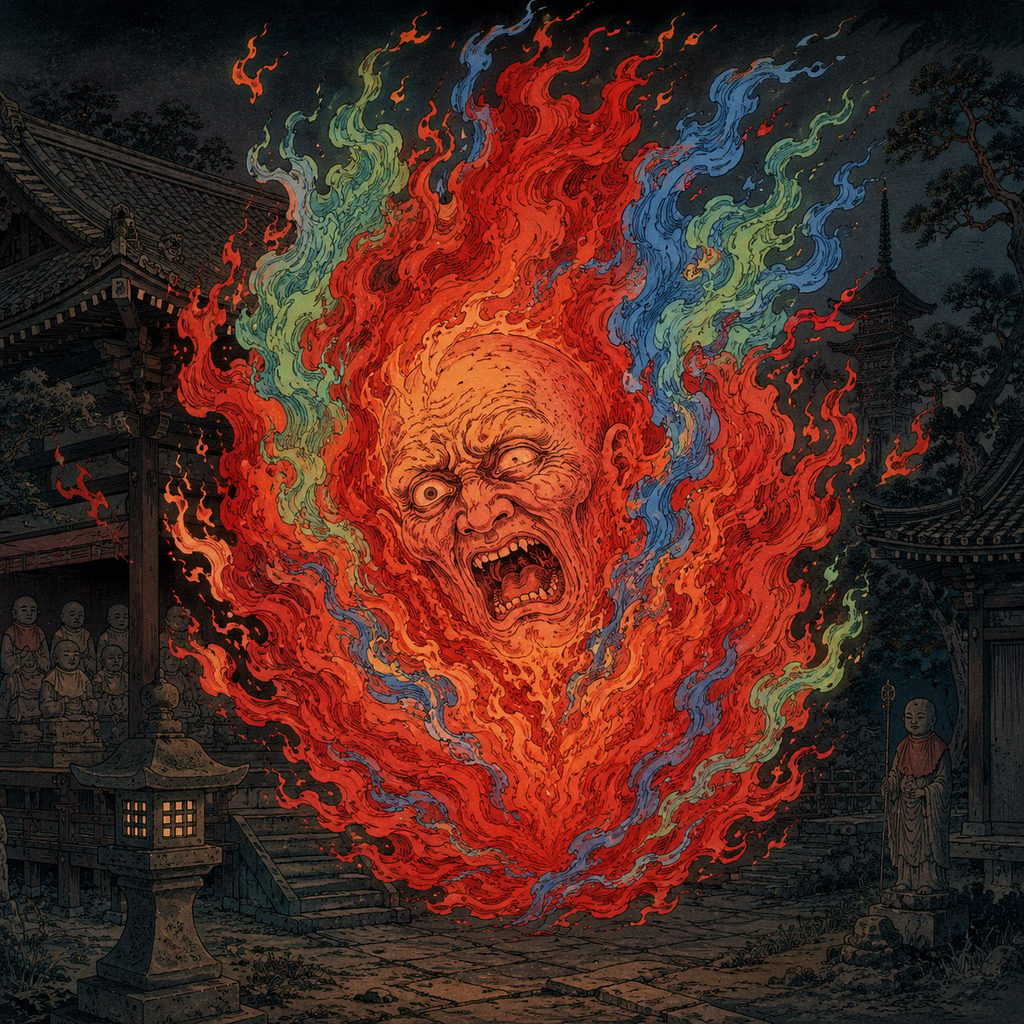
When viewed as a phantom fire born from the sacred lamps of Mibu-dera, the terror of Sogenbi lies not in the "breaking out of fire," but in the sharpness of karma where the one who stole religious fire is transformed into fire itself. Temple lamps illuminate the front of the Buddha and are the light that supports the dead and the faithful. The act of stealing that oil and offerings for selfish desire is spoken of not merely as stealing objects, but as the sin of snatching light from a place of prayer. Sogenbi is the form of that stolen light reversing itself, drifting through the night while burning the monk's face.
The strength of Sekien's illustration is that it does not leave the fireball as an anonymous anomaly. The Sogenbi of "Gazu Hyakki Yagyo"[1], by placing a face in the flames, forces the viewer to ask, "Whose fire is this?" It is not a distant light like Kitsunebi (foxfire) or Shiranui; rather, the visage of the sinner is trapped within the flames. Thus, Sogenbi is closer to a vengeful spirit than a natural phenomenon phantom fire, and simultaneously a ghost that cannot completely lose its human face.
The location of Mibu-dera is also an important axis supporting this apparition. While the extant Mibu-dera is famous for the Shinsengumi and Mibu Kyogen, in the context of Sogenbi, the Jizo-do, sacred lamps, and temple discipline come to the fore. Unlike fires drifting deep in the mountains or over the sea, Sogenbi is a fire born from the internal ethics of a temple, and can be read as the figure of one who betrayed the community's faith and is now unable to leave the temple's vicinity. This is precisely why Mibu-dera is recorded as its true name, rather than roughly setting its location just as "Kyoto Prefecture."
If we draw connections, Sogenbi extends in three directions: Kazenbo, Ubagabi, and Onryo (vengeful spirits). It is close to Kazenbo in being "the spirit fire of a Kyoto monk," and resonates with Ubagabi in that "a sin concerning oil and sacred lamps becomes fire." It shares a broad framework with Onryo, where the unpurified emotions of the dead remain as disasters or anomalies. Placing Sogenbi in the center of this triangle, it rises not as a mere flame yokai, but as a miniature Kyoto ghost story tying together a temple, a sin, and punishment after death.
Source Information
種類全体の出典primary
江戸怪談集 下 (岩波文庫)
著者: 高田衛 編・校注
年代: 1989
出版社: 岩波書店
種類全体の出典reference
壬生寺の歴史
著者: 壬生寺
年代: 公式サイト
出版社: 壬生寺
種類全体の出典reference
妖怪事典
著者: 村上健司 編著
年代: 2000
出版社: 毎日新聞社
種類全体の出典reference
画図百鬼夜行
著者: 鳥山石燕
年代: 1776 (安永 5)
出版社: NDL イメージバンク
種類全体の出典reference
画図百鬼夜行
著者: 鳥山石燕
年代: 安永5年(1776年)
バージョン固有出典 (壬生寺の悪僧が燃える怨火・叢原火)reference
江戸怪談集 下 (岩波文庫)
著者: 高田衛 編・校注
年代: 1989
出版社: 岩波書店
バージョン固有出典 (壬生寺の悪僧が燃える怨火・叢原火)reference
壬生寺の歴史
著者: 壬生寺
年代: 公式サイト
出版社: 壬生寺
バージョン固有出典 (壬生寺の悪僧が燃える怨火・叢原火)reference
妖怪事典
著者: 村上健司 編著
年代: 2000
出版社: 毎日新聞社
バージョン固有出典 (壬生寺の悪僧が燃える怨火・叢原火)reference
画図百鬼夜行
著者: 鳥山石燕
年代: 1776 (安永 5)
出版社: NDL イメージバンク
バージョン固有出典 (壬生寺の悪僧が燃える怨火・叢原火)reference
画図百鬼夜行
著者: 鳥山石燕
年代: 安永5年(1776年)
Personality
It drifts while displaying the agonizing face of a monk inside the flames. Rather than a monster that directly attacks people, it appears as a phantom fire of quiet punishment, displaying night after night the sin of defiling the temple's sacred lamps.
Compatibility
Compatible with tales of Kazenbo, Ubagabi, vengeful spirits, will-o'-the-wisps, and temple/shrine ghost stories. Its outline becomes clearer when read as a karmic tale where a named individual's sin turns to flame, rather than as a natural phenomenon phantom fire.
Abilities & Skills
Weaknesses
In the face of an order of faith that correctly protects the sacred lamps and offerings before the Buddha, the phantom fire only shows sin and holds no great power. Because it is bound to Sogen's individual karma, its presence thins if separated from the context of Mibu-dera.
🔮Test your compatibility with 叢原火 now!
Analyze your personality and values to get a detailed compatibility rating with this yokai.
Free, simple, and results in just minutes.