Sōgenbi
sōgenbi
Sōgenbi, the burning monk of Mibu-dera
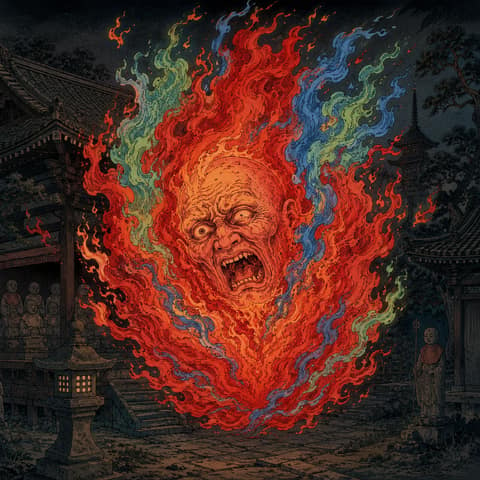
Seen as a ghost light born from the lamps of Mibu-dera, Sōgenbi is frightening not because a fire suddenly starts, but because the man who stole sacred light is made into fire himself. Temple lamps illuminate the Buddha and sustain prayer for the living and the dead. Stealing their oil or offerings is therefore more than the theft of an object: the offender takes light from a place of worship. Sōgenbi is that stolen radiance turned back upon the thief, burning the monk’s face as it drifts through the night. Sekien’s design is powerful because the fireball is never anonymous. The Sōgenbi in *Gazu Hyakki Yagyō* places a face inside the flame and makes the viewer ask whose fire it is. Unlike a distant Kitsunebi or Shiranui, it traps the likeness of a sinner in the light. Sōgenbi is therefore closer to an onryō than to a natural ghost-light phenomenon, yet remains a ghost unable to lose the last trace of its human face. Mibu-dera is essential to the apparition. The temple is now widely associated with the Shinsengumi and Mibu Kyōgen, but the Sōgenbi story brings its Jizō Hall, sacred lamps and monastic discipline to the foreground. Unlike a fire wandering over mountains or sea, this one is born from the ethical order within a temple. It can be read as a member of the religious community who betrayed its trust and can no longer leave the grounds. Sōgenbi connects in three directions. It resembles Kazenbō as the fiery spirit of a Kyoto monk, Ubagabi as a punishment involving stolen oil and sacred light, and the wider category of onryō as a dead person whose unresolved condition persists as calamity. At the centre of that triangle, Sōgenbi becomes more than a fire yokai: it is a compact Kyoto ghost story in which temple, wrongdoing and punishment after death burn together.