
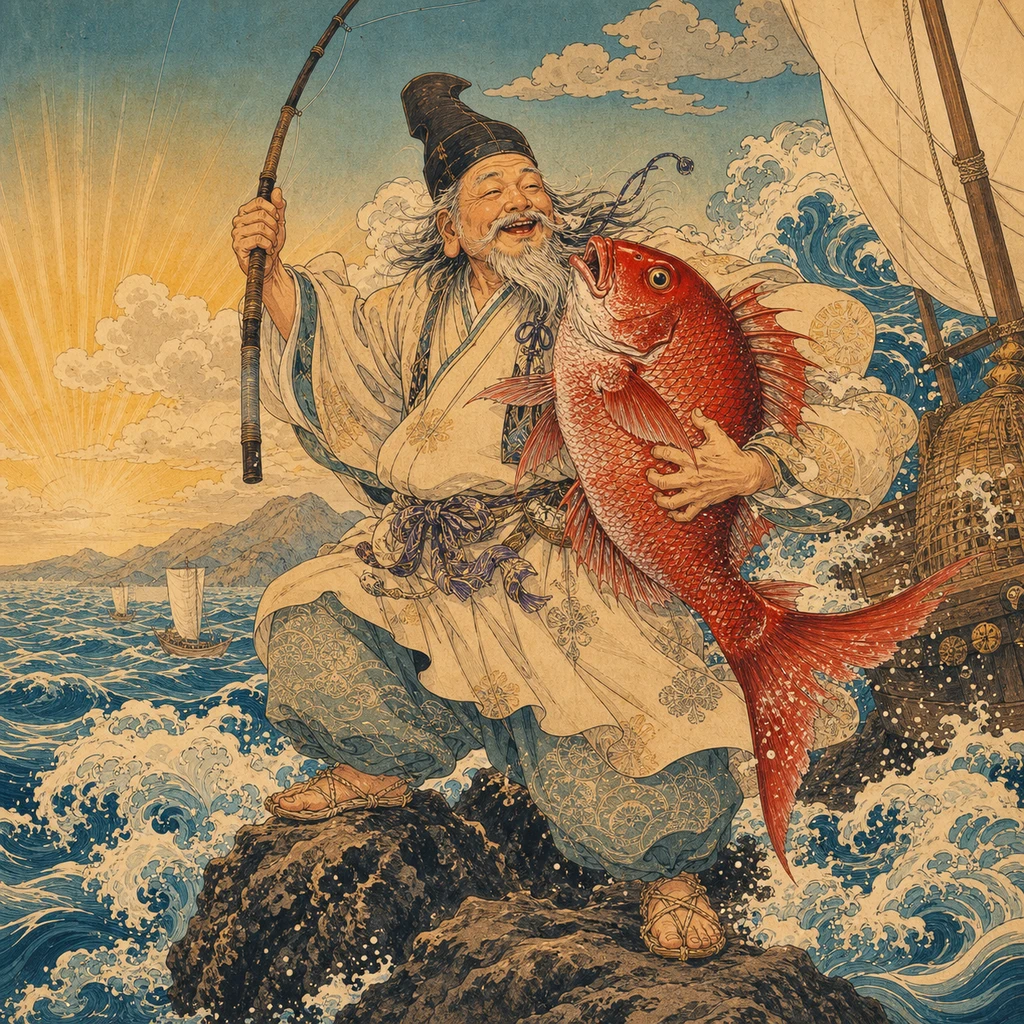
EbisuEbisu
えびす
Detailed Description
"Ebisu" as an Ancient Japanese Belief in the Sea and the Otherworld. While the basic description touches upon the two major origin theories of Ebisu, a thorough analysis reveals the deep layers of "Ebisu" as an indigenous ancient Japanese belief in the sea and the otherworld. The fact that "ebisu" and "emishi" share the same etymology indicates that ancient Japanese collectively referred to beings arriving from "beyond, the otherworld, or boundaries" as "ebisu," finding abundance, fortune, and auspiciousness in them[1]. As a representative example of the "visiting deity (Marebito)" belief systematized by Shinobu Orikuchi, it forms the core of widespread otherworldly and abundance beliefs in ancient Japan.
The Hiruko Myth ── The Narrative Archetype of Deformity, Exile, and Rebirth. The Hiruko myth passed down in the *Kojiki* and *Nihon Shoki*[1] (a deformed child set adrift in a reed boat who is reborn as a deity of abundance in a foreign land) is a representative example of the narrative archetype of "deformity, boundaries, and rebirth" in ancient Japan. The process by which Hiruko washed ashore in Nishinomiya and gained the reverence of fishermen to become Ebisu is the result of this universal religious motif uniquely developing in connection with Japan's indigenous marine and fishing culture.
The Kotoshironushi Myth ── The Origin of Ebisu in the Land Transfer Myth. Kotoshironushi, the eldest son of Okuninushi, is a crucial deity who negotiated with Takemikazuchi on his father's behalf in the land transfer myth[2]. The process of Kotoshironushi, who was fishing at Mihogasaki, hearing of the messenger's arrival and advising his father to accept the transfer is a religious expression of the political integration of the center (Amatsukami) and the regions (Kunitsukami) in ancient Japan. The concrete image of a fishing deity flowed directly into the later iconography of Ebisu holding a sea bream and a fishing rod.
Coexistence of Two Major Origin Theories ── Hiruko and Kotoshironushi Lineages. The fact that the two major origin theories—Hiruko (Nishinomiya Shrine lineage) and Kotoshironushi (Miho Shrine lineage)—coexist and have been passed down without being completely unified demonstrates the flexibility and plurality of Japanese religious culture. The Edo period Seven Lucky Gods faith integrated both lineages under the common name "Ebisu-sama," and the common people affectionately embraced him as the "god who brings business prosperity and fortune" without strictly distinguishing between the two.
Sea Bream, Fishing Rod, Smile ── Medieval and Early Modern Iconography. The modern image of Ebisu (sea bream, fishing rod, smile, ori-eboshi, kariginu) is a culmination of unique designs established in medieval and early modern Japan. (1) The sea bream is a symbol of ancient Japanese fishing, commerce, auspiciousness, and the color red. (2) The fishing rod is a symbol of ancient fishing, rituals, and the Kotoshironushi myth. (3) The smile (Ebisu face) is an expression of gentleness common to gods of fortune since the Middle Ages. (4) The ori-eboshi and kariginu visually emphasize Ebisu's uniqueness as a "fortune god unique to Japan."
Toka Ebisu ── The Festival Culture of Edo Period Commoner Faith. The Toka Ebisu in Kansai (January 9-11) is a representative Ebisu festival established in the Edo period, held on a large scale at places like Imamiya Ebisu, Nishinomiya Shrine, and Kyoto Ebisu Shrine[3]. The accompanying chant "Bring a bamboo branch for business prosperity" and the conferment of lucky charms like the fuku-zasa support the collective prosperity prayers of merchants, restaurants, and individual worshipers.
Ebisu in the 21st Century ── Urban Culture and Modern Prosperity Prayers. Today, Ebisu is widely embraced as the principal deity for Japanese commerce, dining, fishing, navigation, and new business prayers. The place name "Ebisu" around Ebisu Station in Shibuya, Tokyo, originated from the YEBISU Beer factory in the Meiji era and enjoys nationwide fame as a symbolic name for modern urban culture and commercial districts. Repeatedly reshaped in subculture works, he represents a prime example of ancient marine and otherworldly beliefs transforming into a modern Japanese pop icon.
Source Information
種類全体の出典primary
美保神社 (事代主神系恵比寿の総本社)
著者: 美保神社·島根県
年代: 古代~現代
出版社: 島根県松江市美保関町
種類全体の出典primary
西宮神社 (蛭子神系恵比寿の総本社·十日戎)
著者: 西宮神社·兵庫県
年代: 古代~現代 (蛭子神鎮座伝承·現在は全国 3500 余の恵比寿系神社の総本社)
出版社: 兵庫県西宮市社家町
種類全体の出典primary
十日戎 (とおかえびす) ── 関西最大の恵比寿祭礼
著者: 今宮戎神社·西宮神社·京都ゑびす神社等
年代: 江戸期確立~現代
出版社: 大阪市浪速区·兵庫県西宮市·京都府京都市東山区
Personality
Gentle, Prosperous, Business Prosperity, Abundance Prayer, Rebirth in a Foreign Land
Compatibility
Those praying for business prosperity, fishing, navigation, new ventures, the restaurant industry, merchants, and store openings; those who visit Nishinomiya Shrine, Miho Shrine, Imamiya Ebisu Shrine, and Kyoto Ebisu Shrine; those who inherit the Toka Ebisu, treasure ship paintings, and Seven Lucky Gods pilgrimages; and those who resonate with ancient beliefs in the sea, the otherworld, and visiting deities.
Abilities & Skills
Weaknesses
Dilution of singular divine identity due to the coexistence of two major origin theories (confusion between Hiruko/Kotoshironushi lineages), dilution of indigenous pre-medieval beliefs due to incorporation into the Seven Lucky Gods in the Edo period, reduction of sacredness due to post-war secularization and commercialization
診断評価
妖怪バウンダリー・タイプ指標
いたずら濃度
-3.0high: 戯 low: 護
📝 メモ
商売繁盛・漁業・航海を守る温和な福神
変化適応
2.0high: 化 low: 定
📝 メモ
蛭子神・事代主神・七福神へ習合する多層神格
夜話度
-1.0high: 夜 low: 昼
📝 メモ
商売と漁の福神で夜怪性は薄い
情の深さ
1.0high: 縁 low: 境
📝 メモ
異界来訪神として人里に福をもたらすが執着は弱い
結界強度
2.0high: 律 low: 流
📝 メモ
海・異界・港町・商家神棚の境に立つ来訪神
表舞台圧
2.0high: 表 low: 影
📝 メモ
鯛と釣竿の笑顔の老翁として七福神の中心格に立つ
妖怪相性診断
喜び
10.0喜びと楽しさの程度
📝 メモ
えびす顔に象徴される満面の笑顔で十日戎などの祝祭の中心となる
怒り
0.0怒りの激しさの程度
📝 メモ
怒りの伝承は皆無であり極めて温和で平和的な存在
慈悲深い
9.0慈悲深さの程度
📝 メモ
庶民に福をもたらし分け隔てなく豊穣を与える豊かな慈悲深さを持つ
憂鬱
4.0憂鬱で思慮深い程度
📝 メモ
蛭子神話における不具や流刑という深い悲哀の起源をその根底に秘めている
静寂
6.0内なる平静の程度
📝 メモ
海の豊穣と国譲り交渉における事代主の智を併せ持つ落ち着いた賢明さがある
いたずら好き
7.0いたずら好きで活発な程度
📝 メモ
商業や祭礼の活気と親しみやすさを持ち福笹などの賑やかさに象徴される
やさしい
10.0やさしく親しみやすい程度
📝 メモ
商売繁盛や漁業など人々の生活に寄り添う限りない優しさと親しみやすさを持つ
厳格
2.0厳格で真面目な程度
📝 メモ
庶民信仰として極めて大らかであり厳格な教義より実用性と共存を重んじる
守護的
9.0他者を守る傾向
📝 メモ
航海安全や商売繁盛を力強く守り日常の生活を支える守護神
神秘的
6.0神秘的で不思議な程度
📝 メモ
彼方から来る来訪神としての神秘性はあるが日常の生活に深く溶け込んでいる
霊性の深さ
8.0精神的境界の深さ
📝 メモ
古代から続く海や異界から来訪するマレビト信仰の深層を体現する日本固有の神格
Similar Yokai
Yokai with similar personality and characteristics to Ebisu
Opposite Yokai
Yokai with opposite personality and characteristics to Ebisu


🔮Test your compatibility with Ebisu now!
Analyze your personality and values to get a detailed compatibility rating with this yokai.
Free, simple, and results in just minutes.