
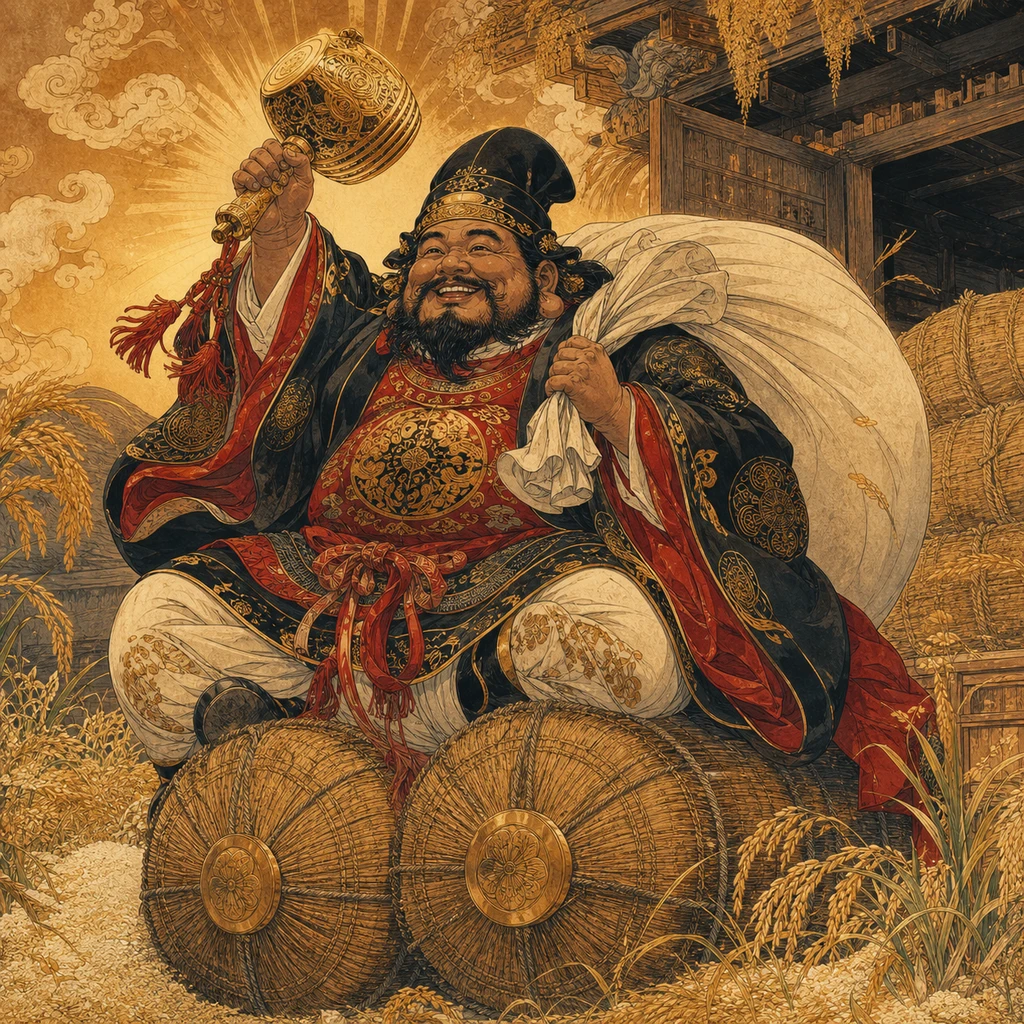
DaikokutenDaikokuten, Fortune God of Two Thousand Years of Transformation
Daikokuten
Detailed Description
From Mahakala to Daikokuten: two thousand years of cultural transformation. The basic profile introduced Daikokuten's main attributes; the deeper story is the long transformation from ancient Indian Mahakala to modern Japanese Daikokuten. Mahakala is the wrathful, nocturnal, destructive aspect of Shiva, and in ancient Indian society he was associated with war, cemeteries, blackness, and fear[1]. Once received into Buddhism, he became a Dharma guardian and moved through Central Asia, China, Korea, and Japan, taking on new meanings in each cultural sphere. In Japan especially, syncretism with Okuninushi, inclusion among the Seven Lucky Gods, and transformation into a wealth deity created a form so new that it almost amounts to rebirth. Daikokuten is a model case of how a foreign deity can be remade inside Japanese religion.
Sanmen Daikokuten: Hieizan and Saicho's religious design. The Sanmen Daikokuten enshrined by Saicho at Hieizan Enryakuji, combining Daikokuten, Bishamonten, and Benzaiten into one three-faced deity, is one of the distinctive creations of Japanese Buddhist history[2]. All three deities come from Indian Buddhist guardian traditions, but Saicho's placement of the combined figure as guardian of the temple kitchen and economy connected Buddhist ideals of compassion and protection with the practical realities of food, training, and institutional survival. Sanmen Daikokuten later spread through Hieizan, Tendai, Shingon, Zen, and related lineages, becoming an important symbol of Japanese Buddhism's ability to integrate practice and material support.
The logic of syncretism through the sound daikoku. The merging of Daikokuten, the Indian-derived Buddhist deity, and Okuninushi, the Japanese Shinto deity, through their shared reading daikoku is a classic example of medieval Japanese religious syncretism through sound[1]. The written forms, doctrines, and origins were unrelated, but the identical reading of "great black" and "great land" was enough to make them overlap. The new deity was not a simple addition of two figures; it gained new life in popular practice. The case reveals a flexible logic in Japanese religion, where sound, image, folk association, and practical benefit can matter more than strict doctrinal consistency.
The civilizational meaning of the Seven Lucky Gods. The Seven Lucky Gods cult, shaped from the Muromachi and Azuchi-Momoyama periods into the Edo period, gathers Daikokuten, Ebisu, Bishamonten, Benzaiten, Fukurokuju, Jurojin, and Hotei around the shared wish for fortune, wealth, and prosperity. Its origins are deliberately mixed: Ebisu is native Japanese, Daikokuten, Bishamonten, and Benzaiten come from Indian religious worlds, and Fukurokuju, Jurojin, and Hotei come from Chinese Daoist, Buddhist, and popular traditions. Edo commoners did not demand a neat theory. They wanted luck, and that pragmatic wish created one of Japan's most inclusive religious combinations.
Rice bales, mallet, and sack: medieval Japanese symbolism of fortune. Daikokuten's three main attributes, rice bales, the uchide no kozuchi mallet, and the great sack, compress medieval Japanese ideas of wealth. Rice bales symbolize harvest, food, land, and tax revenue in an agrarian society, entering Daikokuten through Okuninushi's agricultural layer. The mallet appears in classical tales such as the Konjaku Monogatari Shu and Uji Shui Monogatari as a magical tool that produces what one desires, a symbol of inexhaustible resources. The sack combines elements of Mahakala's treasure bag, Hotei's cloth sack, and Japan's seven-treasures imagery, holding gold, silver, lapis lazuli, tridacna shell, agate, pearl, and coral. These objects hold Indian, Chinese, and Japanese symbolism in a single image.
Edo treasure-ship prints and collective wishes for prosperity. Treasure-ship prints became popular in the Edo period, showing the Seven Lucky Gods riding a ship of riches. Placing such a picture under the pillow on the second night of the New Year was believed to bring a lucky first dream. These images circulated widely as New Year charms for townspeople and merchants, and Daikokuten was often drawn near the center because he best embodied wealth, harvest, and thriving business. Through treasure-ship prints, Edo publishing, ukiyo-e, popular religion, and commercial culture converged. Even today, the motif survives in New Year decorations, greeting cards, and shop talismans.
Daikokuten in the twenty-first century: a fortune god in a global age. Daikokuten remains a familiar god of wealth, business, and harvests. His image is used in New Year Seven Lucky Gods pilgrimages, first shrine visits, prayers for business success, and new-shop celebrations; merchants, restaurants, companies, and private homes still place him on altars. Even in an age of globalization, economic anxiety, and individualization, the desire for fortune, wealth, and prosperity remains universal. Daikokuten gathers that desire into one deity through a two-thousand-year chain linking ancient Indian Mahakala, medieval Sanmen Daikokuten, Edo Seven Lucky Gods worship, and the modern Japanese fortune god. He is one of the clearest symbols of cultural transformation in Japanese religion.
Source Information
種類全体の出典primary
大黒天 (マハーカーラ) の仏教経典体系
著者: 曇無讖訳『金光明経』·密教経典群·『陀羅尼集経』等
年代: 5-8 世紀漢訳·日本伝来は 8-9 世紀以降
出版社: (古代インド原典·中国漢訳·日本伝来仏教経典)
種類全体の出典primary
比叡山延暦寺·三面大黒天 ── 最澄の独自造立
著者: 最澄 (デンギョウ大師·767-822)·天台宗
年代: 平安初期 (788 年延暦寺創建·三面大黒天造立伝承)
出版社: 滋賀県大津市·比叡山延暦寺
Personality
A deity who combines Mahakala's wrath, destruction, and darkness, Hieizan's balance of discipline and temple economy, Okuninushi's compassion, fertility, and matchmaking, and the fortune, wealth, and prosperity of Edo-period Seven Lucky Gods worship.
Compatibility
Close to those who pray for prosperous business, wealth, harvests, new shops, and new ventures; to pilgrims of Hieizan Enryakuji, Entokuin, Senso-ji, and Daikokuten shrines and temples; and to people who continue Seven Lucky Gods pilgrimages, treasure-ship images, and New Year worship.
Abilities & Skills
Weaknesses
His fearsome Indian wrathful nature is largely erased by Japanization, simplifying the deity into a gentle fortune god; syncretism through the sound daikoku weakens his independent identity by blending him with Okuninushi; postwar secularization and commercialization thin his sacred aura; younger generations in a globalized age may know the icon without knowing its origins.
診断評価
妖怪バウンダリー・タイプ指標
いたずら濃度
-2.0high: 戯 low: 護
📝 メモ
財福と修行守護が中心だが古層に憤怒も残る
変化適応
3.0high: 化 low: 定
📝 メモ
マハーカーラから大国主習合・七福神へ変容する
夜話度
1.0high: 夜 low: 昼
📝 メモ
マハーカーラの夜と黒色の古層を持つ
情の深さ
2.0high: 縁 low: 境
📝 メモ
豊穣・縁結び・商業の願いと深く結ぶ
結界強度
2.0high: 律 low: 流
📝 メモ
寺社や神棚など祭祀の場に鎮まる
表舞台圧
3.0high: 表 low: 影
📝 メモ
七福神中心格として福徳を堂々と示す
妖怪相性診断
喜び
10.0喜びと楽しさの程度
📝 メモ
富と豊穣を司る七福神の中心として最高の福徳と喜びをもたらす
怒り
2.0怒りの激しさの程度
📝 メモ
元はインドの憤怒尊だが日本での習合によりその側面はほぼ消えた
慈悲深い
9.0慈悲深さの程度
📝 メモ
万人に等しく福財を分け与える慈悲深い存在
憂鬱
1.0憂鬱で思慮深い程度
📝 メモ
福徳と繁栄の象徴であり哀愁や憂鬱さは全くない
静寂
8.0内なる平静の程度
📝 メモ
温和な微笑みで人々の暮らしを安定させる静かな豊かさ
いたずら好き
6.0いたずら好きで活発な程度
📝 メモ
打出の小槌から望む物を出し宝船で福を運ぶ楽しげな振る舞い
やさしい
9.0やさしく親しみやすい程度
📝 メモ
庶民の現世利益の願いを優しく叶える慈悲の神
厳格
3.0厳格で真面目な程度
📝 メモ
庶民の実利主義に寄り添う親しみやすさがあり厳格さは薄い
守護的
9.0他者を守る傾向
📝 メモ
厨房や商売を火や厄災から守り経済を支える
神秘的
7.0神秘的で不思議な程度
📝 メモ
無尽蔵の富を生み出す袋や小槌の不思議な力
霊性の深さ
9.0精神的境界の深さ
📝 メモ
二千年にわたり異文明間で習合を重ねた壮大な宗教史の結晶
Similar Yokai
Yokai with similar personality and characteristics to Daikokuten, Fortune God of Two Thousand Years of Transformation
Opposite Yokai
Yokai with opposite personality and characteristics to Daikokuten, Fortune God of Two Thousand Years of Transformation


🔮Test your compatibility with Daikokuten now!
Analyze your personality and values to get a detailed compatibility rating with this yokai.
Free, simple, and results in just minutes.