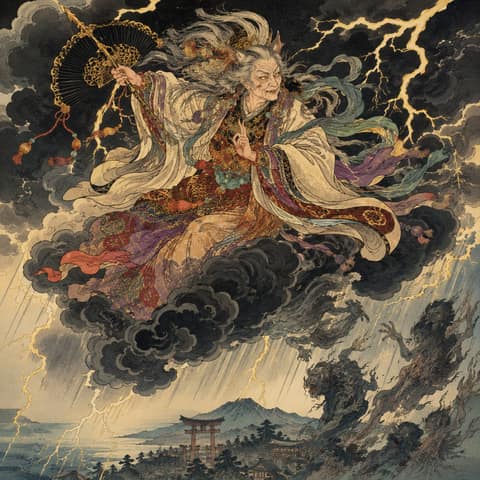
Yasaburō-baba is a man-eating hag told of mainly in Echigo. The mother of a man named Yasaburō, or something that took her place, attacks people in the hills and fields at night, has her arm cut off or is shot, and is found out by that wound; later, it is said, she was enshrined at Yahiko as “Myōtaraten.” The gazetteer Echigo nayose, with a preface dated 1756, records that the mother of Yasaburō, a farmer of Nakajima village, went out every night and killed people, and that after a Shingon priest of Shōryōji in Iwase gave her the precept name Myōtaraten she grew gentle, and a wooden statue carved in her likeness was placed in the Amida hall at the Iyahiko shrine[1].
Folklore & Legends
According to the entry “Yasaburō's house site” in book five of Echigo nayose, beside the road from Nakajima village to Makigahana village there was a plot six or seven feet square, left unplowed in the middle of a field, said to be where the farmer Yasaburō once lived. Yasaburō's mother was rumored to go out every night and kill people, but nothing was known for certain, and years went by. One dark night, when Yasaburō went out with his net to catch ducks, something on the road seized him by the head and tried to drag him off. Yasaburō was strong; he slashed at its arm with the sickle at his waist, got free, and went home, where his old mother lay in the back room complaining of a stomachache. The next morning a trail of blood ran from her room out to the main road, and following it led to the very place of the night before, so the rumor was proved true. After that the mother wandered the hills and fields of Kanbara district doing nothing but uncanny harm, and for some reason killed the people of Sugana manor above all, until a Shingon priest of Shōryōji in Iwase village gave her the precept name Myōtaraten, after which her temper grew gentle. Yasaburō's descendants lived at Yasude village in Kōchidani, deep in the hills behind Muramatsu, having left their home, it was said, because of this affair; and at Yasude and at the Yahiko post station there was a saying that some rain falls every day, even on fine days: a “private rain”[1].
Koshi no kazaguruma (preface 1771), by Ban Kinai, a retainer of the Nagaoka domain, says that Myōtaraten, an auxiliary shrine of the great deity of Iyahiko, was once the mother of a farmer in some village of Kanbara district. She was a cruel old woman who had not lost a single tooth past the age of a hundred, and one autumn lumps like horns grew out on both sides of her hairline and her back teeth lengthened into fangs, to the grief of her son Yasaburō. Around the tenth month, at midnight, the village hunter Gosuke went out netting and saw a mountain-hag-like thing some ten feet tall, its eyes shining like cartwheels, trying to steal the ducks caught in his net; he fired the gun he carried for safety, and it seemed to strike the thing in the chest before it vanished into the air. Next morning the trail of blood led to the window of the room where Yasaburō's mother slept, and she would not come out, saying she had had a stomachache since morning. The village head reasoned that the real mother must have died at some point and this monster had taken her place; when the villagers examined her they found a gunshot wound below her chest, and the old woman at once broke through the door and fled. Under the floor lay human bones and the carcasses of beasts, and the children who had been disappearing from nearby villages were judged to be the monster's doing. A high priest was asked to perform prayers, and she was enshrined beside Yahiko as Myōtaraten, after which the storms and the vanishing of children stopped. Even so, at the end of the tenth month, on nights of fierce wind and rain, a shining thing flies out from the direction of Yahiko to Mount Kanakura in the Muramatsu hills of Koshi district, and this is called the “Myōtarōten storm”; after such a storm, they say, coffins and the like can be found around a cave at the summit[2].
Takagi Toshio's Nihon densetsu shū (1913) gives a tale from Kugita in Zenkon village, below Mount Hachikoku near Kashiwazaki in Echigo, in which Yasaburō-baba is an old woman whom no one would have anything to do with, so that she turned to wickedness, led wild dogs and wolves to lie in wait on Urushiyama, tormented passers-by, and came to eat children and even grown men. At the end of the eleventh month, Yasaburō was chased on Urushiyama on his way back from Kashiwazaki and climbed a great tree; the old woman climbed after him, and when he struck her on the forehead with his hatchet she fled shrieking. At home his mother had a wound on her forehead and said she had hit it on a pillar, and Yasaburō's child was nowhere to be seen. When asked, she said she had licked him up, thinking he was miso, then showed her true form and, hidden by a storm, escaped through the gable toward Mount Hachikoku. From then on the hag lived in a rock cave in the hills, and whenever she saw a funeral with a red parasol and red robes she snatched the coffin and ate the corpse, until the priest of Jōkeiji at Tobioka in Zenkon village changed to a blue parasol and blue robes; after that no coffins were taken, and this temple alone still uses a blue parasol. Later the hag flew off toward Yahiko in Nishikanbara district, where there is a hall that enshrines her. The same book also gives the Yahiko side of the story: Myōtarō, a hunter of Nakajima village in Nishikanbara district, cut off a huge hand with his mountain sword in a hut deep in the hills and brought it home, where his mother, groaning with some grave illness, said it was her hand and flew out the window; the hall built to enshrine her is the Myōtaraten behind Yahiko Shrine[3].
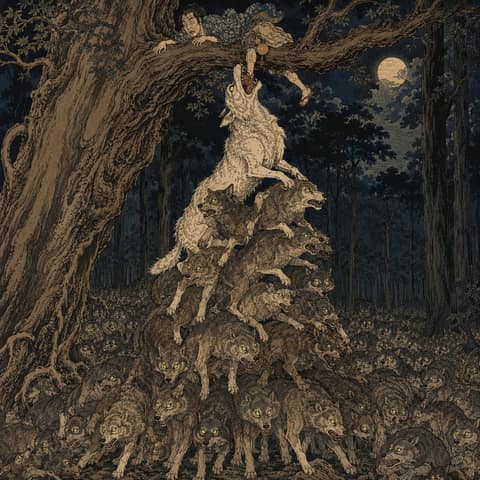
In “Granny Yasaburō” in Minami-Kanbara-gun mukashibanashi shū (1943), edited by Iwakura Ichirō, Yasaburō is a net-hunter who lives with his old granny at the foot of Mount Yahiko. While he is catching birds in the rice fields, four wolves appear, and he climbs a pine tree. The wolves climb onto one another's shoulders in a “wolf chain,” but the wolf at the bottom gives way and the chain collapses, and one runs off somewhere saying, “No good today; let's ask Granny Yasaburō.” Suddenly a great storm comes from the west, a black cloud wraps around Yasaburō, and a huge hand reaches out of the cloud and seizes him by the scruff of the neck, so he cuts it off with the hatchet at his waist. When he brings home the arm, bristling with hair like wire, the granny groaning in the back room reveals herself as a hag, says, “That's my arm, no doubt about it,” puts it back on the stump, and flees. Under the floor lie heaps of the bones of birds, beasts, and people: the hag had eaten the granny and taken her shape[4].
On Sado, it is said that Dakurige Sakyō, near the woods of the Suwa shrine at Sawane, slashed at something that had seized his horse and would not let it move; a she-demon over ten feet tall fled on a black cloud, and later, one rainy night, an old woman came to him, named herself the mother of Yasaburō, a farmer near Yahiko in Echigo, swore to give up her wicked ways, and got her arm back, after which she never appeared on Sado again. Another report from Sado says that Yasaburō-baba was born at Isori on Sado, was driven out to Echigo for her love of human flesh and enshrined there, and every year on the eve of the Isori festival rides a black cloud and raises wind and rain to visit her old home. At Niitsu (now Akiha ward, Niigata City), a man whose catch of fish kept being stolen cut off a hand that reached down from the sky, and the old woman of the house snatched up the arm, fixed it to her own body, and left as a she-demon; at Yoshikawa in Jōetsu, a man up a tree cut off one arm of a mountain hag with his sickle, and when he got home his mother cried “That's my arm!” and flew out through the high window, so that houses in that hamlet are no longer built with high windows. In Mishima, Fukushima Prefecture, they say that “Yasaburō's mother,” having lost an arm, bursts into houses every year on the eighth day of the twelfth month and cuts off children's arms, so a basket is hung on the end of a pole at the door[5].
On the hill behind Hōkōin at Yahiko stands the “Babasugi,” a cedar said to be a thousand years old. Long ago, it is told, a hag who lived at Yahiko was persuaded by a high priest to reform, and thereafter, as a warning to wrongdoers, she hung their corpses and clothes on this great cedar for all to see[6].
ShōmadōYokai Soul Match
Are you anything like Yasaburō-baba?
From about ten questions, the mirror of Shōmadō reads your aura and shows you the one yokai, out of more than five hundred, closest to you.
In every version, Yasaburō or a hunter cuts off a strange thing's arm in the night hills, strikes it on the forehead, or shoots it in the chest. At home the mother lies in bed with a stomachache or some grave illness, and the trail of blood leads back to the place of the night before[1]. In Koshi no kazaguruma a gunshot wound is found below her chest, and human bones turn up under the floor[2].
Enshrined as Myōtaraten
In Echigo nayose, a Shingon priest of Shōryōji in Iwase gives her the precept name Myōtaraten, and her wooden statue is placed beside the main image in the Amida hall at the Iyahiko shrine[1]. In the account Takagi Toshio recorded, the hall built to enshrine her is the Myōtaraten behind Yahiko Shrine[3].
She comes with the storm
Koshi no kazaguruma calls it the “Myōtarōten storm” when, on nights of fierce wind and rain at the end of the tenth month, a shining thing flies from Yahiko to Mount Kanakura[2]. In Minami-Kanbara-gun mukashibanashi shū, the granny summoned by the wolves arrives with a great storm from the west and a black cloud[4]. On Sado they say the thirteenth day of the ninth month, when Granny Yasaburō comes to take back her arm, always turns stormy even if the morning is clear, and that on the eve of the Isori festival, too, she rides a black cloud and raises wind and rain[5].
Character Profile
This section is our own creative profile for storytelling. It is not historical fact or scholarship.
Cruel; goes out into the hills and fields every night to kill people, and eats children and the dead.
Compatibility
She snatches the coffin from any funeral with a red parasol and red robes, but stopped touching the funerals of Jōkeiji once it changed to blue.
Abilities
Reaches a huge hand down from the sky to seize peopleRides a black cloud and raises wind and rainPuts a severed arm back on its stumpLeads wild dogs and wolves
Weaknesses
Her arm can be cut off with a sickle or hatchet, and she can be shot. The wound stays on the mother's body and gives her away.
Habitat
Yahiko in Echigo, the rock caves of Mount Hachikoku, the cave on Mount Kanakura