
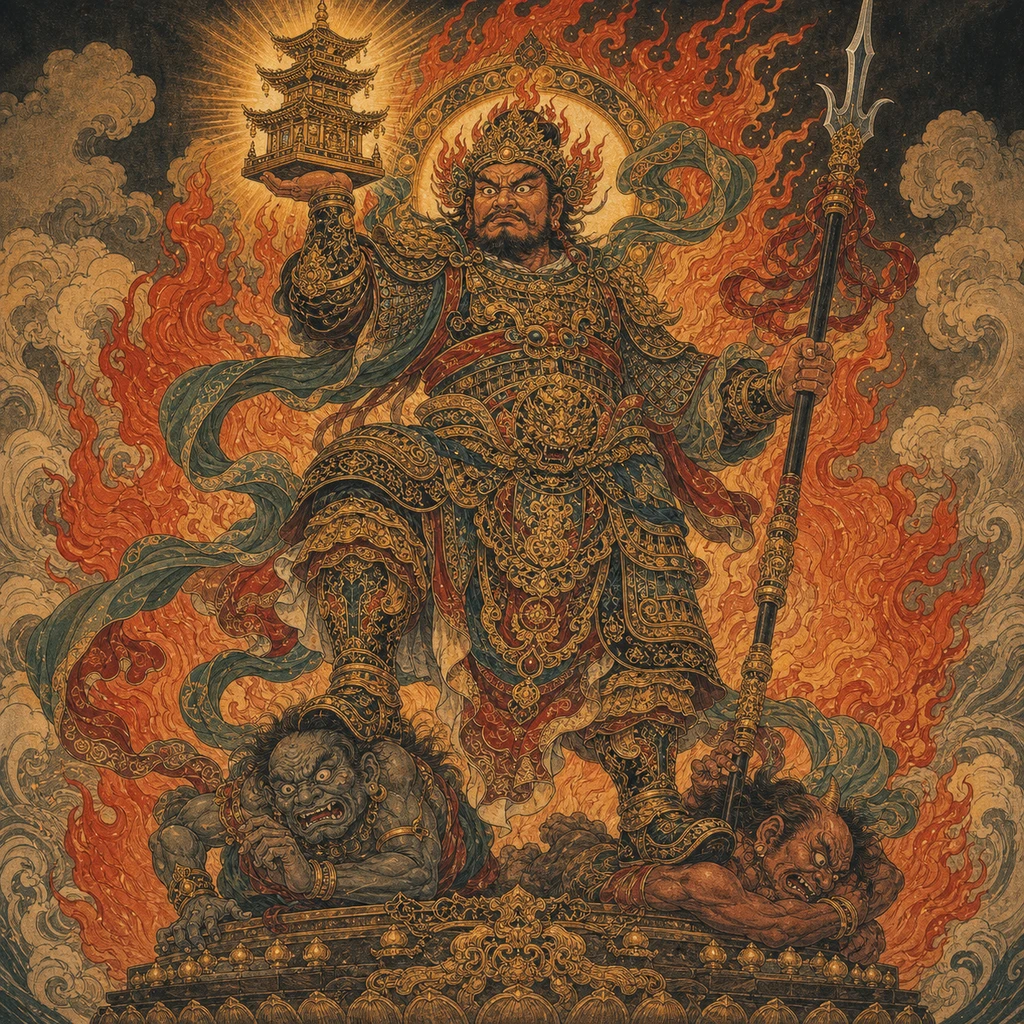
BishamontenThe Armed God of Fortune and Bearer of Six Stages of Multifaceted Faith: Bishamonten
びしゃもんてん
Detailed Description
From Kubera to Vaiśravaṇa: Over a Millennium of Cultural Evolution. While the basic description touches upon Bishamonten's primary attributes, this comprehensive exposition delves into the thousand-year cultural evolution from the ancient Indian Kubera to the modern Japanese Bishamonten. Kubera was an important deity in ancient Indian mythology, serving as the Hindu god of wealth, guardian of the north, and lord of the Yakshas[1]. After being adopted into Buddhism, he became the Dharma protector Vaiśravaṇa and spread to Central Asia, China, and Japan. In each cultural sphere, he underwent unique semantic transformations. In Japan, this produced a multifaceted lineage of faith: the Shigisan Engi involving Prince Shotoku, national protection during the Heian period, victory prayers of Sengoku warlords, and his inclusion among the Seven Lucky Gods in the Edo period. He is a quintessential example of a single deity evolving across centuries and multiple cultural spheres.
The Privileged Position of Tamonten in the Four Heavenly Kings System. In Buddhist cosmology, the Four Heavenly Kings—Jikokuten (East), Zochoten (South), Komokuten (West), and Tamonten (North)—guard the four directions on the slopes of Mount Sumeru. Bishamonten, equivalent to Tamonten, is the only one among them to be worshipped independently as the most highly revered figure. This is the result of Kubera's original high status (as god of wealth and northern guardian) in ancient India being preserved even after his adoption into Buddhism. While Shitenno-ji (established by Prince Shotoku in 593) served as the fundamental training ground for Buddhist state religion enshrining all four kings, Bishamonten (Tamonten) independently developed his own following, leading to the formation of temple networks centered around Shigisan, Kurama, and Todai-ji. This dual nature of being both "one of the Four Heavenly Kings" and an "independent deity" is the defining characteristic of Bishamonten worship.
The Shigisan Engi and Prince Shotoku: The Origin Myth of Japanese Buddhist State Religion. The founding legend of Shigisan Chogosonshi-ji—where Prince Shotoku received a secret treasure of victory from Bishamonten on the year, day, and hour of the Tiger during his campaign against Mononobe no Moriya—is a representative example of the origin myth of Japan's Buddhist state religion[2]. The Battle of Shigisan in 587 was Japan's first religious war over the acceptance of Buddhism, pitting Soga no Umako and Prince Shotoku (pro-Buddhism) against Mononobe no Moriya (Shinto/anti-Buddhism). The victory of the Soga faction solidified the acceptance of Buddhism in Japan. The legend of Bishamonten appearing as the guardian of victory at this historical juncture acts as a religious narrative device that grounds the origin of Japan's Buddhist state religion in Bishamonten worship. The association between the tiger and Bishamonten developed uniquely in Japan stemming from this very legend.
Kurama-dera and the Legend of Minamoto no Yoshitsune: The Evolution of Heian Faith. Kurama-dera in Sakyo Ward, Kyoto, is an ancient temple founded in the early Heian period (traditionally in 770 by Gantei) with Bishamonten as its principal deity, tasked with protecting the north of Heian-kyo and defending the nation. The National Treasure standing statue of Bishamonten (early Heian period) is one of the pinnacle works of Japanese Bishamonten sculpture and a vital cultural asset in ancient sculptural history. Kurama-dera later became the stage for hero legends, such as Minamoto no Yoshitsune (Ushiwakamaru) learning swordsmanship on Mount Kurama from Tengu (considered familiars of Bishamonten), establishing it as a crucial sacred site for samurai faith and heroic lore from the late Heian to early Kamakura periods. This is a prime example of Bishamonten worship expanding from ancient state religion to medieval samurai culture.
Uesugi Kenshin: The "Bi" Banner and the God of War. The apex of Bishamonten worship in Sengoku Japan was Uesugi Kenshin (1530-1578), the powerful daimyo of Echigo. Born in the Year of the Tiger and named "Torachiyo," Kenshin believed he was the reincarnation of Bishamonten, riding into battle under a banner bearing the single character "Bi" (毘). The Bishamon Hall at Kasugayama Castle (present-day Joetsu City, Niigata) formed Kenshin's religious core, where he held prayers during crucial moments before deployments, after victories, and during peace treaties. This stands as a representative example of the trinity of religion, military might, and politics in the Sengoku period, showcasing the typical religious individuality of warlords, comparable to Takeda Shingen's devotion to Fudo Myoo or Oda Nobunaga's reverence for a syncretic Namban deity.
Incorporation into the Seven Lucky Gods and Edo Popular Faith. In the late Muromachi period, the worship of the Seven Lucky Gods was established, and Bishamonten was included as the armed deity of fortune presiding over "martial luck, victory, and wealth." While the other members of the Seven Lucky Gods are depicted with gentle appearances, Bishamonten is the only one who retains his fully armed guise (armor, pagoda, baton, trampling a demon), giving him a unique presence within this belief system. In the Edo period, Bishamonten played an important role in Takarabune (treasure ship) paintings, New Year's Seven Lucky Gods pilgrimages, and prayers for business prosperity and academic success. He became the core of popular religious culture that aggregated multiple layers of heritage: the ancient Indian wealth god Kubera, the protector of the Heian state, the victory deity of Sengoku warlords, and the popular lucky god of the Edo period.
Bishamonten in the 21st Century: Modern Continuity of Multifaceted Faith. Today in the 21st century, Bishamonten is a rare deity that bears a six-stage multifaceted heritage: (1) wealth and northern guardian from ancient India, (2) Tamonten of the Buddhist Four Heavenly Kings, (3) victory guardian of Prince Shotoku and the Shigisan Engi, (4) the faith of Sengoku warlords like Uesugi Kenshin, (5) the armed lucky god of the Edo Seven Lucky Gods, and (6) the modern deity answering prayers for business, exams, and sports victories. He is devoutly worshipped at Shigisan Chogosonshi-ji, Kurama-dera, Todai-ji, and Bishamonten temples and shrines nationwide. Furthermore, he is continuously reimagined in subculture works (such as the games "Nobunaga's Ambition," "Sengoku BASARA," "Megami Tensei," and the manga "Demon Slayer: Kimetsu no Yaiba"). He remains a symbolic figure of Japanese Buddhism, religion, and samurai culture, embodying the unbroken continuity of cultural heritage from antiquity to the present day.
Source Information
種類全体の出典primary
毘沙門天 (ヴァイシュラヴァナ) の仏教経典体系
著者: 『金光明経』·『北方毘沙門天王随軍護法真言』·密教経典群
年代: 5-8 世紀漢訳·日本伝来は奈良·平安期
出版社: (古代インド·中央アジア·中国漢訳·日本伝来仏教経典)
種類全体の出典primary
信貴山朝護孫子寺 (聖徳太子と寅信仰の起源)
著者: 信貴山朝護孫子寺
年代: 587 年 (聖徳太子の物部守屋追討祈願伝承) ·現代まで継承
出版社: 奈良県生駒郡平群町信貴山
Personality
A multifaceted divine persona spanning over a millennium, integrating the fierce protectiveness embodied in his majestic armed guise (wearing armor, holding a pagoda and baton, trampling a demon), the reliable martial guardianship fervently trusted by historical heroes like Prince Shotoku and Uesugi Kenshin, and the compassionate benevolence that brings fortune, wealth, and prosperity as one of the Seven Lucky Gods.
Compatibility
Deeply compatible with those seeking martial fortune, victory, business prosperity, academic success, athletic triumphs, new business ventures, family safety, and longevity. Also resonates with those who visit Shigisan Chogosonshi-ji, Kurama-dera, Todai-ji, and Bishamonten temples nationwide; those who revere tigers; those who inherit the faith of Sengoku warlords; and those who appreciate his cultural evolution from ancient India to the modern era.
Abilities & Skills
Weaknesses
The end of warlord faith (the dilution of samurai devotion after the Edo period), the simplification of his divinity due to the complete disappearance of the true nature of Kubera as an ancient Indian wealth god, the reduction of his sanctity through post-war secularization and commercialization, and the trivialization of his godhood through subcultural adaptations.
診断評価
妖怪バウンダリー・タイプ指標
いたずら濃度
-3.0high: 戯 low: 護
📝 メモ
北方守護、戦勝、財福を授ける守護尊
変化適応
0.0high: 化 low: 定
📝 メモ
多層的に習合するが変身能力は主題でない
夜話度
-1.0high: 夜 low: 昼
📝 メモ
武神、福神、守護尊であり夜話性は薄い
情の深さ
1.0high: 縁 low: 境
📝 メモ
信者や武将との信仰関係は強いが執着ではない
結界強度
3.0high: 律 low: 流
📝 メモ
北方守護と寺院結界を担う四天王である
表舞台圧
3.0high: 表 low: 影
📝 メモ
甲冑と宝塔を持つ武装福神として正面に立つ
妖怪相性診断
喜び
5.0喜びと楽しさの程度
📝 メモ
七福神の一柱として財福や現世利益の喜びをもたらすが、本質は厳格な武神。
怒り
7.0怒りの激しさの程度
📝 メモ
邪鬼を踏みつけ、宝塔と宝棒で魔を打ち払う勇猛な戦神としての激しい武威を持つ。
慈悲深い
8.0慈悲深さの程度
📝 メモ
福・財・勝運・商売繁盛など、現世の人々の願いに広く応える慈悲深さを兼ね備える。
憂鬱
1.0憂鬱で思慮深い程度
📝 メモ
財宝と勝運の神であり、内省的な憂鬱さや感傷的な要素は存在しない。
静寂
5.0内なる平静の程度
📝 メモ
仏法守護の四天王・多聞天として、激しい外見の内に確固たる悟りと平静を秘める。
いたずら好き
2.0いたずら好きで活発な程度
📝 メモ
七福神の中でも唯一の武装姿を崩さない、真面目で威厳に満ちた存在。
やさしい
4.0やさしく親しみやすい程度
📝 メモ
威風堂々とした武神であるため、親しみやすい優しさよりは力強い庇護が目立つ。
厳格
9.0厳格で真面目な程度
📝 メモ
仏法と北方を厳密に守護し、魔を寄せ付けない強い規律と武将の厳格さ。
守護的
10.0他者を守る傾向
📝 メモ
四天王最高の北方守護尊であり、武将の戦勝から家内安全まで全てを護る絶対的守護者。
神秘的
6.0神秘的で不思議な程度
📝 メモ
寅の眷属や聖徳太子への秘宝授与など呪術的・神秘的な逸話を持つ。
霊性の深さ
8.0精神的境界の深さ
📝 メモ
古代インドから現代まで千数百年の重層的信仰を集約する圧倒的な神格の歴史。
Similar Yokai
Yokai with similar personality and characteristics to The Armed God of Fortune and Bearer of Six Stages of Multifaceted Faith: Bishamonten
Opposite Yokai
Yokai with opposite personality and characteristics to The Armed God of Fortune and Bearer of Six Stages of Multifaceted Faith: Bishamonten

🔮Test your compatibility with Bishamonten now!
Analyze your personality and values to get a detailed compatibility rating with this yokai.
Free, simple, and results in just minutes.