Noppera-boThe Faceless Anomaly of Kii-no-kuni-zaka
nopperabo
Detailed Description
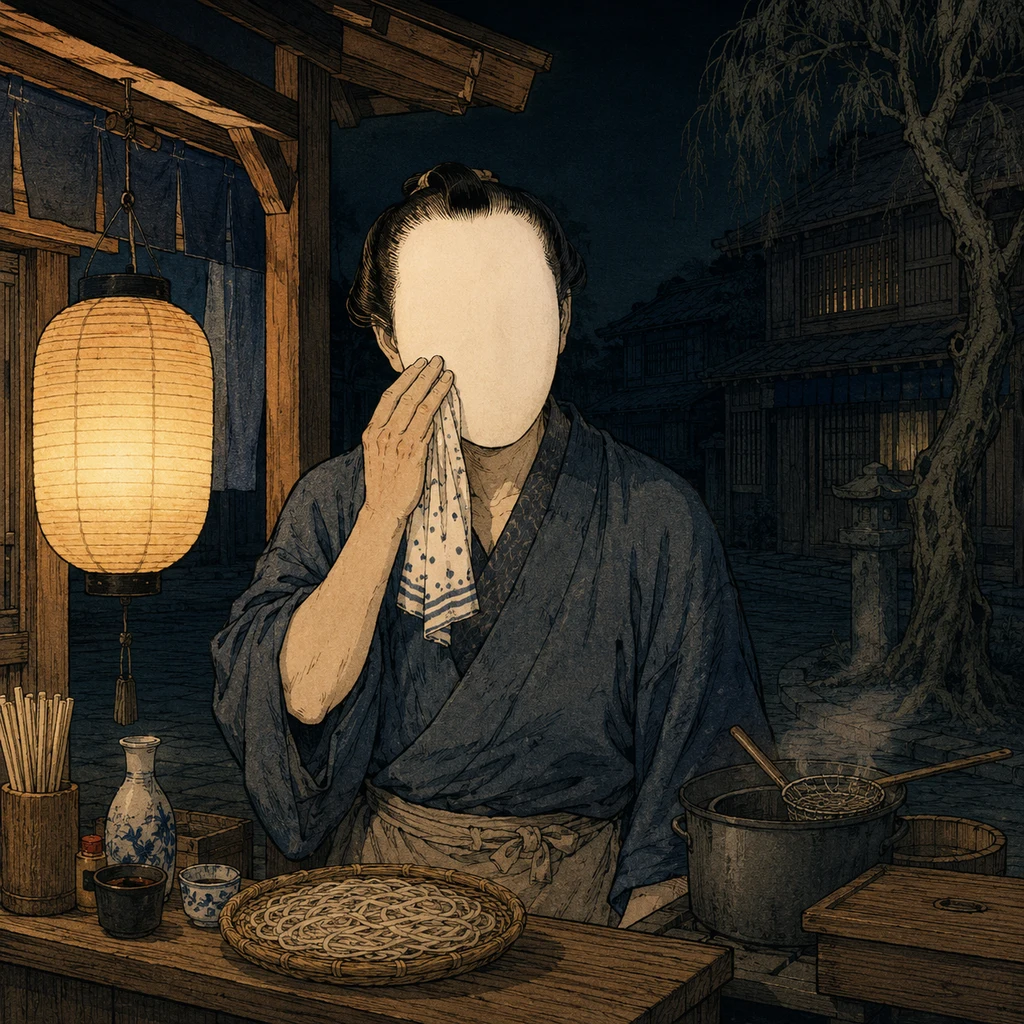
In this version, we interpret the Noppera-bo as a "mujina-type ghost story of facial erasure." The reason Lafcadio Hearn's "Mujina" is so powerful is that it doesn't end with merely showing the faceless woman; it has the man at the soba stand—the supposed sanctuary—perform the exact same action[1]. The first encounter is an anomaly of the dark road; the second encounter is an anomaly where the very systems of everyday life collapse. Despite moving from the dark slope to the illuminated street stall, the horror draws closer, turning the very person one is conversing with into a blank void.
The terror of this ghost story is rooted not in the physical design of the face, but in the "failure of confirmation." The man attempts to confirm that the crying woman is human, and fails. He then attempts to confirm that the soba stand is a safe human society, and fails again. The Noppera-bo does not physically attack, but it shatters the viewer's judgment process twice. The face is a screen for reading identity, emotion, and the presence or absence of hostility; when it vanishes completely, a person is left paralyzed, unable to know how to interact with the other.
The connection to the "mujina" is the deep focus of this version. Hearn's title was "Mujina," and the name "Noppera-bo" was strongly foregrounded by later adaptations. In folklore, mujina, tanuki, and foxes are shape-shifting beasts that frequently interchange, frightening humans while keeping their true identities ambiguous[2]. By maintaining this ambiguity, the Noppera-bo emerges not as a "person without a face," but as "something disguised as what appears to be a person." Precisely because its true identity remains unknown, the terror cannot be cleanly resolved through explanation.
The illustrated Noppera-bo condensed the ambiguity of folklore into a single, powerful image. In Shigeru Mizuki's yokai encyclopedias, the outline of a faceless humanoid became so distinct that readers now immediately picture a smooth visage just by hearing the name[3]. Yet behind this clear iconography lies an inherent obscurity: "we don't know whose face it is" and "we don't know what is shape-shifting." It is visually simple, but narratively, it is doubly unstable.
While this version of the Noppera-bo lacks direct lethal force, it robs the victim of the ability to "read" the other. If fear arises from "finding a dangerous enemy," the Noppera-bo conversely creates a state where one "cannot even determine if it is an enemy." With a faceless entity, one cannot tell if it is angry or smiling, looking at them or turning away. The white blankness left behind is both the face of the anomaly and an empty canvas reflecting the viewer's own profound anxiety.
What is crucial in this version is that the Noppera-bo performs an "erasure of identity," not just a "lack of expression." If it were an angry or smiling face, one could still read the emotion. But without eyes, nose, or mouth, the clues of age, gender, gaze, feeling, and even the possibility of speech are all eradicated. Because every cue for treating the entity as human vanishes, the viewer is stranded, unable to decide whether they are facing a person, an object, or a monster.
Furthermore, by having the soba shopkeeper reveal the same face, the anomaly gains multiplicity. The victim doesn't feel they have escaped a single monster; instead, it feels as if the rules of the world itself have shifted to ones where faces can simply be erased. Herein lies the modern terror of the Noppera-bo tale. What has lost its face is not just the woman or the shopkeeper, but the very mechanism by which humans confirm one another's existence.
Source Information
種類全体の出典reference
怪談「むじな」
著者: 小泉八雲(ラフカディオ・ハーン)
年代: 1904
出版社: Kwaidan: Stories and Studies of Strange Things
種類全体の出典reference
水木しげるの妖怪事典
著者: 水木しげる
年代: 1981
出版社: 東京堂出版
種類全体の出典reference
妖怪事典
著者: 村上健司
年代: 2000
出版社: 毎日新聞社
バージョン固有出典 (紀伊国坂の顔なき怪・のっぺらぼう)reference
怪談「むじな」
著者: 小泉八雲(ラフカディオ・ハーン)
年代: 1904
出版社: Kwaidan: Stories and Studies of Strange Things
バージョン固有出典 (紀伊国坂の顔なき怪・のっぺらぼう)reference
水木しげるの妖怪事典
著者: 水木しげる
年代: 1981
出版社: 東京堂出版
バージョン固有出典 (紀伊国坂の顔なき怪・のっぺらぼう)reference
妖怪事典
著者: 村上健司
年代: 2000
出版社: 毎日新聞社
Personality
It borrows human form and everyday conversation to erase its features the moment the victim feels safe, stripping them of their judgment. While not aggressive, it transforms the very concept of a safe haven into an abyss of nothingness.
Compatibility
人間関係の違和感や、相手の表情を読めない不安に敏感な人と相性がよい。静かな恐怖、反復する怪談、正体不明の化かしを好む人にも向く。
Abilities & Skills
Weaknesses
It has weak physical capturing power. If its true identity is decisively read as the trickery of a tanuki, fox, or mujina, the absolute anxiety generated by the blank face is somewhat diminished.
🔮Test your compatibility with Noppera-bo now!
Analyze your personality and values to get a detailed compatibility rating with this yokai.
Free, simple, and results in just minutes.