
Amaterasu-OmikamiSupreme Deity of Takamagahara
あまてらすおおみかみ
Detailed Description
The Peculiarity of Japanese Mythology: Sun God = Female. While the base description touched on the primary myths of Amaterasu-Omikami, this detailed explanation delves into the comparative religious peculiarity of Japanese mythology in making the sun god female. Sun deities in ancient world mythologies—such as Greece's Apollo, Egypt's Ra, India's Surya, Inca's Inti, and Babylonia's Shamash—are predominantly male. On the other hand, female sun deities like Japan's Amaterasu, Norse's Sól, Baltic's Saulė, and some in Eastern Europe are relatively rare. In post-war Japanese mythological studies, scholars like Takeshi Matsumae proposed the male deity theory, stating that "the archetype of Amaterasu was various male sun gods (Amateru deities) who were later feminized,"[1] which became a central controversy. If we adopt this theory, the feminization of the sun god can be read as a unique deification process that advanced within the kingship, religion, and agricultural rituals of ancient Japan.
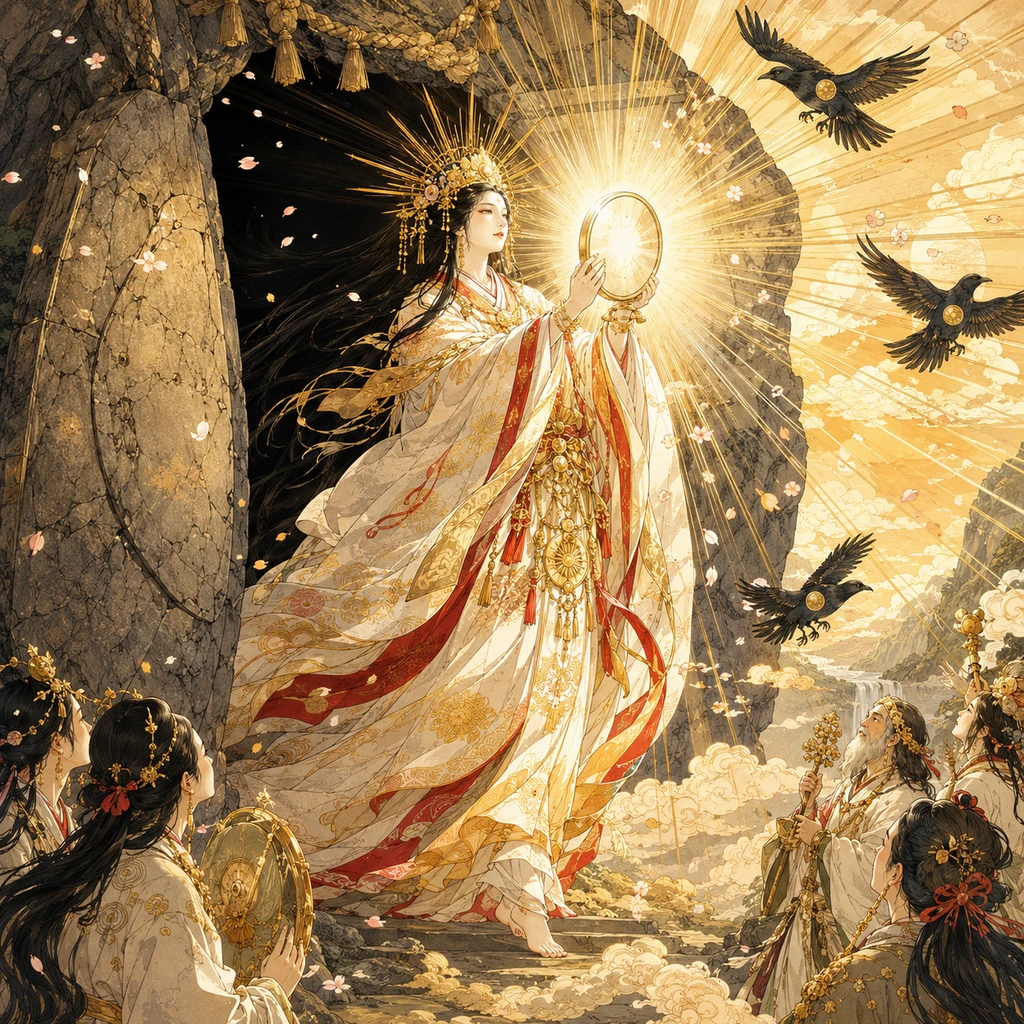
The "Hiding in the Rock Cave" Tale ── Comparative Religion of Sun Disappearance Myths. The "Hiding in the Rock Cave" tale, where Amaterasu-Omikami hides in a cave and plunges the world into darkness[1], is a prime example of "sun disappearance and rebirth" in world mythology. Myths recounting the disappearance and rebirth of the sun—such as the Aten faith of ancient Egypt, Surtr in Norse myth, the Hittite sun god disappearance myth, and the Baltic sun god rebirth myths—are widely distributed as religious responses to the winter solstice, solar eclipses, and agricultural cycles in ancient farming societies. Amaterasu's seclusion is interpreted as the origin myth of Shinto kagura and ritual ceremonies, where "ritual tools like Ame-no-Uzume's kagura dance, the Yata mirror, jewels, evergreen trees, and the eternal bird (announcing the eternal dawn)" summon the sun god from the cave. As the root myth of religious rituals like the ancient Japanese winter solstice festival, Niiname-no-Matsuri, and Kanname-no-Matsuri, it holds cosmological significance far beyond a simple heroic tale.
The Three Sacred Treasures ── The Unity of Kingship and Religion. The Three Sacred Treasures (the Yata mirror, Yasakani jewel, and Kusanagi sword) that Amaterasu-Omikami bestowed upon Ninigi during the heavenly descent[1] symbolize the unity of kingship, religion, and mythology in ancient Japan. The Yata mirror embodies sunlight and Amaterasu's spirit; the jewel is a symbol of spiritual power and prayer in ancient Japanese religion; and the Kusanagi sword is a symbol of martial power and rule obtained through Susanoo's slaying of the Eight-Headed Serpent. The Three Sacred Treasures became the core of ancient imperial enthronement rituals and continue to function as the central apparatus of imperial succession ceremonies to this day. They are devices embodying the unique continuity of myth and politics in ancient Japan, where mythological narratives exert a sustained influence on modern political systems and state rituals.
Ise Jingu and the Shikinen Sengu ── Two Thousand Years of Succession. The Inner Shrine of Ise Jingu (Kotaijingu) is the sacred site enshrining Amaterasu-Omikami from ancient times to the present. Through the "Shikinen Sengu" (the ritual of completely rebuilding the shrine buildings every 20 years), which began in the 4th year of Empress Jito (690 CE)[2], ancient architectural techniques, rituals, and Shinto culture have been passed down for over 1,300 years. This is a unique philosophy of succession that "embodies eternity through newness"—realizing an "eternity as constant rebirth" through periodic wooden reconstruction, in contrast to the "unchanging eternity" of ancient stone temples. The Shikinen Sengu continues in the 21st century, with the 62nd iteration conducted in 2013. It is a rare phenomenon in world religious history that embodies the essential views of time, eternity, and renewal in ancient Shinto.
The Imperial Lineage and the Basis of Ancient State Legitimacy. As the ancestral deity of the ancient imperial lineage, Amaterasu-Omikami has been at the core of the basis of legitimacy for the Japanese state from ancient times to the present[1]. The genealogy from Emperor Jimmu to successive emperors to the modern emperor was established through five generations from Amaterasu, functioning as an apparatus to guarantee the continuity between ancient myth and the ancient state. This is a prime example of establishing legitimacy through a founding myth of an ancient state, alongside China's Mandate of Heaven, Korea's Dangun myth, Rome's Aeneas myth, and Britain's Brutus myth. She has a complex religious and political history, having been emphasized and politically utilized as the core of State Shinto in pre-war Japan, and undergoing a history of re-evaluation and depoliticization under the post-war system of separation of church and state and popular sovereignty.
Ise Shinto, Ryobu Shinto, and Yoshida Shinto ── History of Medieval Shinto Thought. In medieval Japan, faith in Amaterasu-Omikami gave rise to multiple ideological systems such as Ise Shinto, Ryobu Shinto, Yoshida Shinto, and Suika Shinto. Ise Shinto (Kamakura-Muromachi periods) was formed by Ise priesthood lineages like the Watarai and Arakida families, producing Shinto scriptures like the "Shinto Gobusho." Ryobu Shinto (Kamakura period) was a syncretism with Shingon Esoteric Buddhism, centered on the "Honji Suijaku" theory that identified Amaterasu with Mahavairocana (Dainichi Nyorai). Yoshida Shinto (Muromachi period) was a unique system formed by Kanetomo Yoshida (1435-1511), advocating "Yuiitsu Shinto," which positioned Shinto above Buddhism and Confucianism. Suika Shinto (Edo period) was a system integrating Confucianism, Neo-Confucianism, and Shinto by Ansai Yamazaki (1618-1682), emphasizing Shinto ethics centered on Amaterasu. These medieval and early modern Shinto thoughts evolved around Amaterasu-Omikami as their central axis, playing a decisive role in the formation of Japan's indigenous religious philosophy.
Amaterasu-Omikami in the 21st Century ── From National Tutelary Deity to Individual Spirituality. Under the post-war constitutional system of separation of religion and state and popular sovereignty, Amaterasu-Omikami has been redefined from a political status as the "core of pre-war State Shinto" to a religious status as the "tutelary deity of the entire nation and the spiritual pillar of individuals." With over 8 million annual visitors to Ise Jingu, the nationwide distribution of Jingu Taima (amulets) centered on Ise Jingu, and the organizational structure of Shinto groups and the Association of Shinto Shrines, faith in Amaterasu remains at the foundation of Japanese daily religious life in the 21st century. At the same time, she has become a modern icon repeatedly reimagined in subcultures, games, and manga, making this a rare case where ancient myth and the spiritual culture of modern Japanese people maintain continuity across two millennia. Beyond merely a deity appearing in myths, she is a presence that holds sustained meaning as a core symbol running through the entirety of Japanese culture.
Source Information
種類全体の出典primary
伊勢神宮内宮 (皇大神宮)·式年遷宮
著者: 神宮司庁
年代: 垂仁天皇 25 年 (約 2000 年前) 鎮座·持統天皇 4 年 (690 年) 式年遷宮開始·第 62 回 2013 年斎行
出版社: 三重県伊勢市·神宮司庁
種類全体の出典reference
古事記
著者: 太安万侶
年代: 和銅 5 年 (712)
出版社: (現存最古の日本神話典籍)
種類全体の出典reference
古事記伝 (全 44 巻)
著者: 本居宣長
年代: 1798 (寛政 10 年完成)
出版社: (江戸期国学の代表的注釈書、 没後 1822-1825 年に整版刊行)
種類全体の出典reference
日本書紀
著者: 舎人親王ら
年代: 720
出版社: (養老4年成立の正史)
Personality
Radiant and benevolent, yet possessing a strict sense of order. She feels a strong responsibility as a ruler but has an overly sensitive and emotionally intense side that leads her to shut herself away when deeply hurt.
Compatibility
Highly compatible with those who respect order and have bright, sincere hearts. Clashes with those who are chaotic, rule-breaking, or overly aggressive.
Abilities & Skills
Weaknesses
Overly sensitive reaction to her brother Susanoo's violent acts (the sensitivity of shutting herself in the cave upon the weaving maiden's death), the limits of an ancient ruler who plunged the world into darkness out of her own emotions, political utilization in pre-war State Shinto (and the history of post-war re-evaluation and depoliticization)
診断評価
妖怪バウンダリー・タイプ指標
いたずら濃度
-3.0high: 戯 low: 護
📝 メモ
光・秩序・農耕を司る守護的最高神
変化適応
1.0high: 化 low: 定
📝 メモ
岩戸隠れで世界の光の状態を変えるが変身は少ない
夜話度
-3.0high: 夜 low: 昼
📝 メモ
太陽と昼の神格そのもの
情の深さ
2.0high: 縁 low: 境
📝 メモ
岩戸隠れの感受性と皇統への縁が強い
結界強度
3.0high: 律 low: 流
📝 メモ
高天原と伊勢祭祀の秩序を統べる
表舞台圧
3.0high: 表 low: 影
📝 メモ
高天原の主神・太陽女神として最高度に顕れる
妖怪相性診断
喜び
8.0喜びと楽しさの程度
📝 メモ
世界に光と生命をあまねくもたらし神楽の舞を楽しむ
怒り
5.0怒りの激しさの程度
📝 メモ
弟の乱暴には激怒して岩戸に隠れるなど強い感情の起伏を見せる
慈悲深い
9.0慈悲深さの程度
📝 メモ
岩戸から再び出御し世界に赦しと光をもたらした根源的な慈悲
憂鬱
6.0憂鬱で思慮深い程度
📝 メモ
機織女の死や弟の暴虐に悲観し世界を暗黒に閉ざした繊細さ
静寂
9.0内なる平静の程度
📝 メモ
高天原の秩序を司り世界を泰平に保つ最高神格の静謐
いたずら好き
2.0いたずら好きで活発な程度
📝 メモ
基本は厳格な統治者だが神々の宴の楽しげな声には誘い出された
やさしい
9.0やさしく親しみやすい程度
📝 メモ
万物を育む太陽の暖かさと慈愛を体現する女神
厳格
8.0厳格で真面目な程度
📝 メモ
穢れを嫌い三種の神器を通じて国家の正統性を厳格に規定する
守護的
10.0他者を守る傾向
📝 メモ
日本国家の礎であり国民を総体として守護する絶大な力
神秘的
9.0神秘的で不思議な程度
📝 メモ
八咫鏡に宿り式年遷宮によって永遠に更新され続ける神秘性
霊性の深さ
10.0精神的境界の深さ
📝 メモ
皇祖神として古代から現在まで神道の頂点に立つ究極の聖性
Similar Yokai
Yokai with similar personality and characteristics to Supreme Deity of Takamagahara
Opposite Yokai
Yokai with opposite personality and characteristics to Supreme Deity of Takamagahara
🔮Test your compatibility with Amaterasu-Omikami now!
Analyze your personality and values to get a detailed compatibility rating with this yokai.
Free, simple, and results in just minutes.
Like this yokai?
Visit a shrine to discover your guardian yokai