
Tsurube-otoshiTsurube-otoshi, the Severed Head That Falls from an Old Tree
tsurube-otoshi
Detailed Description
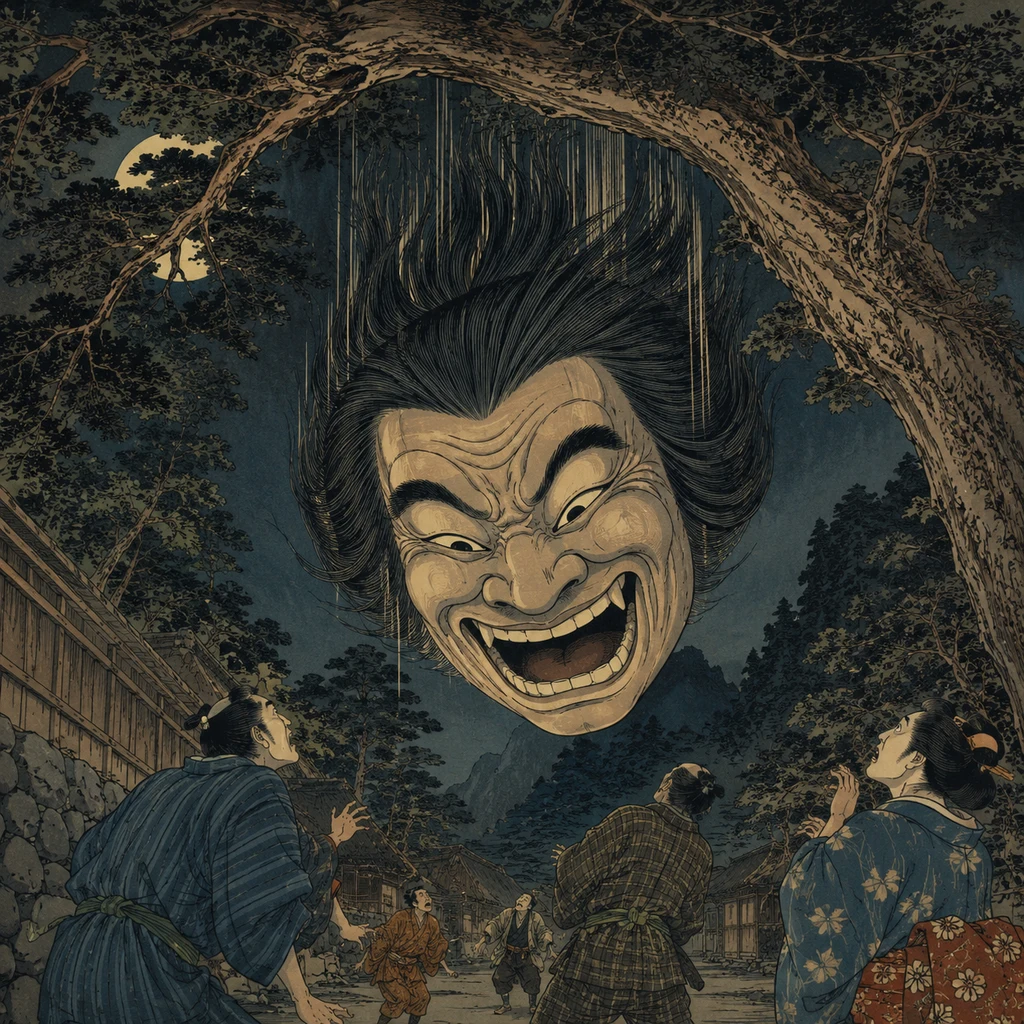
At dusk on a mountain road, a branch creaks once overhead. You look up, but the canopy has already dissolved into darkness. The moment you begin walking again, laughter rings out and an enormous severed head plunges down with the speed of a well bucket. In this form, Tsurube-otoshi turns the simple act of falling into terror.
Two scenes from the traditions of the former Sogabe Village, preserved in *Kuchi Tanba Kōhishū*, are especially important for understanding this image.[1] The presence in the kaya tree at Hōki calls, “Is the night work done? Shall I lower the bucket? Creak, creak,” descending with laughter before climbing back into the tree. From an old pine at Tera, by contrast, a severed head drops and eats people. The detail that it stays away for two or three days after feeding makes it more than a passing illusion. It was imagined as a hungry predator lying in wait along the community's night roads.
Placed side by side, the two stories reveal a method of attack. First, a voice or the sound of a branch draws the traveler's attention overhead. Then the thing closes the distance at once from the darkness of the canopy. After the attack, it rises again as though a rope were hauling up a well bucket. The name describes its motion more precisely than its appearance. The everyday movement of a bucket at a familiar well, transferred to an old tree at night, becomes a dreadful question: what is about to fall onto the person below?
The giant severed head is not Tsurube-otoshi's only form. Hokuriku traditions also record a being that drops the bucket itself from a tree, one that forces travelers into a riddle-like exchange, and one that carries anyone who touches it into the sky.[2] The head is a forceful image connecting the man-eating traditions of Tanba with modern yokai art, but it cannot stand for every regional account. The form described here brings one strand of the wider tradition into focus: Tsurube-otoshi as a predator hidden in an old tree.
Nor can its difference from Tsurube-bi be decided by appearance alone. The early-modern Tsurube-oroshi and Sekien's Tsurube-bi center on uncanny fire descending from a tree.[3] The severed-head form instead centers on voice, sudden descent, and predation. Even so, both inhabit old trees and move up and down like a well bucket. No source shows a flame simply transforming into a face, but the evidence is equally insufficient to call the traditions unrelated. A sounder reading is that a shared older name and motion acquired different bodies in different local narratives.
Mizuki Shigeru's 1992 original painting *Tsurube-otoshi* clearly embodies the modern impression of an enormous face appearing in a tree.[4] A giant head communicates danger immediately and makes the instant of descent easy to visualize. It was therefore more readily remembered in manga, encyclopedias, and three-dimensional figures than an invisible voice or an ordinary bucket. Yet returning to the local tales after seeing the face lets us hear what the picture cannot show: a question about finished night work, the creak of a rope, the movement of leaves, and a presence drawing closer from somewhere above. Tsurube-otoshi's true domain is not the giant face alone. It is the instant in which a person cannot help but look up.
Source Information
種類全体の出典primary
秋の日は釣瓶落とし
著者: デジタル大辞泉・精選版 日本国語大辞典
年代: 辞書項目
出版社: 小学館(コトバンク掲載)
種類全体の出典reference
画図百鬼夜行
著者: 鳥山石燕
年代: 安永5年(1776年)
出版社: 国立国会図書館デジタルコレクション
種類全体の出典reference
古今百物語評判
著者: 山岡元隣
年代: 貞享3年(1686年)
出版社: 早稲田大学図書館古典籍総合データベース
種類全体の出典primary
愛媛県美術館年報・研究紀要 令和3年度
著者: 愛媛県美術館
年代: 2022年
出版社: 愛媛県美術館
種類全体の出典reference
日本妖怪大事典
著者: 水木しげる 画・村上健司 編著
年代: 2005
出版社: 角川書店
種類全体の出典primary
「釣瓶落しの怪」の伝承―北陸地方の事例をめぐって―
著者: 松本孝三
年代: 1992年
出版社: 『加能民俗研究』通巻23号、加能民俗の会、46–52頁
種類全体の出典primary
口丹波口碑集
著者: 垣田五百次・坪井忠彦 編
年代: 大正14年(1925年)
出版社: 郷土研究社(炉辺叢書27)
バージョン固有出典 (古木から落ちる生首・釣瓶落とし)reference
画図百鬼夜行
著者: 鳥山石燕
年代: 安永5年(1776年)
出版社: 国立国会図書館デジタルコレクション
バージョン固有出典 (古木から落ちる生首・釣瓶落とし)reference
古今百物語評判
著者: 山岡元隣
年代: 貞享3年(1686年)
出版社: 早稲田大学図書館古典籍総合データベース
バージョン固有出典 (古木から落ちる生首・釣瓶落とし)reference
愛媛県美術館年報・研究紀要 令和3年度
著者: 愛媛県美術館
年代: 2022年
出版社: 愛媛県美術館
バージョン固有出典 (古木から落ちる生首・釣瓶落とし)reference
「釣瓶落しの怪」の伝承―北陸地方の事例をめぐって―
著者: 松本孝三
年代: 1992年
出版社: 『加能民俗研究』通巻23号、加能民俗の会、46–52頁
バージョン固有出典 (古木から落ちる生首・釣瓶落とし)reference
口丹波口碑集
著者: 垣田五百次・坪井忠彦 編
年代: 大正14年(1925年)
出版社: 郷土研究社(炉辺叢書27)
Personality
A capricious and cruel presence that waits in the crown of an old tree. It uses laughter or a call to make travelers look up, then plunges down while their attention is fixed overhead.
Compatibility
Those drawn to night mountain roads and the space beneath old trees are more likely to encounter it. A cautious traveler who notices sounds overhead and chooses open paths is more likely to expose its ambush.
Abilities & Skills
Weaknesses
The traditions record no fixed weakness or method of defeating it shared across regions. Avoiding the ground directly beneath old trees and noticing laughter or creaking branches overhead are the clearest ways to evade an encounter.
診断評価
妖怪バウンダリー・タイプ指標
いたずら濃度
3.0high: 戯 low: 護
📝 メモ
京都系では人を喰らう捕食型、岐阜滋賀系でも投下で脅かす加害性が高い
変化適応
2.0high: 化 low: 定
📝 メモ
生首、釣瓶、火の玉など地域により落ちるものの形が分裂する
夜話度
2.0high: 夜 low: 昼
📝 メモ
山間街道や峠道の古木怪として夜話性が高い
情の深さ
-1.0high: 縁 low: 境
📝 メモ
古木の精霊として場に宿るが、人への情や執着より襲撃性が中心
結界強度
3.0high: 律 low: 流
📝 メモ
古松・カヤ・杉・欅など特定の古木と峠道に強く縛られる
表舞台圧
2.0high: 表 low: 影
📝 メモ
古木から生首や釣瓶が急落し、笑い声や発話を伴って強く脅かす
妖怪相性診断
喜び
3.0喜びと楽しさの程度
📝 メモ
樹木から落ちて脅かす怪異であり喜びは少ない
怒り
7.0怒りの激しさの程度
📝 メモ
人を驚かせる激しい動きを持つ
慈悲深い
1.0慈悲深さの程度
📝 メモ
他者への思いやりを持つ存在ではない
憂鬱
4.0憂鬱で思慮深い程度
📝 メモ
暗い夜道を落ちてくる不気味さ
静寂
5.0内なる平静の程度
📝 メモ
落ちてくる前は木の上に潜む静けさ
いたずら好き
7.0いたずら好きで活発な程度
📝 メモ
驚かす行為自体にいたずらの意図が含まれる
やさしい
1.0やさしく親しみやすい程度
📝 メモ
驚かし害を与える可能性がありやさしさはない
厳格
2.0厳格で真面目な程度
📝 メモ
特定の規律や戒めを持つ存在ではない
守護的
0.0他者を守る傾向
📝 メモ
人を守る要素は一切ない
神秘的
7.0神秘的で不思議な程度
📝 メモ
木の上から火や首が落ちてくるという奇妙な怪現象
霊性の深さ
5.0精神的境界の深さ
📝 メモ
在地伝承の怪異であり深い霊性はない
Similar Yokai
Yokai with similar personality and characteristics to Tsurube-otoshi, the Severed Head That Falls from an Old Tree

Opposite Yokai
Yokai with opposite personality and characteristics to Tsurube-otoshi, the Severed Head That Falls from an Old Tree
🔮Test your compatibility with Tsurube-otoshi now!
Analyze your personality and values to get a detailed compatibility rating with this yokai.
Free, simple, and results in just minutes.
Like this yokai?
Visit a shrine to discover your guardian yokai