
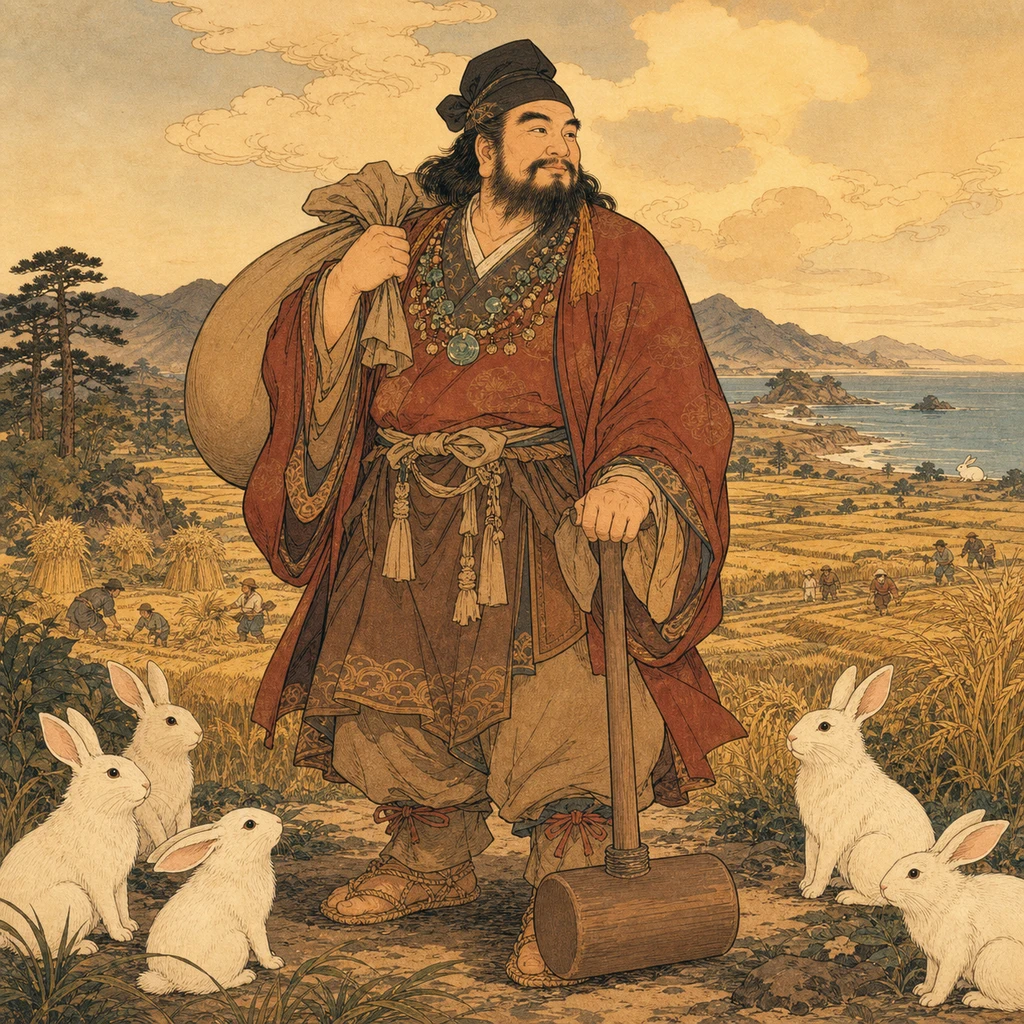
Okuninushi no KamiOkuninushi no Kami, Lord of Izumo Myth and God of Matchmaking
Okuninushi no Kami
Detailed Description
The many-named god and the gathering of local faith. The basic profile noted Okuninushi's many names; the deeper point is what such multiplicity means in religious history. Names such as Onamuchi, Okuninushi, Omononushi, Ashihara-shikoo, Yachihoko, Utsushi-kunitama, and Okunitama are often interpreted as traces of local land, agricultural, warrior, medical, and serpent cults absorbed into Okuninushi[1]. When the Kojiki and Nihon Shoki were compiled in the early eighth century, the ritsuryo state needed a mythic structure that could relate central power to regional cults. The result was a paired mythology: the heavenly line of Takamagahara and Amaterasu, and the earthly line of Ashihara no Nakatsukuni and Okuninushi. The convergence of Izumo ritual lineages, Mount Miwa worship, and faiths from Inaba, Hoki, Koshi, Noto, Omi, and other regions makes Okuninushi a figure of religious, political, and geographic integration.
The White Hare of Inaba as the origin of compassion and healing. The White Hare of Inaba is one of ancient Japan's most famous myths of compassion, medicine, and dialogue with animals[1]. Washing the flayed hare in fresh water and applying cattail pollen can be read as a mythic form of herbal knowledge and ritual healing. The hare's prophecy that Yagamihime will choose Onamuchi rather than the powerful elder brothers presents an ethics of matchmaking: true connection comes not from force or appearance, but from inner compassion. This remains the ethical core of Izumo Taisha's matchmaking faith. Bonds are not random accidents; they are drawn by virtue.
Trials in Ne no Katasukuni and the heroic descent to the underworld. Onamuchi survives Susanoo's trials in Ne no Katasukuni: the snake chamber, the chamber of centipedes and bees, and the field set on fire, all with Suseribime's help[1]. In comparative mythology this belongs to the broad pattern of the hero's visit to the underworld, the overcoming of ordeals, and marriage to a woman from the other realm. Parallels are often drawn with heroic cycles such as Odysseus, Heracles, Sigurd, Nala, and Hou Yi. The Japanese version is especially striking because the trial comes from the father god, the marriage is with that god's daughter, and the hero leaves with both blessing and power, joining themes of patriarchy, generational succession, and otherworldly marriage.
Land-making with Sukunabikona as a civilization myth. The joint work of Okuninushi and Sukunabikona forms a myth of civilization: medicine, agriculture, ritual healing, hot springs, and the techniques that make life possible. Sukunabikona is a tiny deity, said to be about the size of a thumb and clothed in a moth's skin, and he forms a sharp counterpart to the great land-lord Okuninushi. Myths of civilization around the world often pair figures of contrasting scale or character; they imagine culture as something born from cooperation. After Sukunabikona leaves for Tokoyo no Kuni, Omononushi appears and helps complete the land. The pattern suggests a world made not by one god alone, but through divine differentiation and collaboration.
Kuniyuzuri as a religious expression of political integration. The yielding of the land translates the political integration of ancient central and regional powers into mythic form[1]. Takamagahara presses its claim; Okuninushi consents; Izumo Taisha is built; he withdraws as lord of the unseen realm. This sequence is often read as a mythic reflection of the incorporation of Izumo's independent religious culture into the central ritsuryo order. The strength contest between Takemikazuchi and Takeminakata also links the story to Suwa worship and warrior-god traditions, showing how local cults were nested within the central mythic system. The legends of Izumo Taisha's immense ancient hall, forty-eight or ninety-six meters high, symbolize the extraordinary ritual compensation granted to Okuninushi after the yielding.
Izumo Taisha and the faith of Kamiarizuki. Izumo Taisha, Kizuki Taisha, is one of ancient Shinto's great sacred centers, alongside Ise Jingu, and enshrines Okuninushi as its principal deity[2]. The old tenth month is Kamiarizuki in Izumo, when the gods are present, and Kannazuki elsewhere, when the gods are absent. The belief that Japan's myriad gods gather in Izumo to discuss ties, destiny, and human affairs underlies the Kamiari Festival to this day. That ritual imagination supports Okuninushi's modern identity as god of matchmaking and fate. Even the contrast between "the month with gods" in Izumo and "the month without gods" elsewhere preserves an ancient religious geography in language itself.
Daikokuten syncretism and Seven Lucky Gods worship. From the medieval period onward, Okuninushi merged with Daikokuten, the Buddhist Mahakala. The shared sound daikoku connected "great land" and "great black," allowing a land-making, healing, matchmaking deity to absorb the prosperity and mercantile power of early modern Daikokuten. As Seven Lucky Gods worship spread in the Edo period, Okuninushi entered popular life as Daikoku-sama, a god of flourishing trade, wealth, and harvest. Seen beside Benzaiten and the other lucky gods, he shows how ancient myth, early modern urban piety, and modern tourist religion remain linked across two millennia.
Okuninushi in the twenty-first century: matchmaking and the Izumo brand. Today Okuninushi still draws enormous numbers of visitors as the principal deity of Izumo Taisha and as Japan's great god of relationships. His layers, matchmaking, healing, land-making, commerce, and fate, remain active in modern practices around marriage, life choices, business, divination, and travel. The "Izumo" image is built from all of these layers. Modern media, including games such as Okami and manga such as Demon Slayer, continue to reuse and reshape Izumo myth. Okuninushi is therefore a leading example of an ancient deity still narrated, visited, and consumed in contemporary culture.
Source Information
種類全体の出典primary
出雲大社 (杵築大社·いずもおおやしろ) ── 古代神道の中核聖地·神在祭
著者: 出雲大社·神宮司庁
年代: 古代~現代 (国譲り神話起源·現代社殿は延享元年/1744 年造営、 江戸期遷宮を継承)
出版社: 島根県出雲市大社町杵築東
種類全体の出典reference
古事記
著者: 太安万侶
年代: 和銅 5 年 (712)
出版社: (現存最古の日本神話典籍)
種類全体の出典reference
日本書紀
著者: 舎人親王ら
年代: 720
出版社: (養老4年成立の正史)
Personality
A many-layered deity who joins the compassion of the White Hare of Inaba, the endurance shown in Susanoo's trials, the cooperative land-making shared with Sukunabikona, and the grave dignity of the lord who yields the land and rules the unseen world.
Compatibility
Close to those who pray for relationships, healing, land-making, business, and guidance in fate; to pilgrims of Izumo Taisha, the Kamiari Festival, Mount Miwa, Kizuki Taisha, and Izumo-line shrines; and, through Daikokuten, to Seven Lucky Gods worship, prosperity rites, and prayers for good fortune.
Abilities & Skills
Weaknesses
Persecuted by the eighty sibling gods and killed twice before revival; politically defeated by the pressure to yield the land to Takamagahara; after the land-yielding, withdraws from direct rule over the visible world; his mythic position remains unstable because the Kojiki and Nihon Shoki preserve different genealogies.
診断評価
妖怪バウンダリー・タイプ指標
いたずら濃度
-3.0high: 戯 low: 護
📝 メモ
医薬・縁結び・国造りの徳が中心
変化適応
2.0high: 化 low: 定
📝 メモ
多名と習合で神格が大きく変容する
夜話度
1.0high: 夜 low: 昼
📝 メモ
幽冥界の主として暗い側面も持つ
情の深さ
3.0high: 縁 low: 境
📝 メモ
縁結びと多くの神話的関係が本質
結界強度
2.0high: 律 low: 流
📝 メモ
出雲と幽冥界の主として領域を持つ
表舞台圧
3.0high: 表 low: 影
📝 メモ
出雲の主神として国土を経営する
妖怪相性診断
喜び
8.0喜びと楽しさの程度
📝 メモ
縁結びや豊穣、七福神の大黒天として人々に福をもたらす
怒り
4.0怒りの激しさの程度
📝 メモ
国造りの過程で戦うこともあるが基本は怒りより協調と忍耐の神
慈悲深い
10.0慈悲深さの程度
📝 メモ
「徳によって縁を結ぶ」古代神話における最高の慈悲の体現者
憂鬱
7.0憂鬱で思慮深い程度
📝 メモ
兄弟神からの迫害、過酷な試練、そして国譲りという挫折と諦観を抱える
静寂
9.0内なる平静の程度
📝 メモ
幽冥界の主として見えない世界から静かに人々を見守る
いたずら好き
5.0いたずら好きで活発な程度
📝 メモ
多くの女神と結ばれる艶聞や少彦名命との快活な国造りの側面
やさしい
10.0やさしく親しみやすい程度
📝 メモ
白兎を助けたエピソードに象徴される根源的な優しさと慈愛
厳格
5.0厳格で真面目な程度
📝 メモ
試練を乗り越える強さはあるが厳罰より慈悲と徳を重んじる
守護的
9.0他者を守る傾向
📝 メモ
医薬や農耕を伝え国土と民衆の生活を根本から守護する
神秘的
10.0神秘的で不思議な程度
📝 メモ
目に見えない「縁」や運命を司る神在月の神秘の主
霊性の深さ
10.0精神的境界の深さ
📝 メモ
日本神話の最重要神格の一柱であり幽冥界を統べる絶大な霊性
Similar Yokai
Yokai with similar personality and characteristics to Okuninushi no Kami, Lord of Izumo Myth and God of Matchmaking
Opposite Yokai
Yokai with opposite personality and characteristics to Okuninushi no Kami, Lord of Izumo Myth and God of Matchmaking
🔮Test your compatibility with Okuninushi no Kami now!
Analyze your personality and values to get a detailed compatibility rating with this yokai.
Free, simple, and results in just minutes.
Like this yokai?
Visit a shrine to discover your guardian yokai