
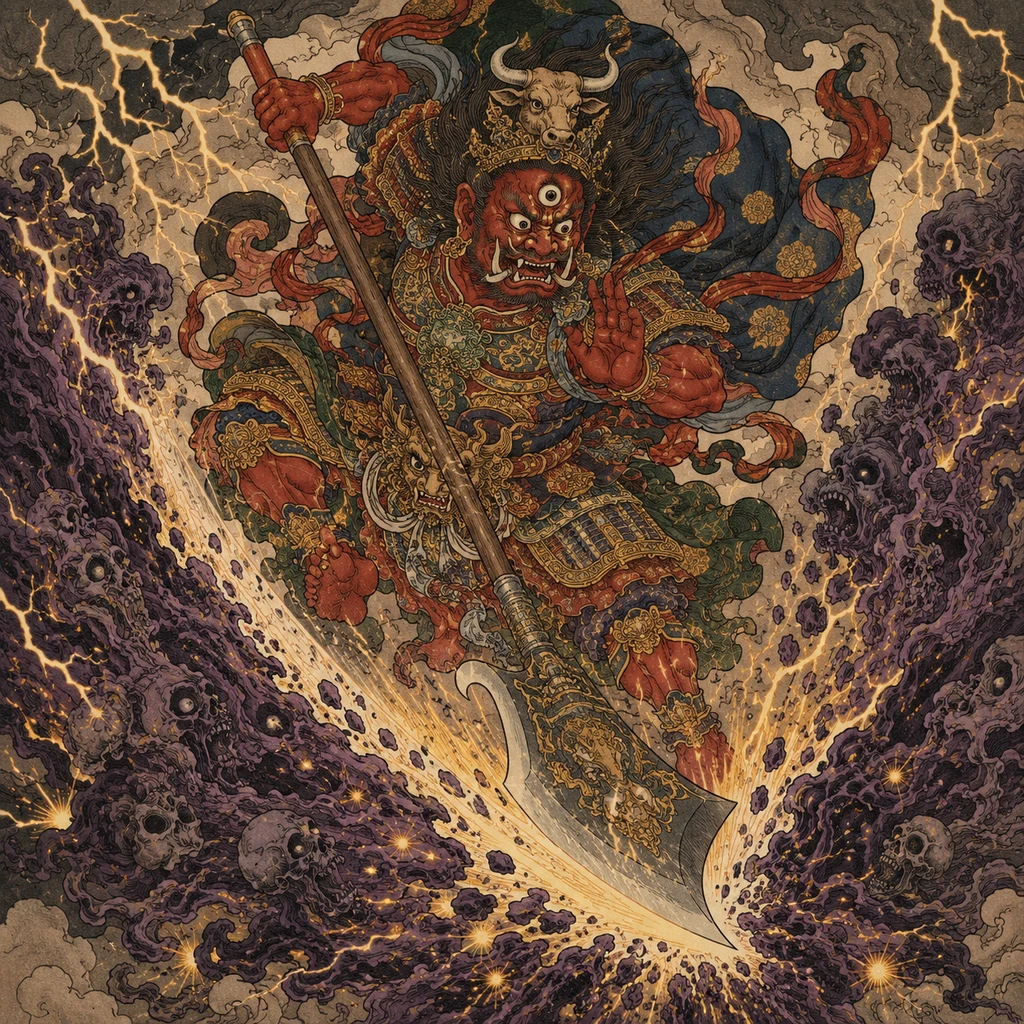
Gozu TennoGion's Supreme Plague-Dispelling Deity - Gozu Tenno
ごずてんのう
Detailed Description
Gozu Tenno (also known as Mutō-no-Kami) is a uniquely Japanese deity whose existence is unconfirmed in foreign lands like India, China, or Korea[1]. Several theories regarding his origin coexist and remain academically unconfirmed: 1) A Buddhist origin theory claiming he is the guardian deity of Jetavana (an ancient Indian monastery where Shakyamuni preached). The name 'Gozu' (ox head) is said to derive from Mount Gośīrṣa in Magadha, India, known for sandalwood, where a guardian named 'Gozu Tenno' was purportedly worshipped. 2) A Korean Peninsula origin theory attributing him to Mount Sudusan, introduced to Japan by ancient Korean immigrants (related to Mount Gozu where Dangun descended in Korean founding myth). 3) A syncretic theory suggesting he is an ancient Japanese immigrant/agricultural deity (the ox being a symbol of farming) reinterpreted through Buddhism and Taoism. Though conclusive evidence is lacking, immigrant influence and his later syncretism with Susanoo-no-Mikoto are the prevailing views from the Middle Ages onward.
The core narrative of his worship is the Somin Shōrai legend found in the 'Bingo-no-kuni Fudoki' (compiled in the early 8th century, now surviving only as fragments cited in the 'Shaku Nihongi')[2]. While traveling to the Southern Sea to marry the Dragon King's daughter, Mutō-no-Kami (= Gozu Tenno; 'Mutō' is also theorized to derive from the ancient Indian Maheśvara) sought lodging at the home of the brothers Kotan Shōrai and Somin Shōrai in Bingo Province (modern-day eastern Hiroshima). The wealthy elder brother, Kotan Shōrai, refused him, while the poor younger brother, Somin Shōrai, welcomed him with a humble meal of millet. Years later, Mutō-no-Kami returned with his eight divine children and told Somin Shōrai, 'Wear a woven reed ring (chinowa) around your waist and chant "I am a descendant of Somin Shōrai" to escape the plague,' before departing. The next day, Kotan Shōrai's entire family was wiped out by the plague, while Somin Shōrai's family survived thanks to the chinowa. This is the origin of the 'Amulet of Somin Shōrai's Descendants' (an amulet placed at doorways) and the 'Chinowa-kuguri' (a purification ritual held at the end of June), rituals still performed at Gion shrines, Tenno shrines, and Ise Jingu nationwide.
Kyoto's Yasaka Shrine (formerly Gion Shrine / Kanjin-in Gion Shrine / Gion Kanjin-in) is the hub of Gozu Tenno worship[3]. The shrine's history holds multiple theories: 1) Founded in 656 by the Korean envoy Irishi, who enshrined Susanoo from Mount Gozu (most plausible); 2) Enshrined by Ennyo, a monk from the southern capital, in 876; 3) The Imperial Court began praying at Gion during the great plague of 869 (the origin of the Gion Goryo-e). Ranked among the twenty-two elite shrines during the Heian period, the Gion Shrine became the most critical religious center for the Imperial Court, nobility, and Kyoto's citizens.
The Gion Festival was established in 869 as a ritual for Gozu Tenno (= Susanoo) to ward off plagues and is one of Japan's three major festivals (alongside the Aomori Nebuta and Awa Odori)[4]. When a massive plague swept Kyoto and the nation in 869, the Imperial Court ordered prayers at the Gion Shrine. They created 66 halberds (hoko) representing the 66 provinces of the time to gather the plague gods, then banished them to Shinsen-en (modern-day Nakagyo-ku, Kyoto) — an event known as the 'Gion Goryo-e.' It evolved through the medieval and early modern periods, establishing the Yamahoko float procession, folding screen displays, and Yoiyama eves during the Muromachi period. It is now a month-long summer hallmark of Kyoto and was registered as a UNESCO Intangible Cultural Heritage in 2009, representing the pinnacle of Kyoto's tourism resources.
Among other major centers of Gozu Tenno worship, Hiromine Shrine (Hiromineyama, Himeji City, Hyogo Prefecture; supposedly founded by imperial decree of Emperor Shomu in 733, with alleged involvement by Kibi no Makibi) claims to be the 'Head Shrine of Gozu Tenno,' asserting that Kyoto's Gion Shrine was established as a branch of Hiromine[5]. However, due to lengthy medieval and Edo-period disputes over hierarchy among Kyoto's Gion, Hiromine, Tsushima, and Yasaka, the academic consensus on the 'true head shrine' remains undetermined. Tsushima Shrine (Tsushima City, Aichi) serves as the core of Gozu Tenno worship in the Tokai region[6], with its Tenno Festival (August) being one of Japan's three major river festivals. The countless shrines nationwide bearing the names 'Tenno', 'Yakumo', 'Gion', 'Susanoo', or 'Hikawa' demonstrate the vast spread of Gozu Tenno worship.
With the Shinto-Buddhism Separation Order of the Meiji Restoration (1868) and the abolition of Shugendo (1872), the Buddhist title 'Gozu Tenno' was banned, and all Gozu Tenno, Tenno, Gion, and Kanjin-in shrines were forcibly renamed as shrines dedicated to Susanoo-no-Mikoto[7]. Kyoto's Gion Kanjin-in became 'Yasaka Shrine,' while local shrines were renamed to Yasaka, Susanoo, Hikawa, or Gion shrines. However, commoners retained colloquial names like 'Tenno-san' and 'Gion-san,' and folk customs such as passing through the chinowa, the Somin Shōrai amulets, and the Gion Festival persisted seamlessly. During the modern COVID-19 pandemic (2020-), the Gion Festival and chinowa rituals regained attention, reawakening memories of Gozu Tenno as the deity of plague dispellment. In folklore and religious history, he is positioned as 'the greatest victim of the Shinto-Buddhism separation.'
Source Information
種類全体の出典primary
祇園祭 (祇園御霊会·869 年起源)
著者: 朝廷·京都市民
年代: 869~
出版社: 神道·神社史·民俗·古典
種類全体の出典primary
牛頭天王·素戔嗚同一視 (中世~)
著者: 中世神道·神仏習合
年代: 平安後期~
出版社: 神道·神社史·民俗·古典
種類全体の出典primary
牛頭天王·日本独自尊格説
著者: 近世~現代宗教学·民俗学
年代: 現代
出版社: 神道·神社史·民俗·古典
種類全体の出典primary
廣峯神社·牛頭天王総本宮説
著者: 社伝·廣峯神社·吉備真備関与説
年代: 733 年伝創建
出版社: 神道·神社史·民俗·古典
種類全体の出典primary
明治神仏分離·牛頭天王禁止
著者: 明治政府·神祇官
年代: 1868~
出版社: 神道·神社史·民俗·古典
種類全体の出典primary
蘇民将来説話 (『備後国風土記』 逸文)
著者: 奈良期成立 (現·『釈日本紀』 所引逸文)
年代: 8 世紀初頭
出版社: 神道·神社史·民俗·古典
種類全体の出典primary
津島神社·東海牛頭天王中軸
著者: 社伝·津島神社
年代: 平安期~
出版社: 神道·神社史·民俗·古典
種類全体の出典primary
八坂神社 (祇園社·感神院) 創建縁起
著者: 社伝·『八坂神社縁起』
年代: 656·869
出版社: 神道·神社史·民俗·古典
Personality
Despite his intimidating, grotesque appearance (an ox head), he exhibits a dual nature of profound mercy and duty, as shown in the Somin Shōrai legend. He is fiercely loyal, protecting the descendants of anyone who has shown him kindness from plagues for all eternity.
Compatibility
Highly compatible with those praying for health, warding off sickness, and lovers of summer festivals. Best suited for families who practice the chinowa passing and hang the Somin Shōrai amulets.
Abilities & Skills
Weaknesses
Stripped of his name due to the Meiji Shinto-Buddhism separation; forcibly replaced by Susanoo-no-Mikoto in many Tenno shrines. If colloquial names like 'Tenno-san' or 'Gion-san' vanish, memories of his true deity status will fade.
診断評価
妖怪バウンダリー・タイプ指標
いたずら濃度
-2.0high: 戯 low: 護
📝 メモ
疫神の畏怖を持つが、蘇民将来の子孫を守り疫病退散を担う。
変化適応
2.0high: 化 low: 定
📝 メモ
牛頭天王、武塔神、素戔嗚への習合で神格が大きく変容する。
夜話度
0.0high: 夜 low: 昼
📝 メモ
夏疫や御霊会に関わるが、夜の出没神ではない。
情の深さ
2.0high: 縁 low: 境
📝 メモ
受けた恩を末代まで返す義理深さが説話の核にある。
結界強度
3.0high: 律 low: 流
📝 メモ
門符、茅の輪、天王社の祭祀で疫と家の境を強く守る。
表舞台圧
3.0high: 表 low: 影
📝 メモ
牛頭の疫神王として祇園社・天王社の中心に立つ大きな神格である。
妖怪相性診断
喜び
5.0喜びと楽しさの程度
📝 メモ
祭神として祇園祭などの華やかな祭祀で歓待される。
怒り
9.0怒りの激しさの程度
📝 メモ
宿を貸さなかった巨旦将来一族を皆殺しにする凄まじい怒りと苛烈さ。
慈悲深い
7.0慈悲深さの程度
📝 メモ
貧しい歓待に報いて一族を永遠に庇護する義理堅く深い慈悲。
憂鬱
3.0憂鬱で思慮深い程度
📝 メモ
激しく動的な神格であり、内向的な憂鬱さは薄い。
静寂
2.0内なる平静の程度
📝 メモ
疫病と荒ぶる神であり、常に動的で猛々しい。
いたずら好き
2.0いたずら好きで活発な程度
📝 メモ
強面の威圧感が先行し、悪戯好きの要素はない。
やさしい
5.0やさしく親しみやすい程度
📝 メモ
恩を受けた者には非常に優しく報いるが、敵対者には容赦がない二面性。
厳格
8.0厳格で真面目な程度
📝 メモ
恩義と冷酷さを峻別する、ある種の恐ろしいまでの厳格さを持つ。
守護的
10.0他者を守る傾向
📝 メモ
「蘇民将来の子孫なり」と唱える者を末代まで疫病から守護する絶大な加護。
神秘的
8.0神秘的で不思議な程度
📝 メモ
異国由来の得体の知れない強力な神霊としての神秘。
霊性の深さ
9.0精神的境界の深さ
📝 メモ
日本独自の疫病退散の最大神格としての巨大な信仰圏。
Similar Yokai
Yokai with similar personality and characteristics to Gion's Supreme Plague-Dispelling Deity - Gozu Tenno
Opposite Yokai
Yokai with opposite personality and characteristics to Gion's Supreme Plague-Dispelling Deity - Gozu Tenno
🔮Test your compatibility with Gozu Tenno now!
Analyze your personality and values to get a detailed compatibility rating with this yokai.
Free, simple, and results in just minutes.