Karakasa-kozou
KAH-rah-KAH-sah koh-ZOH
Karakasa-kozou, the Old Umbrella Hopping on Night Roads
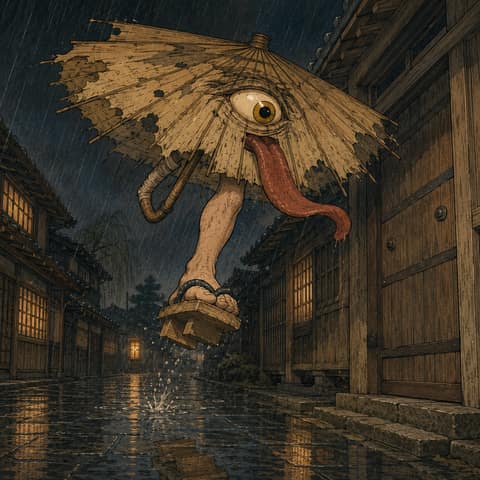
This is an interpretation of the one-eyed, one-legged paper umbrella monster, typified by post-Edo period kusazoushi (illustrated entertainment books) and performing arts. In this version, Karakasa-kozou is not a terrifying vengeful spirit that takes human lives, but exhibits an extremely comical and mischievous nature, lurking in the dark to surprise passersby and enjoying their reactions. Although its iconographic roots trace back to the Muromachi period's *Hyakki Yagyo Emaki*, the widely recognized form of "the umbrella handle becoming one leg, with a single eye and long tongue sticking out from the umbrella's fabric" is the result of repetitive production in late Edo "monster playing cards," sideshows, and kabuki trick props. Lined up with visually impactful yokai like the Rokurokubi and Mitsume-kozou, it became a staple star of "toy prints" for children due to the amusement of its design. It appears in alleyways and under eaves at night, hopping on one leg while rustling its frame, causing visual and onomatopoeic strange phenomena, such as licking human faces with its long tongue, but it causes no essential harm. Because it lacks region-specific legends, its haunts and activities are freely adapted depending on the medium, which ironically made it easy to adapt to modern movies and animation. In a sense, it is the ultimate form of Edo townspeople culture completely deodorizing the primal fear of "tsukumogami"—the idea that old objects possess souls—into a "character (toy)" and sublimating it into entertainment.