Yamata no Orochi
Yamata no Orochi
Serpent God of Izumo's Hii River: Yamata no Orochi
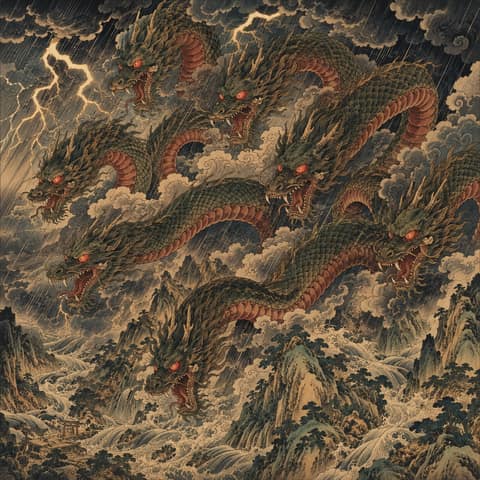
Orochi is more than a snake. The old word orochi is often explained as combining a term for peak or ridge with chi, a word for spirit-power. The Kojiki describes moss, cypress, and cedar growing on the serpent and a body spanning eight valleys and eight ridges. That is closer to a living mountain range than to an animal. Other Japanese serpent-slaying tales, from Koga Saburo at Suwa to the Yahiko serpent of Echigo and the Aso traditions around Takeiwatatsu, can be read in the same serpent-deity line. The Kojiki's account of Omononushi in the reign of Sujin, where a god appears as a snake, forms another great pole of ancient Japanese serpent worship. Sand iron and the bloody riverbed. Oku-Izumo was a center of sand iron and tatara smelting. Kanna-nagashi washed mountain soil through channels, separating sand iron and staining riverbeds with red earth and iron. The Kojiki's image of Orochi's belly as always bloody and raw can therefore be read as the mythic language of a red river. Furnace fire, the relative independence of ironworking groups, and the seizure of good blades by central power all make the ironmaking reading persuasive. Mizu no Bunka issue 54 presents this as one of the key local theories. The repeated eight. Yamata, eight heads and eight tails, eight valleys and eight ridges, yashiori sake, eight vats, and the "Yakumo tatsu" poem all make eight the story's organizing number. It may mean literal eight, sacred multiplicity, or both. The eightfold fence around Kushinada-hime gives the number a ritual and spatial force. Even the placement of the tale in book one, section eight of the Nihon Shoki has invited speculation, though that remains an inference about editorial intent. Izumo drawn into Yamato myth. Orochi's defeat can also be read politically. A serpent deity of Izumo is slain by Susanoo from the Takamagahara sphere, and the treasure inside its tail enters the imperial regalia. The later kuni-yuzuri myth of Okuninushi follows the same broad problem: how Izumo is brought into the central mythic order. The Izumo no Kuni no Miyatsuko lineage claims descent in the Susanoo line while serving Okuninushi's cult, so the story survives both as a myth of conquest and as Izumo's own ritual memory. Iwami Kagura keeps the serpent moving. Iwami Kagura's Orochi turns the ancient myth into a present-day bodily performance. Paper-and-bamboo serpent bodies coil and strike across the stage, and several serpents may fight at once. Once an offering at shrine festivals, the performance also became a postwar attraction and regional symbol. What the audience sees is not an abstract myth, but the way Izumo and Iwami continue to tell the serpent story through movement, sound, and spectacle.