YOKAI.JP
Summer Kaidan
Yokai Cards

151 cards

Summer Kaidan

A Bon Night with Yokai

Contemporary Japanese matsuri photography in the lineage of Mika Ninagawa, Rinko Kawauchi, and Kishin Shinoyama. Cinestill 800T tungsten warmth, paper lanterns aglow, the western sky still tinged blue. Yatai smoke, indigo yukata, vermilion goldfish — yokai standing among the lively crowd at the same temperature as the humans around them.

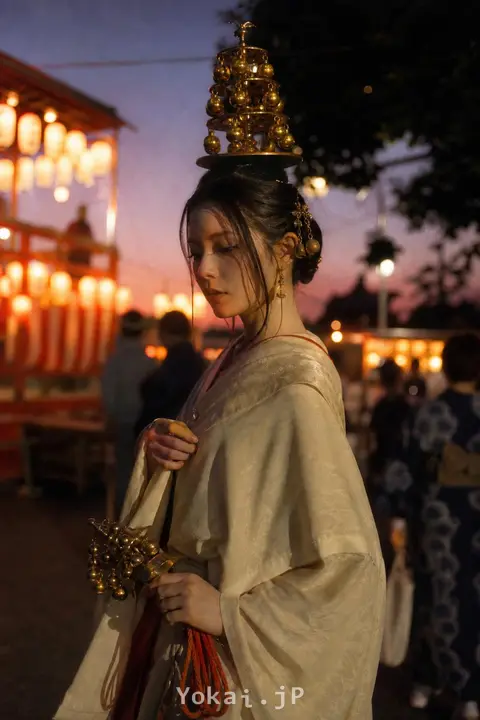
Suzuhiko-hime — Summer Kaidan

Suzuhiko-himeSuzuhiko-hime

White-Clad, Crowned with Kagura Bells

In the lantern-blurred shrine grounds, a woman in white wears golden kagura bells above her head and carries more bells in her hand. Against her lowered eyes and the dusk, only the metal fittings shine clear. Suzuhiko-hime is a yokai preserved in Sekien’s illustration, a woman crowned with kagura bells. Bells are said to summon the gods, but in this stillness, even the ones being called would hold their breath.

View card
Ao-andon — Summer Kaidan

Ao-andonAo-andon

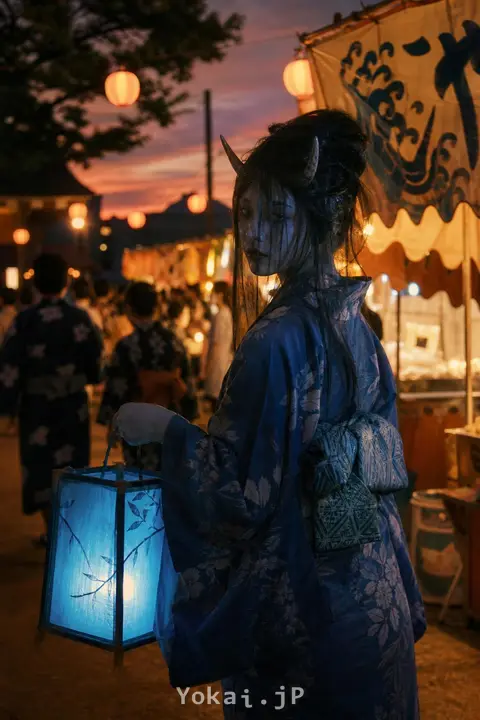
The Horned Woman with the Blue Andon

Beside a stall curtain, a horned woman turns back with a blue andon lamp in her hand. Her yukata and face have sunk into pale blue; only the lanterns around her seem to hold any heat. Ao Andon is the apparition said to appear at the end of a hundred ghost stories, named for the andon lamp covered in blue paper. Whether the tales have truly reached one hundred, no one is eager to check.

View card
Biwa Bokuboku — Summer Kaidan

Biwa BokubokuBEE-wah BOH-koo-BOH-koo

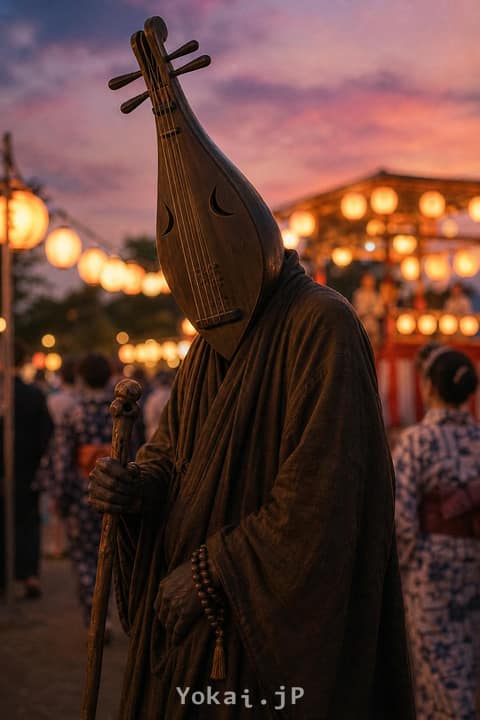
Biwa-Head on Lantern Street

On a street strung with lanterns, a monk-like figure with a biwa for a head grips a staff. His brown robe, the prayer beads at his wrist, and the lights of the tower behind him pick out the old grain of the wood. Biwa Bokuboku is a tsukumogami: a biwa inhabited by a spirit, taking the form of a blind minstrel-priest. Still carrying its attachment to a famed instrument, it stands mute amid the human bustle.

View card
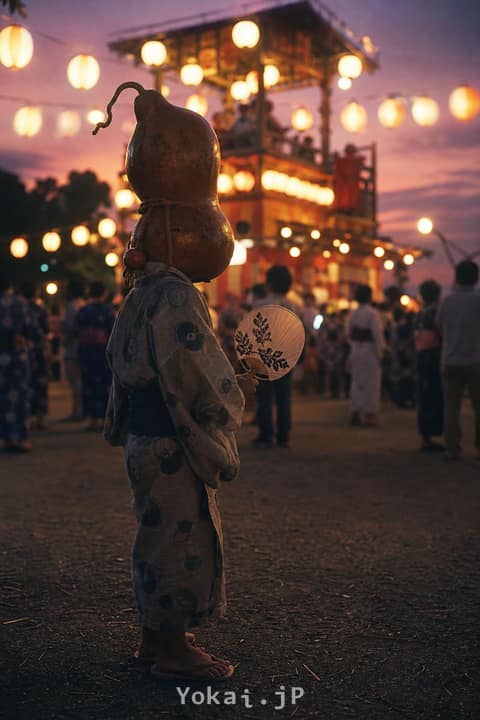
Hyōtan Kozō (Gourd Boy) — Summer Kaidan

Hyōtan Kozō (Gourd Boy)HYOH-tahn koh-ZOH

The Gourd-Headed Boy Looks Up

In front of the evening dance tower, a gourd-headed boy stands holding a fan. His yukataed back is small, and the round glow of the lanterns overlaps the curve of his head. Hyōtan Kozō is thought to be a tsukumogami, a spirit settled into a long-used gourd. Apparently he does nothing beyond startling people, but his back looks oddly proud of itself.

View card
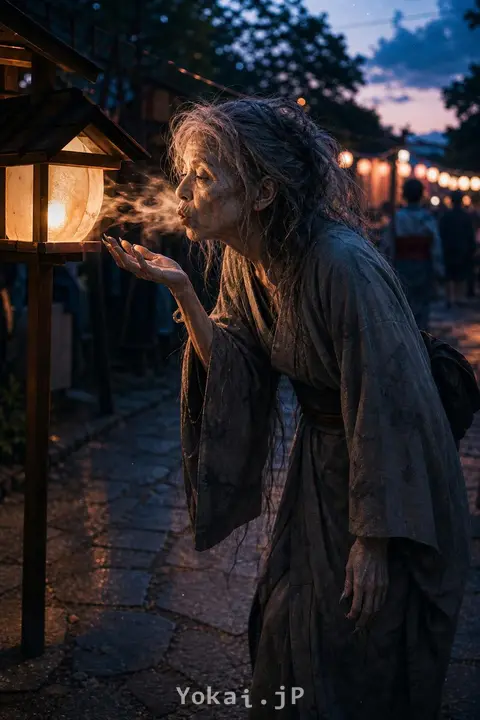
Fire-Quenching Crone — Summer Kaidan

Fire-Quenching Cronehee-KEH-shee-bah-bah

The Old Woman Breathing at the Lantern

At a lantern along the shrine approach, an old woman with wild hair puckers her cheeks and leans in with her breath. She lifts one palm like a saucer; deep beyond the wet paving stones, paper lanterns stand in a row. Hikeshi Baba is an old woman who snuffs out the flames of paper lanterns, andon lamps, and candles with a breath from afar. Let just one light drop out of the festivities, and the night road suddenly belongs to this side.

View card
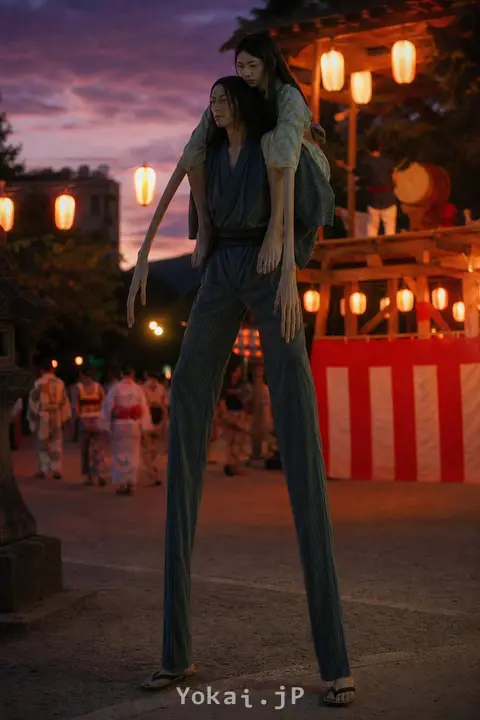
Ashinaga Tenaga (Long-Legs and Long-Arms) — Summer Kaidan

Ashinaga Tenaga (Long-Legs and Long-Arms)ah-shee-NAH-gah teh-NAH-gah

Ashinaga-Tenaga at the Bon Dance Tower

Before the lanterns of the dance tower, a man with unnaturally long legs carries a woman on his back, her arms hanging below his knees. Against the violet evening sky, their silence floats high above the ground. Ashinaga-Tenaga is a tale of strange people: the long-legged one carries the long-armed one, and together they take prey in the shallows. Even on festival sand, the division of labor is perfectly clear.

View card
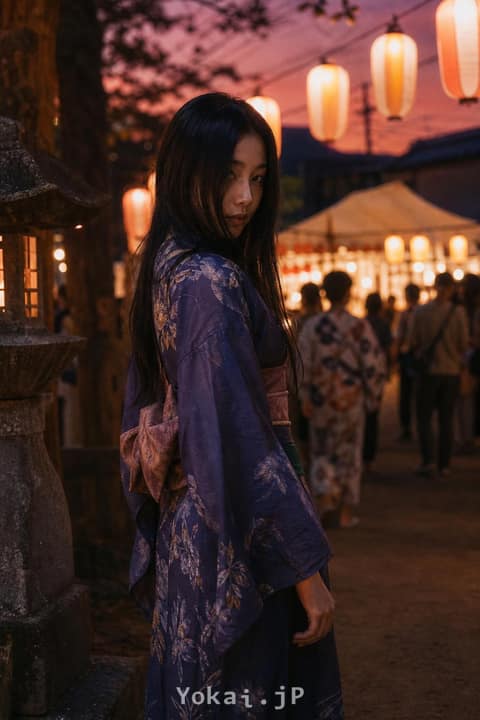
The Woman of Ikebukuro — Summer Kaidan

The Woman of Ikebukuroee-keh-BOO-kroh no OHN-nah

Ikebukuro’s Gaze by the Stone Lantern

Beside the stone lantern, a woman in a purple yukata turns back against the passing crowd. Lantern orange and sunset sink into her hair; only the brightness of the food stalls keeps up its distant noise. The Woman of Ikebukuro was said, when hired into another household, to bring strange sounds, thrown stones, and disordered bowls and andon lamps. The face on which nothing is happening is the one you remember later.

View card
Tsurube-bi (Bucket Fire) — Summer Kaidan

Tsurube-bi (Bucket Fire)TSOO-roo-beh-bee

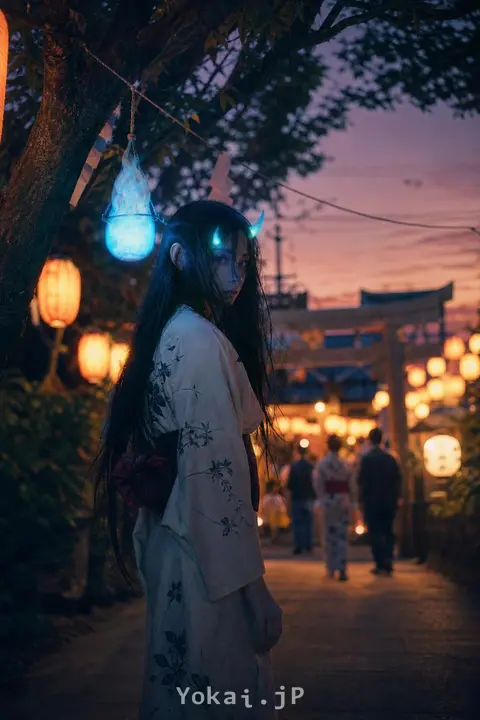
Blue Fire Hanging from the Branches

From a thick tree branch, a pouch of blue-white fire hangs as if lowered on a rope. A woman in a white yukata turns back with long hair that looks wet, while the small blue light on her forehead meets the orange of the paper lanterns. Tsurube-bi is a ghostly fire said to rise and fall from trees over night roads like a well bucket, and it is also said not to burn anything. Even knowing it is harmless, a light that keeps swaying overhead makes the feet hurry.

View card
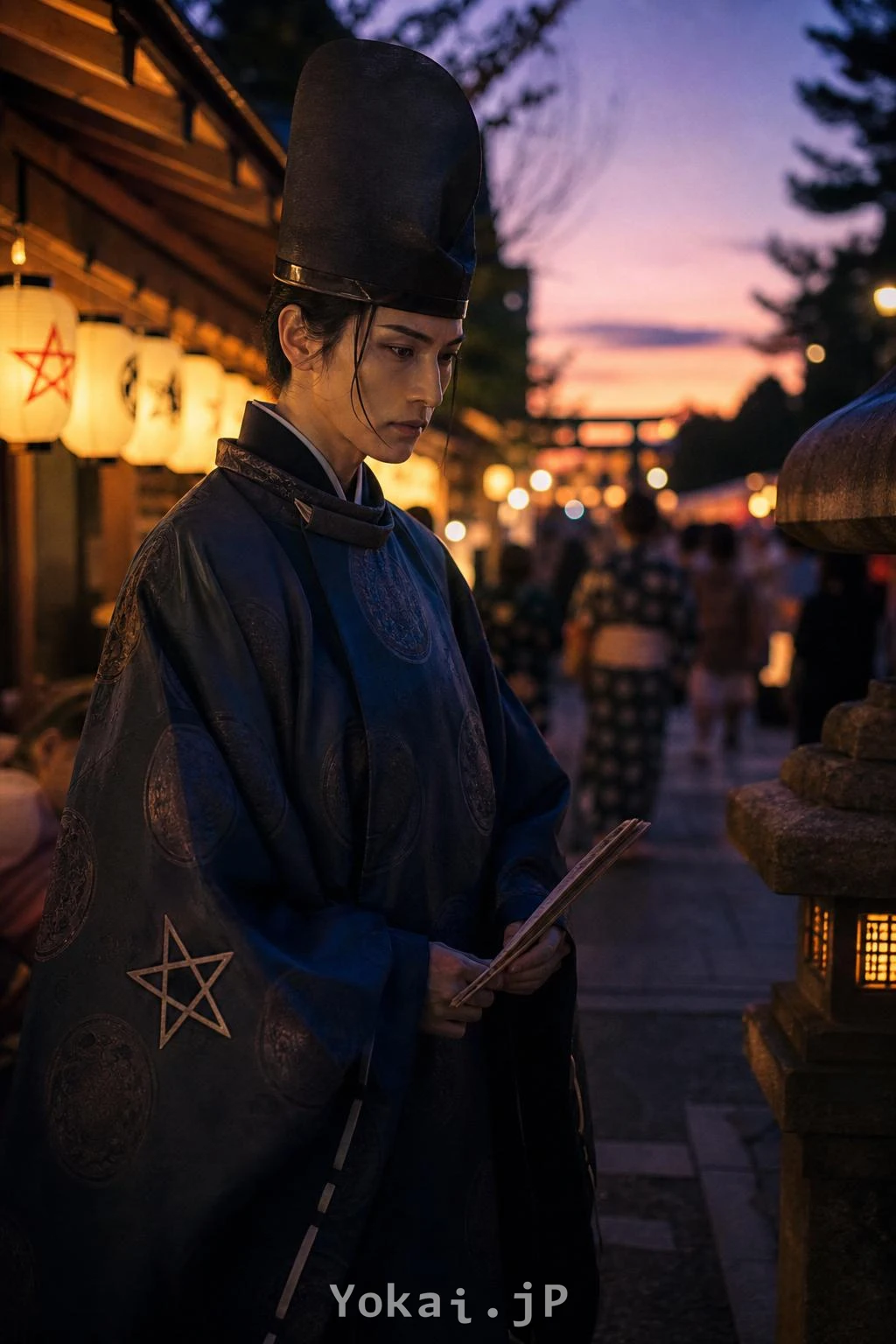
Abe no Seimei — Summer Kaidan

Abe no SeimeiAH-beh noh SAY-may

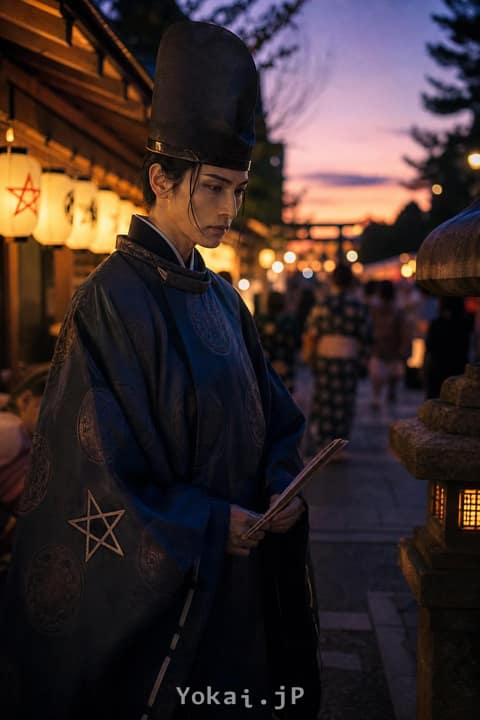
The Onmyoji Beneath Star Lanterns

Before a shrine lined with star-marked lanterns, a man in an eboshi wears blue robes and holds a slender talisman. He lets the small flame of a stone lantern fall across his profile, standing half a step outside the noise. Abe no Seimei is recorded as a court onmyoji trained in astronomy, calendars, and divination. Later generations layered on tales of his shikigami, and even this stillness looks like the interval in which something is being sealed.

View card
Meat-Sucker — Summer Kaidan

Meat-SuckerNEE-koo-soo-ee

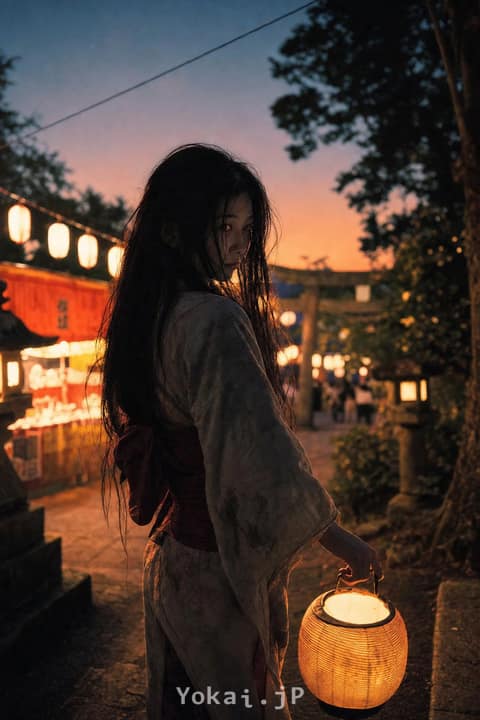
The Eyes of the Woman Asking for Fire

Beside stone steps where the red glow of the stalls recedes, a disheveled woman holds a lantern low and looks this way. Only the hem and sleeve of her white yukata float faintly in the round light at her hand. Niku-sui, told of in Kumano, is said to take the form of a young woman and approach night travelers asking, “Lend me a light.” The darkness beyond the stolen lantern has already begun at the edge of the photograph.

View card
Tengu — Summer Kaidan

TenguTengu

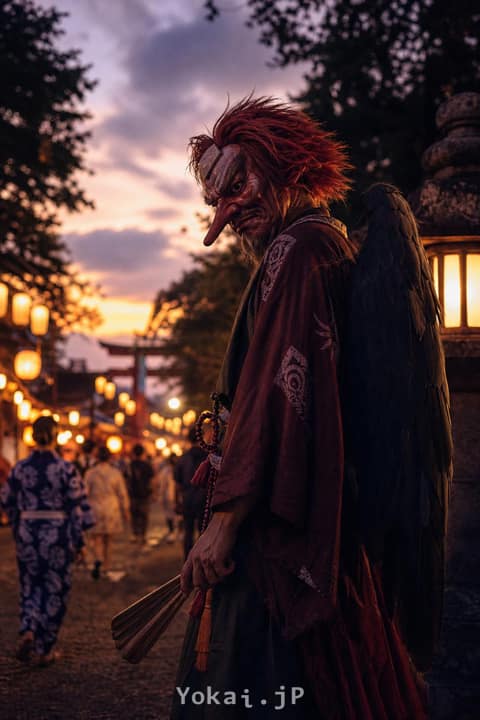
The Great Tengu Measures the Approach

Backlit by the glow of stone lanterns, a large figure in red robes looks back down the approach, a fan hanging from his hand. The long nose, bristling hair, and black wings silently measure the lines of yukata-clad visitors passing by. Tengu are bound to mountains and Shugendo, testing people with martial skill and spiritual power, at times guiding them and at times leading them astray. If this is the great tengu bearing Atago’s name, even the festival’s high spirits will not go unnoticed.

View card
Heiroku — Summer Kaidan

HeirokuHAY-roh-koo

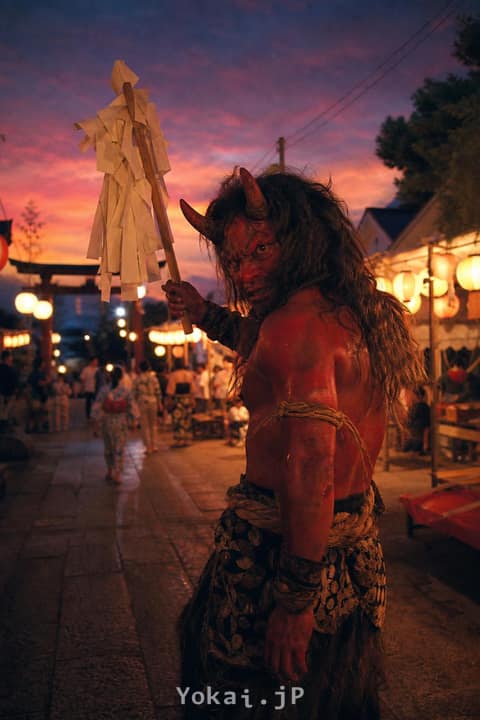
A Red Oni Raising the Shide

On the stone-paved approach, a red-skinned oni bares its upper body and turns back, lifting high a gohei wand with white shide paper streamers. Stall lights and sunset dye the wet shoulders and horns the same vermilion. Heiroku appears in Sekien’s Hyakki Tsurezure Bukuro as a raging oni holding a gohei. As if carrying the disorder of a festival tied to no fixed shrine, only the center of the commotion flares with heat for an instant.

View card
Hiyori-bō (Fair-Weather Monk) — Summer Kaidan

Hiyori-bō (Fair-Weather Monk)hee-YOH-ree-boh

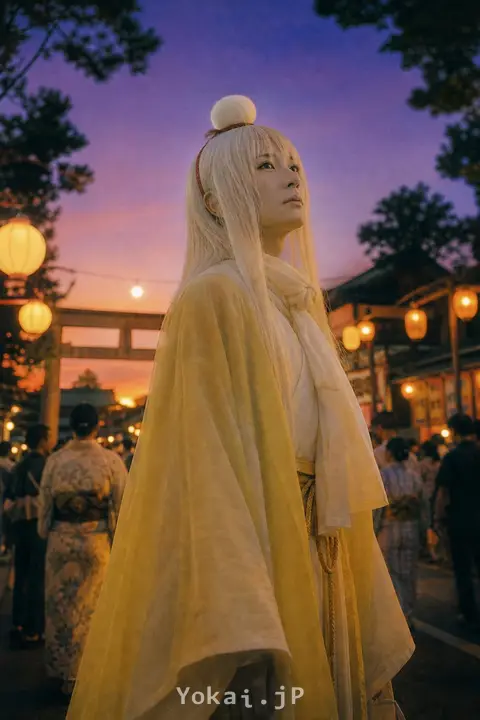
The White Orb Carrying Fair Weather

Between the crowd before the torii and the round paper lanterns, a white-haired figure stands in layered pale-yellow robes. The white round ornament overhead brightens the lingering evening sky by a single point. Hiyori-bo, Sekien wrote, appears on sunny days and shows itself on rainy days not at all. If the festival night has stayed this dry and clear, perhaps someone has quietly taken charge of the sky.

View card
Kappa — Summer Kaidan

KappaKAH-pah

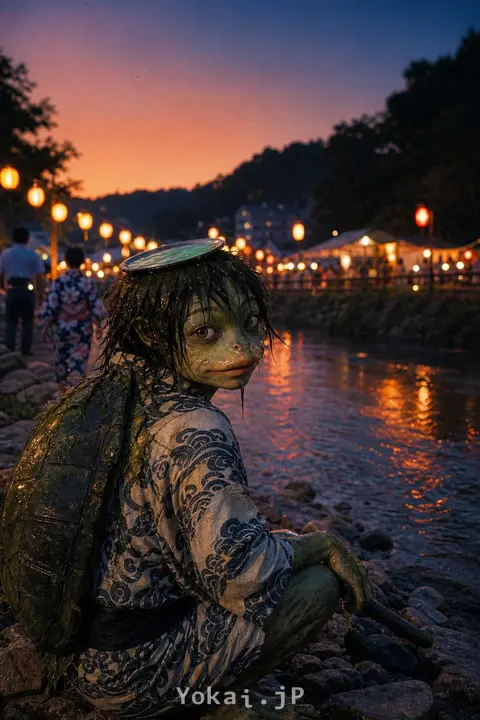
Plate-Head Wet in the Riverlight

At dusk, with the orange of lanterns trembling on the river, a small shadow crouches on the stony bank. Wet hair, the shell on its back, and even the dish on its head are slick with water as it glances back just a little. Kappa are said to live in rivers and marshes, losing their strength when the water in the dish on their heads dries up. They love mischief and sumo, but if those eyes invite you at the water’s edge, you may want to remember the rules.

View card
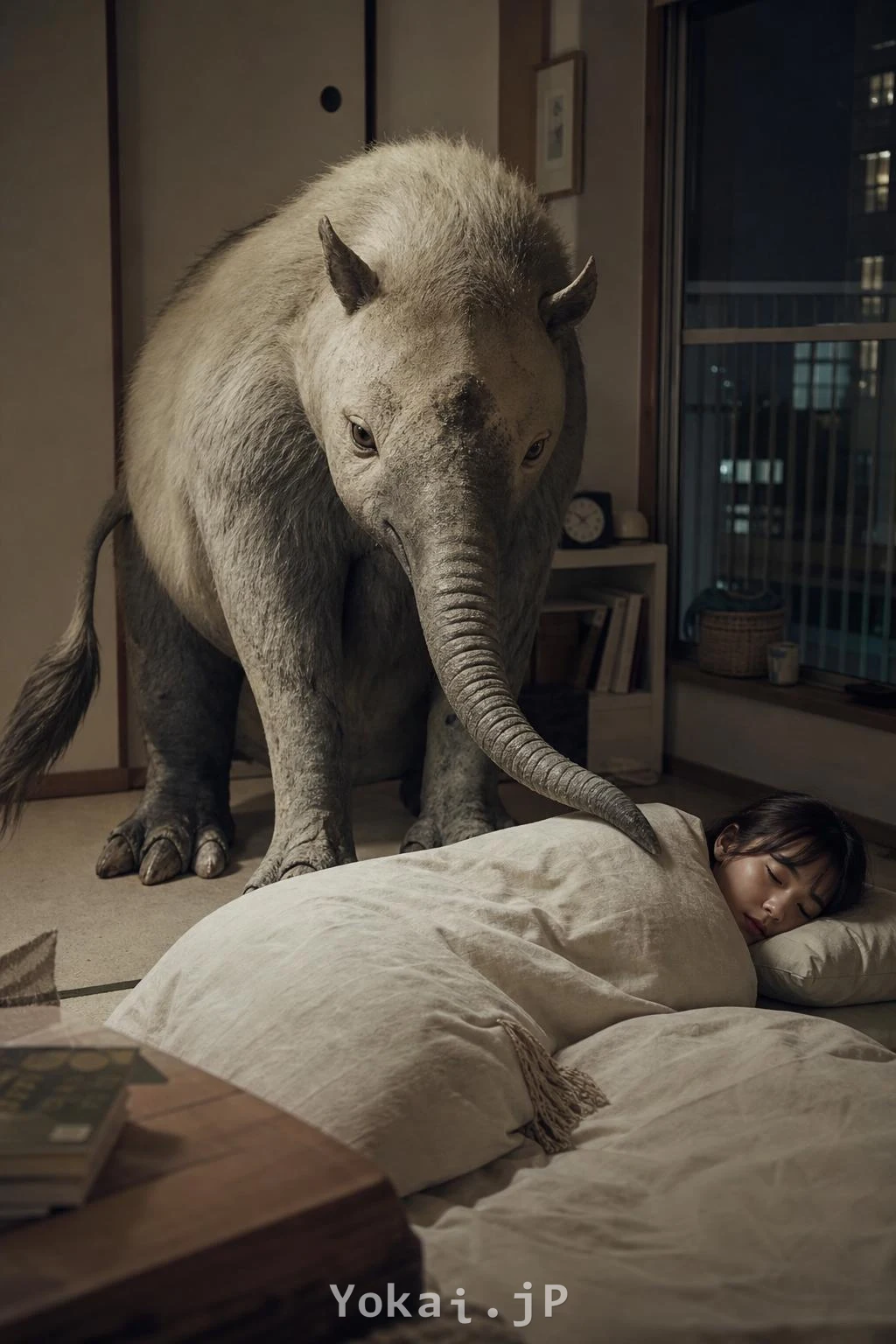
Rokurokubi — Summer Kaidan

RokurokubiRokurokubi

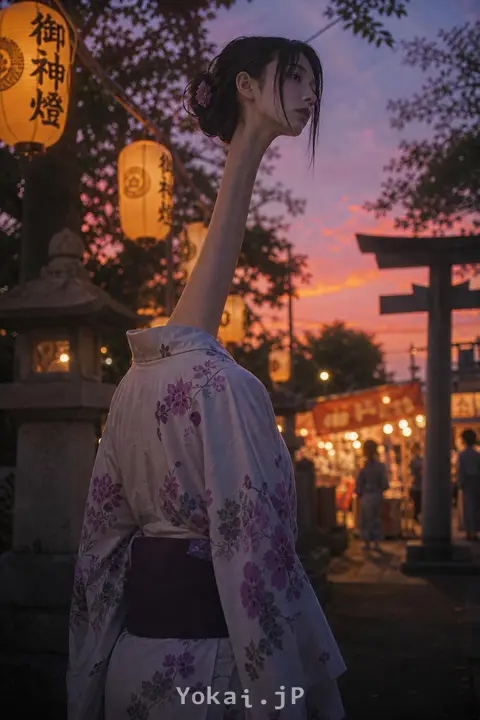
The Long Neck Beneath the Shrine Lanterns

On an approach where shrine lanterns and the torii’s shadow sink into dusk, a woman in a floral yukata turns her back. Only the neck, extending smoothly from her shoulder, rises beyond the stall lights to show her profile. Rokurokubi are uncanny beings said to pass as human by day, their necks stretching as sleep comes on. The long silence before she returns to the festival’s clamor is what feels most human.

View card
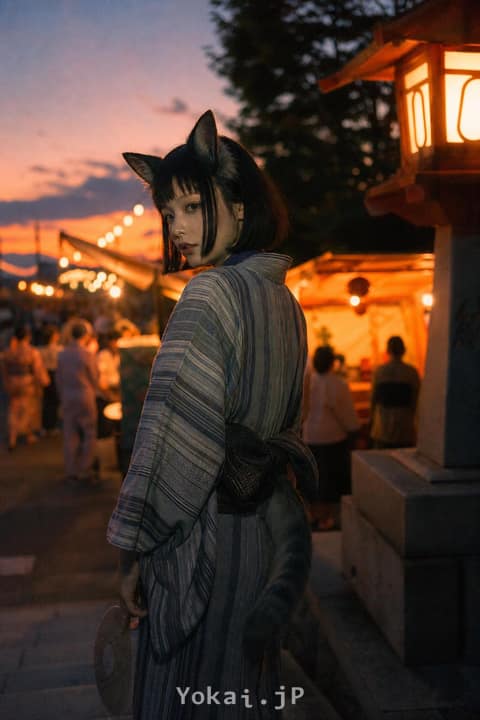
Cat Maiden — Summer Kaidan

Cat MaidenNEH-koh-moo-SOO-meh

The Cat’s Side-Eye Under the Lantern

Under the lantern light, a girl in a striped yukata turns back over her shoulder. Black cat ears stand against the evening sky, a fan in her hand, while the food stalls behind her dissolve into orange. Neko-musume was a name attached in Edo-period sideshows and tales of eccentrics to women who behaved in catlike ways. At the border between friendliness and caution, only the gaze slips away first.

View card
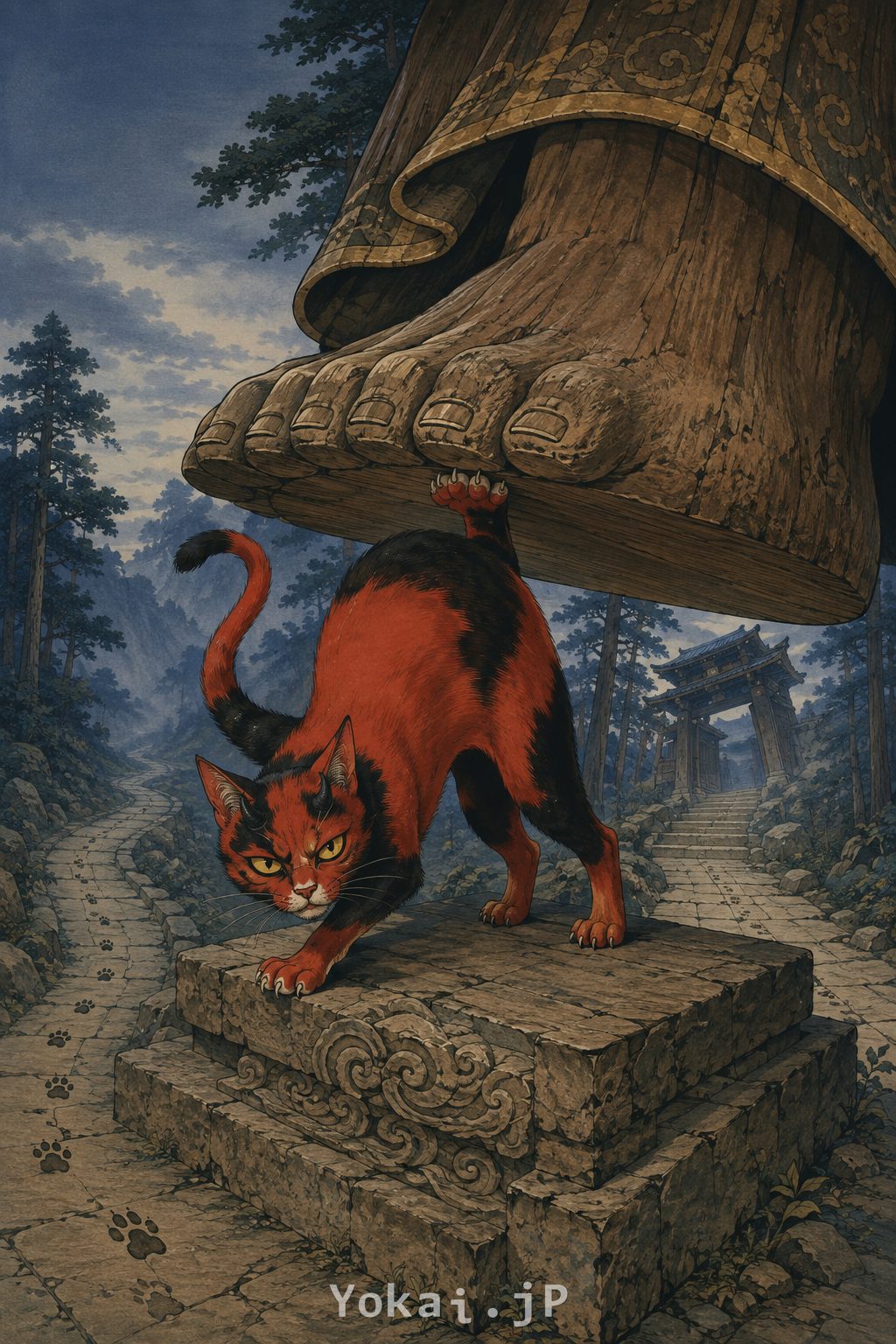
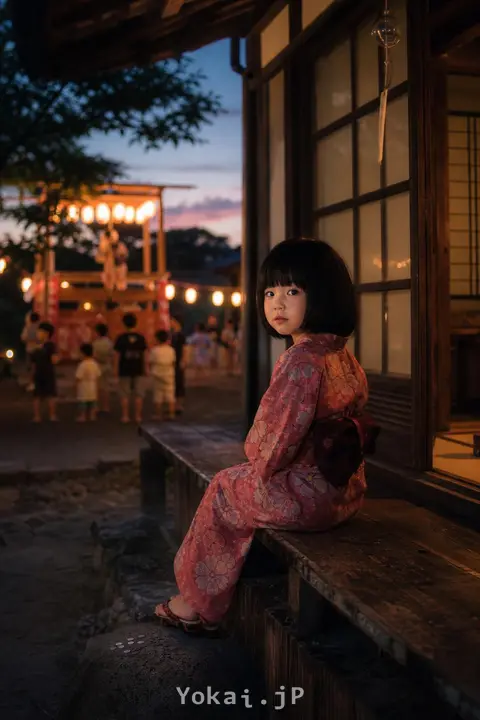
Zashiki-warashi — Summer Kaidan

Zashiki-warashizashiki-warashi

The Child Turning on a Summer Veranda

On the veranda of an old house, a child in a pink yukata sits and turns back. The room beyond the shoji glows bright, while past the wind chime under the eaves, the festival tower and lanterns blur softly. Zashiki-warashi are guardian children said to live in houses in Tohoku, bringing prosperity to the homes where they are seen. More than the bustle outside, what matters is whether this one will remain in the room.

View card
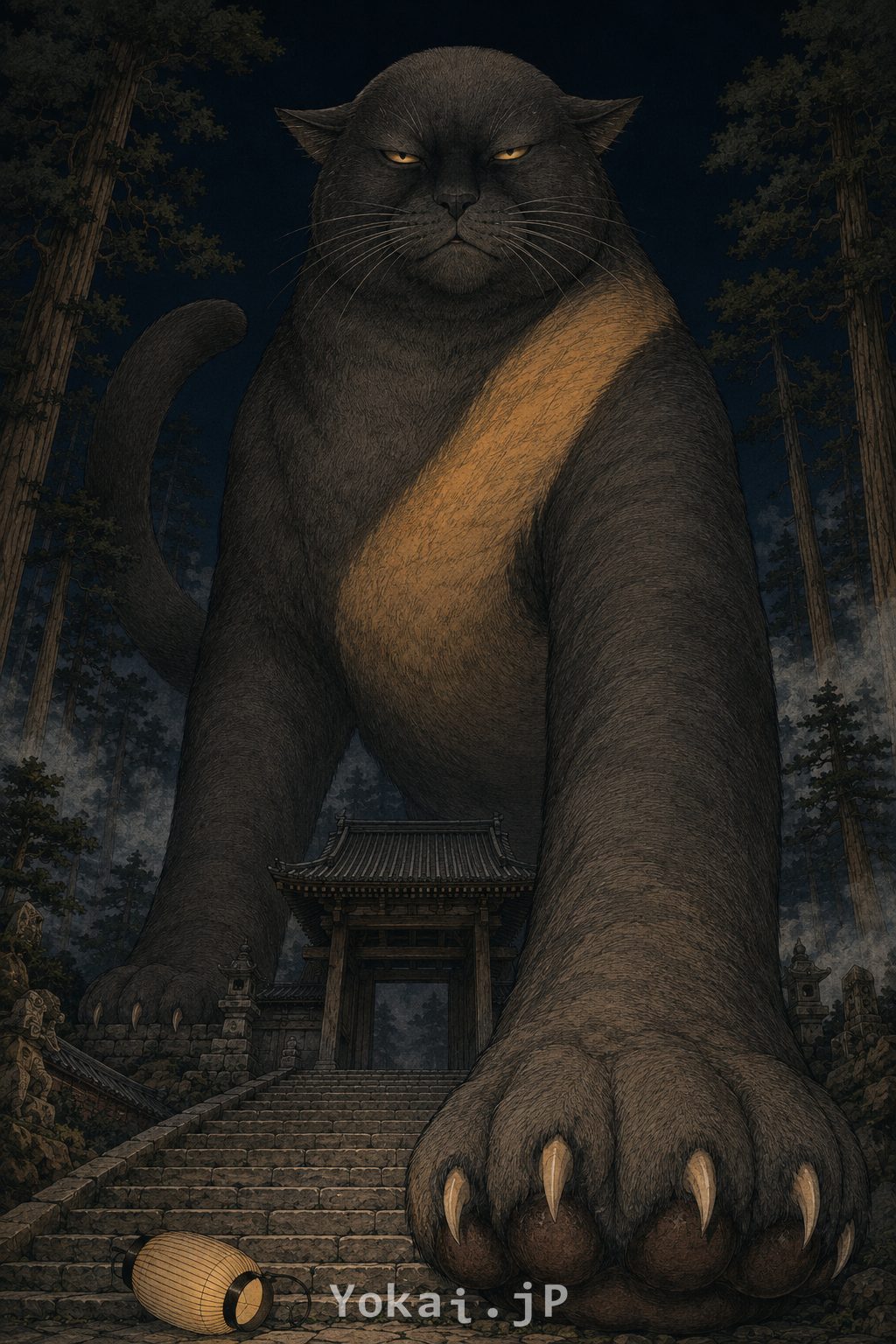
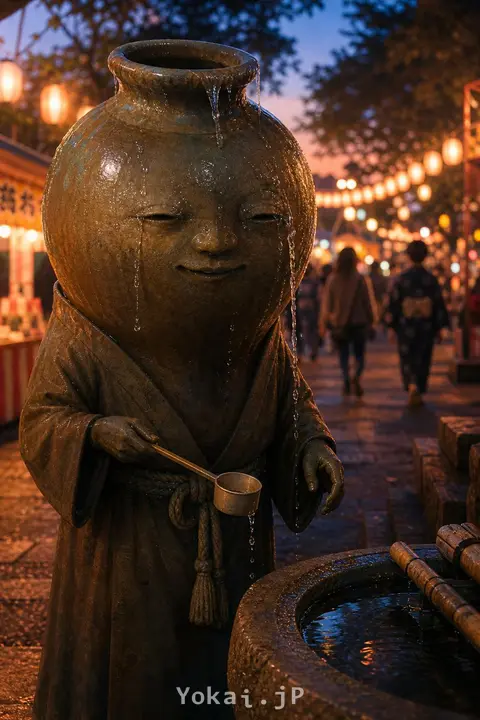
Kameosa — Summer Kaidan

KameosaKAH-meh-OH-sah

The Festival Jar That Never Runs Dry

Beside the purification basin, the face of a round great jar narrows its eyes. Water keeps spilling over the rim, and a small dipper hangs from the hand of a wet sleeve. Kame-osa is the auspicious jar drawn by Toriyama Sekien, whose water never runs out no matter how much is drawn. If that water sound never stops on a festival night, it feels as though a little good fortune might be shared.

View card
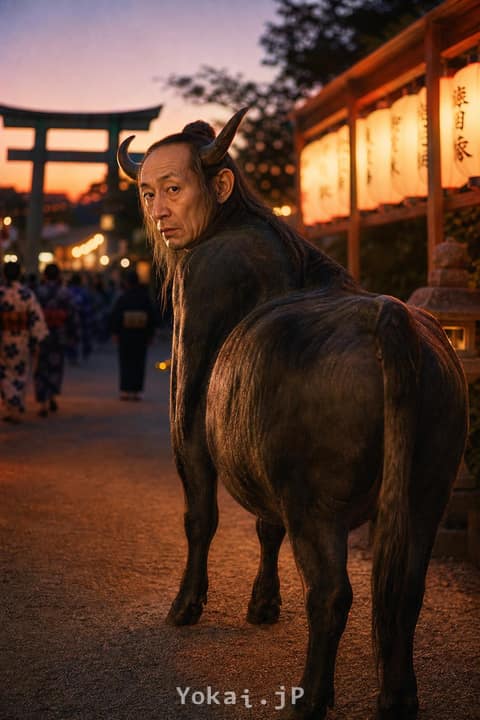
Kudan (Prophetic Human-Cow Yokai) — Summer Kaidan

Kudan (Prophetic Human-Cow Yokai)koo-DAHN

A Prophetic Bull-Shadow at the Evening Torii

On the approach to the torii, a man with the body of a cow looks back over his shoulder. A stone lantern and votive paper lanterns at his side wash the black back and two horns in orange light. The kudan is a prophetic beast said to appear with a human face and a bovine body, foretelling abundance, dearth, and what lies ahead for the world. It speaks only as much as it needs to, and its form, they say, never remains for long.

View card
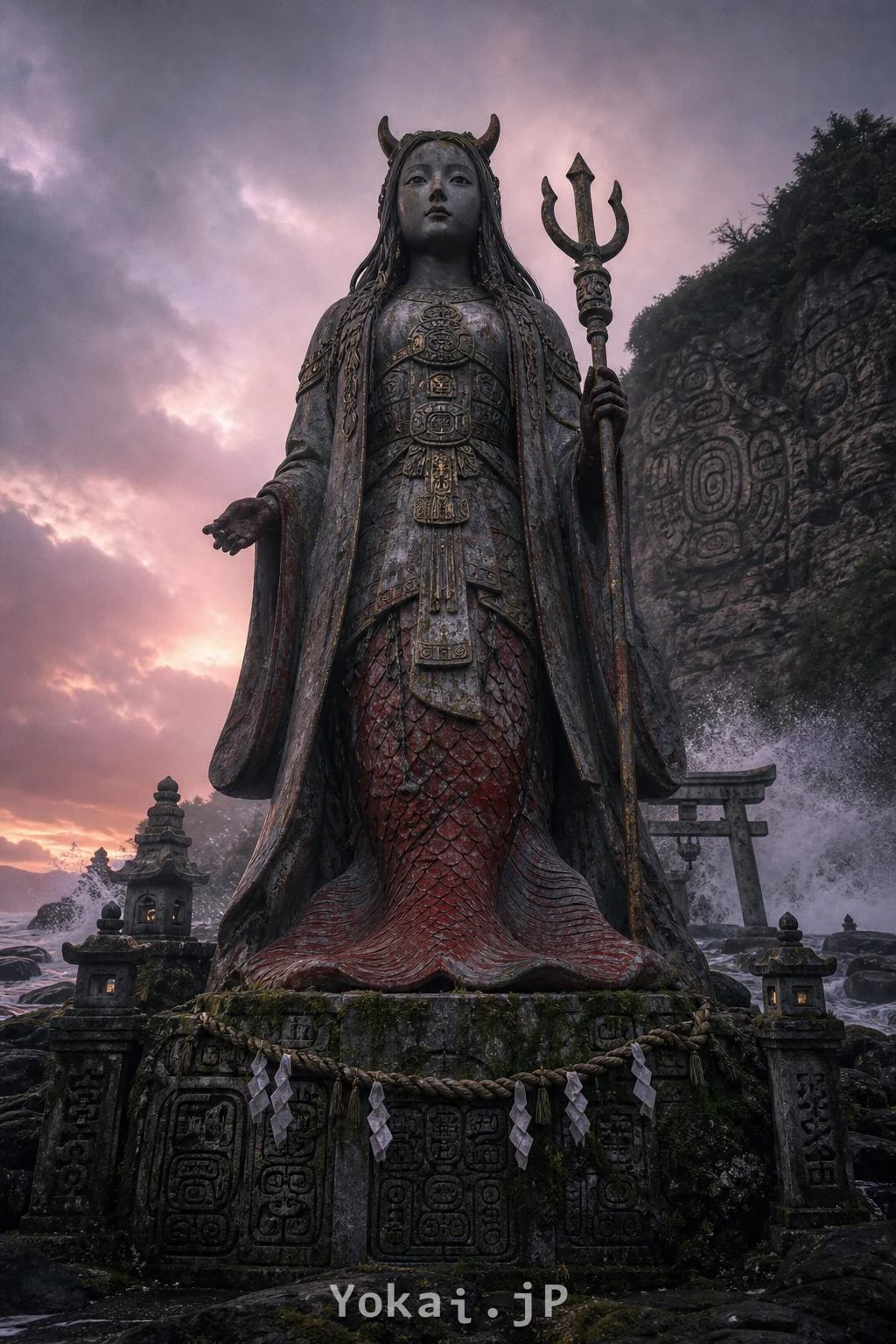
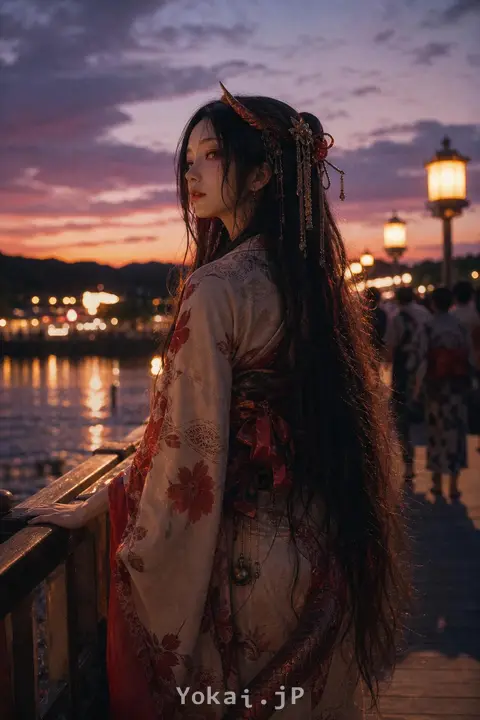
Hashihime (Bridge Princess) — Summer Kaidan

Hashihime (Bridge Princess)HAH-shee-HEE-meh

Jealousy Lingering on the Evening Bridge

With one hand on the railing of a riverside bridge, a woman in a floral yukata looks back into the dusk. A single horn glints beyond her hair ornament, and festival lights tremble on the river’s surface. Hashihime is both the guardian enshrined at old great bridges and a name that, through jealousy, can become an oni. Any praise for another bridge is better left to sink quietly inside the chest.

View card
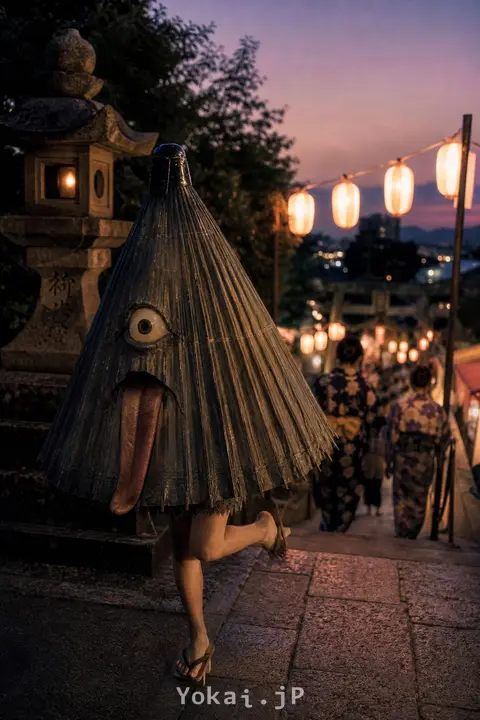
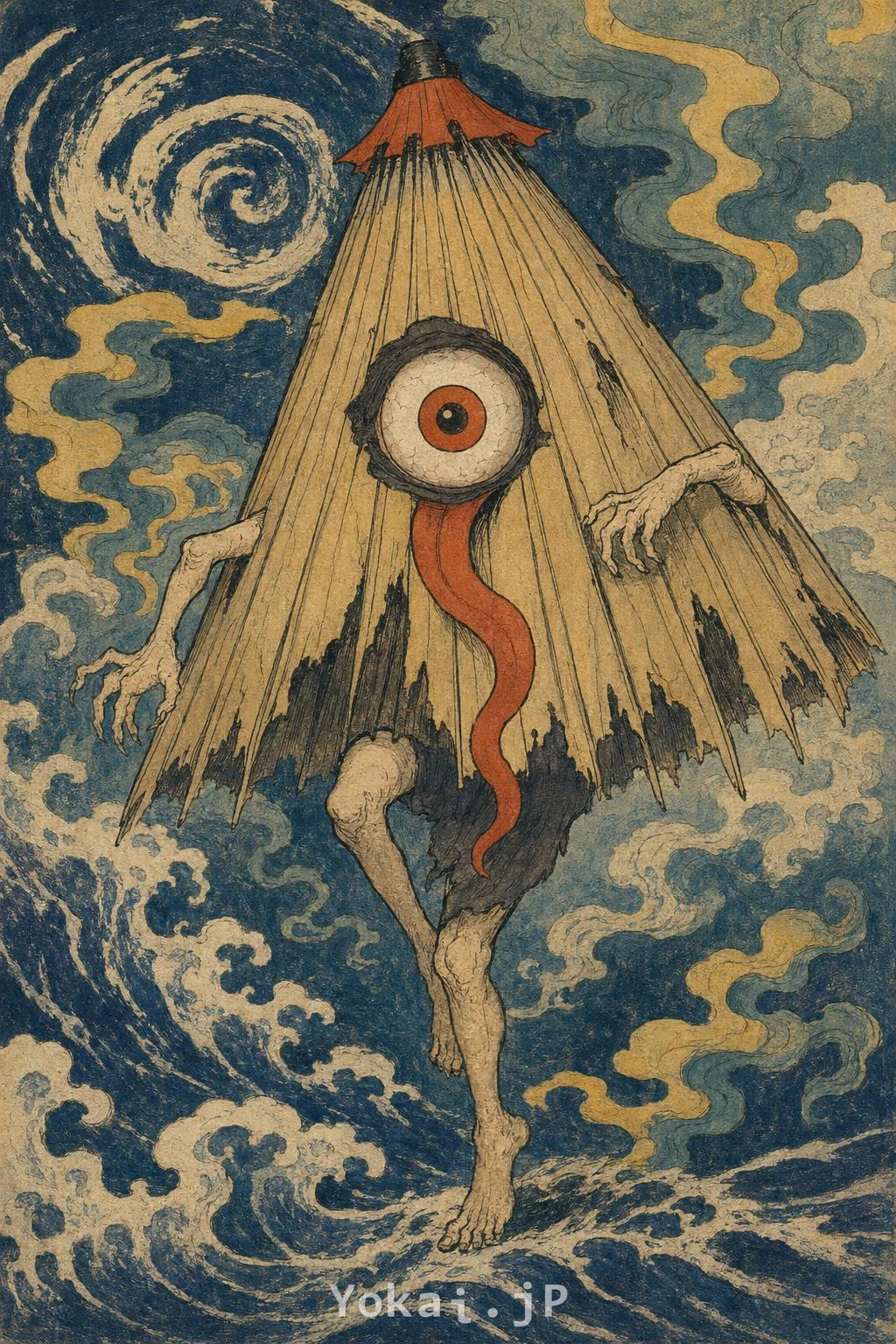
Karakasa-kozou — Summer Kaidan

Karakasa-kozouKAH-rah-KAH-sah koh-ZOH

A One-Eyed Umbrella at Dusk

Beside a stone lantern, on a lantern-lined slope, the canopy of an old wagasa turns toward us. A long tongue peeks out below its single eye, and one geta-clad foot floats in the air. Karakasa-kozō is the familiar tsukumogami of an old umbrella, beloved in picture scrolls and ukiyo-e. Rather than snatching people up to eat them, he gives the heart on the walk home one sharp leap.

View card
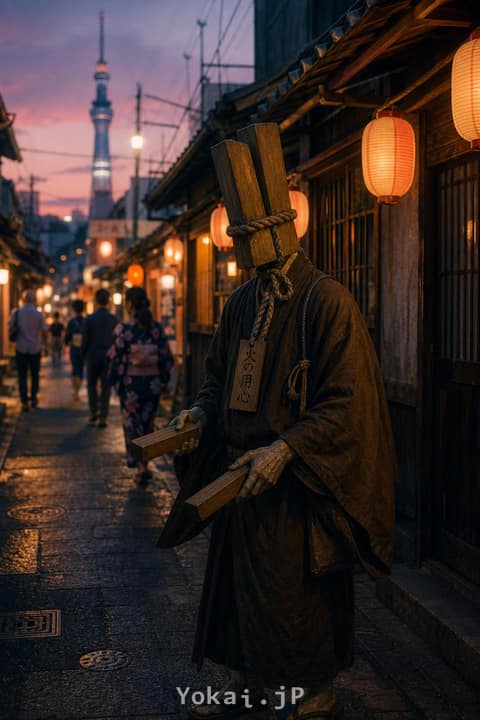
Accompanying Hyōshigi — Summer Kaidan

Accompanying Hyōshigioh-KOO-ree hyoh-SHEE-ghee

Clappers in the Rain-Cleared Alley

Lanterns line a wet stone-paved alley, and a distant tower fades into mist. A night watchman stands with wooden hyōshigi clappers tied like a face, a “Hi no yōjin” fire-watch placard on his chest. In the Seven Wonders of Honjo, after the clappers finish their beat, an unseen sound sends the rhythm on from behind. In a town still damp with rain, it is hard to laugh it off as an echo.

View card
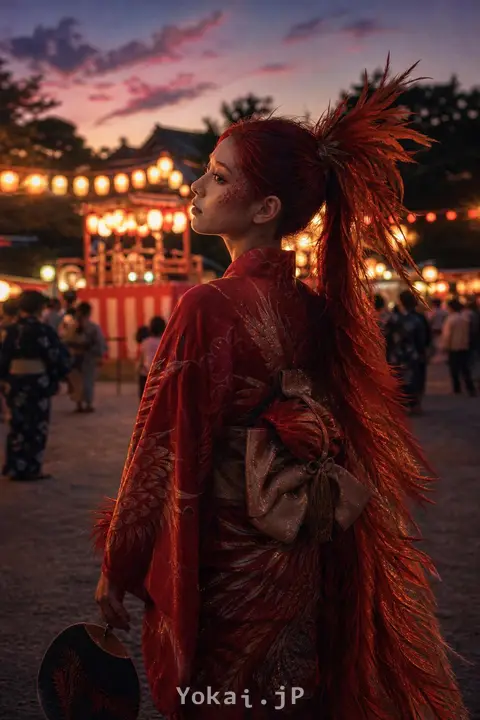
Suzaku (Vermilion Bird) — Summer Kaidan

Suzaku (Vermilion Bird)Suzaku

Red Feathers in the Summer Dusk

In the sunset shrine grounds, with rows of lanterns and a festival tower behind, the profile of a figure in red rises into view. From the feather ornament extending out of the hair to the fan in the hand, everything carries the color of fire. Suzaku, the Vermilion Bird of the Four Symbols, guards the south and is bound to summer and red. Even inside the murmur of the festival, it is quiet, as if it had chosen to descend only where the place was pure.

View card
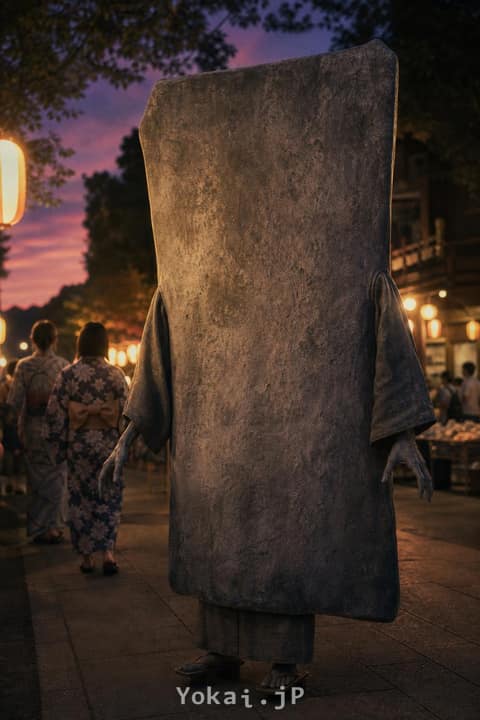
Nurikabe — Summer Kaidan

NurikabeNOO-ree-KAH-beh

The Gray Slab Blocking the Night Road

In the middle of the shrine approach, a large gray slab stands upright. Sleeves and hands protrude from either side, zōri-clad feet show below, and only the yukata figures behind it continue walking on. Nurikabe is the unseen wall yokai that blocks the way at night. Some say it can be undone by stopping, stepping aside, or striking the ground, but the more urgently you move, the more flatly the road closes up.

View card
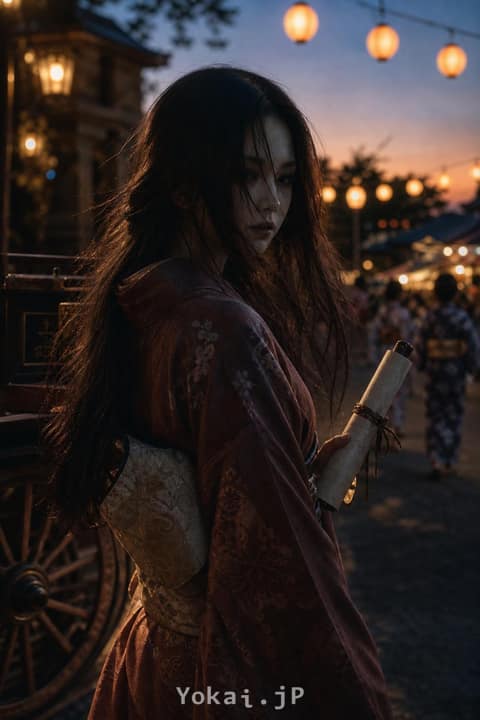
Fuguruma Yōhi (Letter-Carriage Enchantress) — Summer Kaidan

Fuguruma Yōhi (Letter-Carriage Enchantress)FOO-goo-ROO-mah YOH-hee

A Shadow Clutching Love Letters

Beside a wheel, a woman in a crimson kimono turns back with a roll of paper held to her chest. Hair falls across her cheek, while the rows of lanterns and the crowd melt small into the depths of the slope. Fuguruma Yōhi is what took shape from the attachment that settled over old love letters. When she grips that scroll beside the cart that carries correspondence, even the years without a reply seem to gain weight.

View card
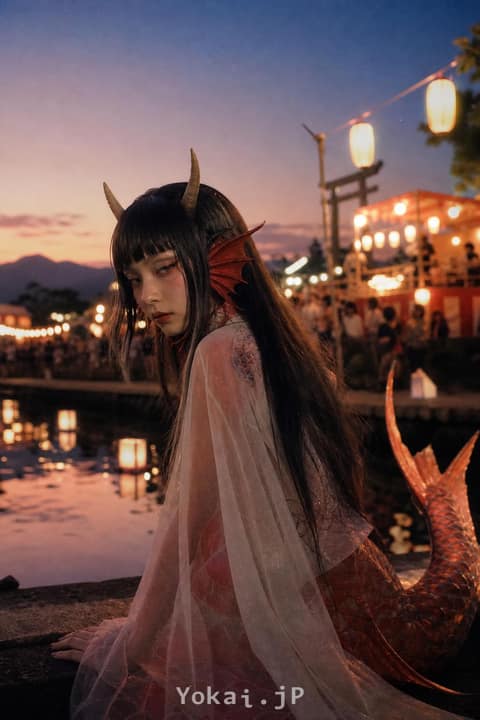
Jinja-hime — Summer Kaidan

Jinja-himejinja-hime

The Red Ryūgū Herald at the Waterline

On a waterside curb, a horned woman sits side-saddle. Red finlike ears, a translucent robe, and a fish tail bending backward all hover close to the lantern-reflected surface. Jinja-hime is a prophetic creature said to be a messenger from Ryūgū, the Dragon Palace, who appeared on a beach in Hizen. She foretold an epidemic after a bountiful harvest and said that copies of her image would avert disaster; her gaze feels almost like an announcement.

View card
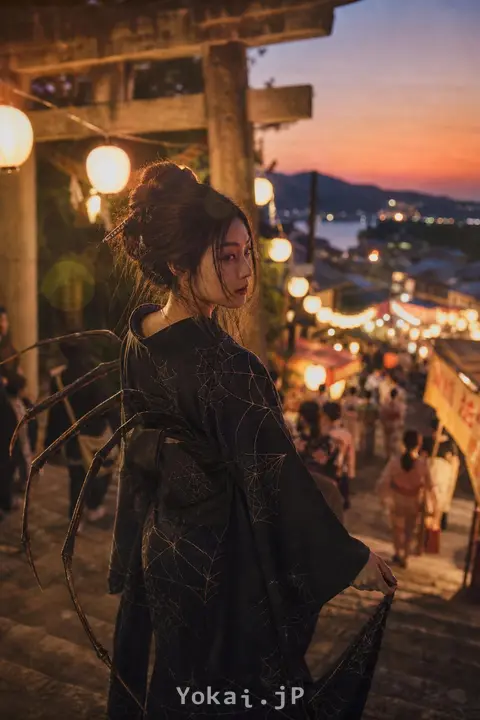
Jorōgumo — Summer Kaidan

JorōgumoJorōgumo

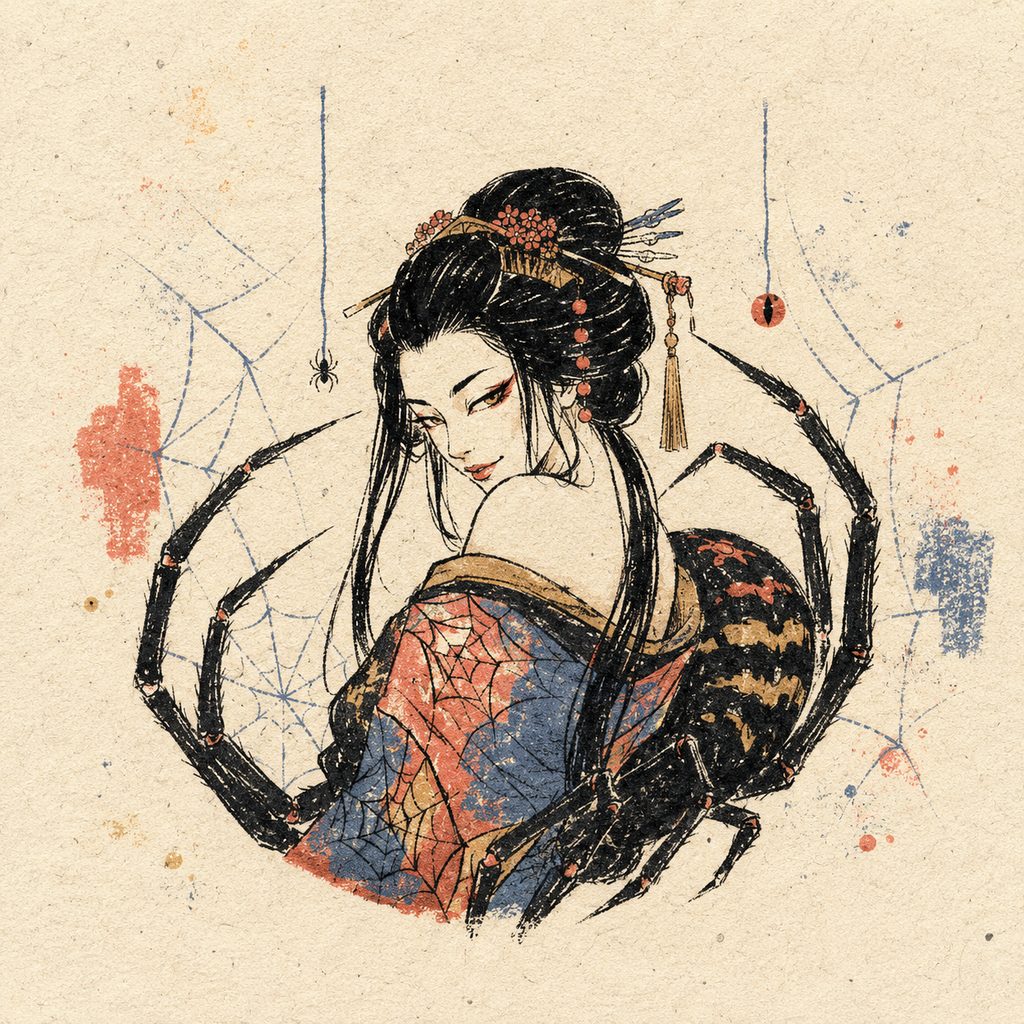
Spider Legs on the Stone Steps

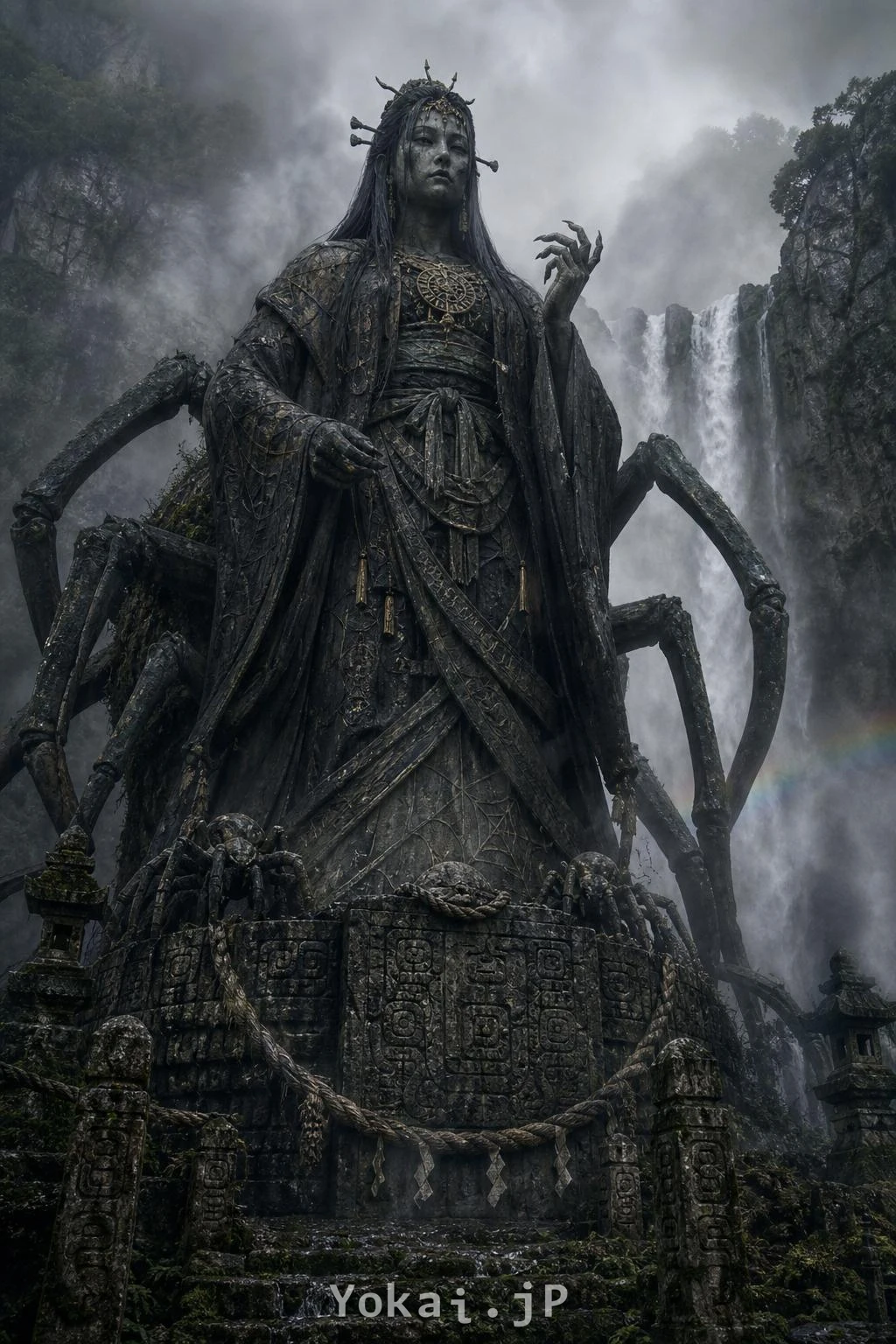
Halfway up the stone steps, thin spider legs jut from the back of a black kimono. White webbing runs through the pattern, and beyond the face turning toward us, the festival lights below blur into the slope. Jorōgumo is said to be a great spider that changes into a beautiful woman, luring people in and binding them with thread. The tales gather around waterfalls, pools, and the edges of mountain villages, but these steps begin to look like a threshold too.

View card
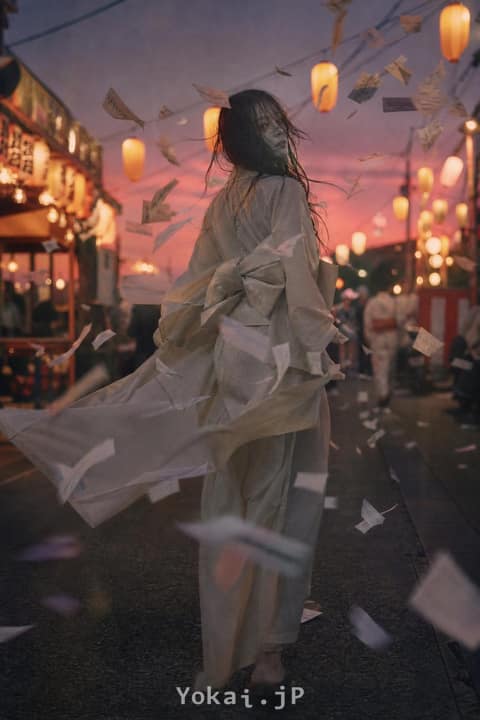
Paper Dance — Summer Kaidan

Paper DanceKAH-mee-mai

Paper Dancing over the Stalls

On a street where stall lights bleed into the evening, a woman in a white kimono turns back. Between the lanterns overhead, tanzaku strips and scraps of paper scatter one by one, as if lifted by the wind. Kami-mai names the uncanny sight of paper rising into the air on its own. In old kaidan it is sometimes treated as an incident of nose paper; once it mingles with the festival noise, no one feels much like picking it up.

View card
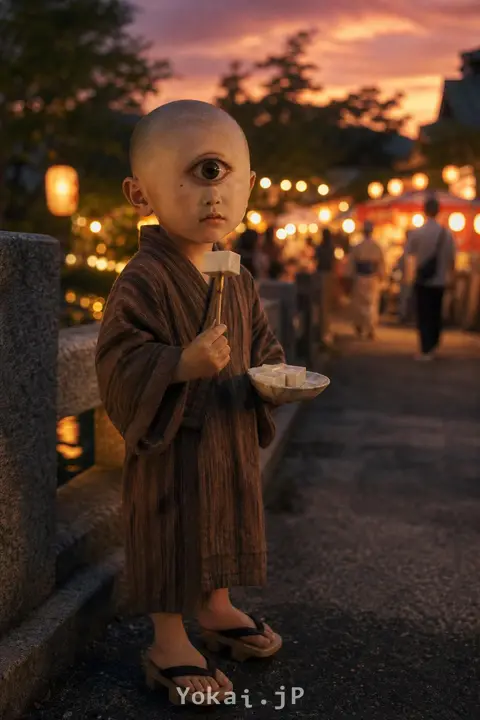
Hitotsume-kozou — Summer Kaidan

Hitotsume-kozouhee-TOH-tsu-meh koh-ZOH

The One-Eyed Boy with Tofu

At the foot of a stone bridge, a small boy-priest in a yukata stands holding a tofu skewer and a plate. The large single eye in the center of his forehead stares straight down the lantern-blurred approach. Hitotsume-kozō is less a creature that hurts people than a prankster who appears without warning and makes them jump. The folk belief that he hates beans somehow drifted toward the image of a tofu-lover, and oddly, it suits him.

View card
Nure-onna — Summer Kaidan

Nure-onnanure-onna

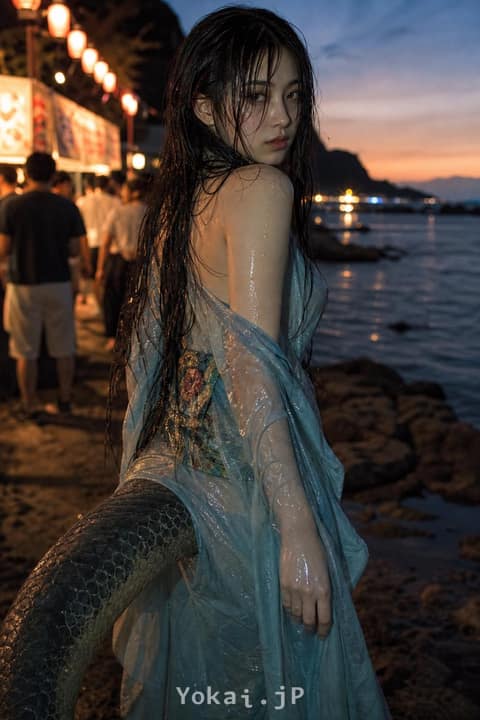
Wet Hair in the Shore Lights

Beside a seaside stall, with the ocean at her back, a woman’s hair and shoulders shine with water. From beneath a sheer blue cloth, a long scaled tail lies heavy across the sand. Nure-onna is a waterside apparition, a wet-haired woman who unsettles and beguiles. In picture scrolls she is often given a serpent body, and only that silent gaze is enough to delay the road home.

View card

Recent comments

Browse other decks