
BenzaitenDefault
べんざいてん
Detailed Description
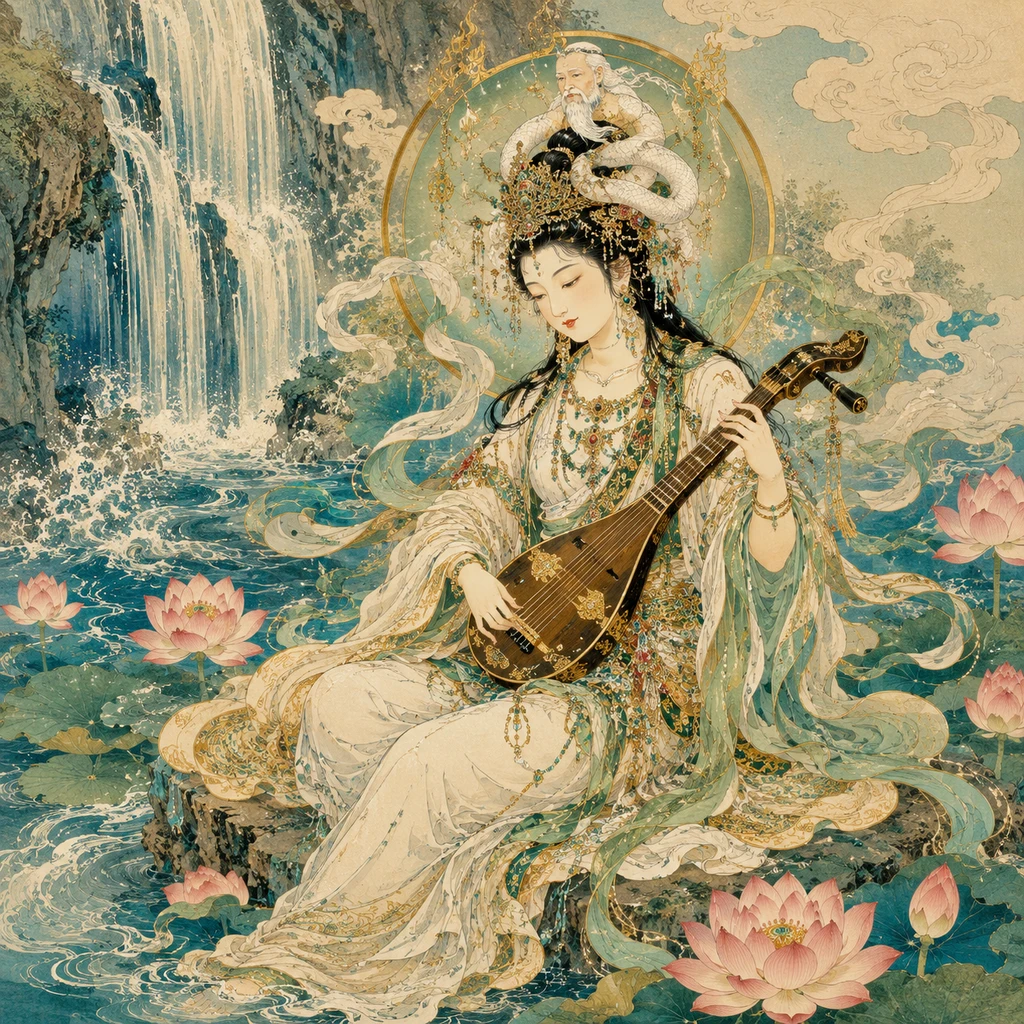
From Sarasvatī to Benzaiten — Two Thousand Years of Cultural Transformation. While the basic description touches on Benzaiten's major sanctuaries and folk beliefs, this in-depth analysis explores her cultural evolution spanning over two millennia from ancient India's Sarasvatī to modern Japan's Benzaiten. Sarasvatī is one of the oldest deities in the Rigveda (c. 1500–1200 BCE), governing river flows, music, arts, language, and poetry[1]. After being adopted into Buddhism, she was transformed into a tutelary deity in the Golden Light Sutra and Lotus Sutra, spreading to China, Korea, and Japan. In Japan, she evolved through several stages: (1) as a scriptural protector during the ancient Ritsuryo Buddhist period (7th–9th centuries); (2) merging with Ugajin to form Uga-Benzaiten in the medieval Kamakura period; (3) becoming a deity of wealth and a member of the Seven Lucky Gods in the early modern Edo period; (4) having her enshrined identity frequently altered to Ichikishimahime during the Meiji era's separation of Shinto and Buddhism; and (5) transitioning into a subject of modern superstitions, tourism, and subculture. She stands as a prime example of an ancient deity's cultural evolution, continuously transmitting her legacy while altering her appearance, attributes, and name over two millennia.
Ugajin — The Mysterious Human-Headed Snake Deity. Ugajin, who merged with Benzaiten from the Kamakura period onward, is a bizarre figure depicted with a human head and a coiled snake body, and remains a mystery in academic studies. While the etymology of "Uga" points to the grain deity Ukanomitama from the Kojiki and Nihon Shoki, the origins of the serpent imagery are debated, with theories citing influences from the Chinese creator deities Fuxi and Nuwa, the Indian Naga (serpent gods), and indigenous Japanese snake worship from sites like Mount Miwa and Suwa. The amalgamation of a "uniquely Japanese snake deity of unknown origin" with a "Buddhist goddess of Indian origin" to form Uga-Benzaiten is a symbolic testament to the syncretism, creativity, and mysticism of medieval Japanese religious culture.
Two-Armed vs. Eight-Armed Statues — Dual Iconographic Lineages. There are two main lineages of Benzaiten statues[1]. (1) Two-Armed Statues: Depicting an elegant heavenly maiden playing a biwa (lute). This lineage inherits the original musical goddess nature of Sarasvatī and has been the traditional form in Japan since the Heian period. (2) Eight-Armed Statues: Depicting a heavily armed warrior goddess holding eight weapons and ritual implements such as a sword, jewel, bow, arrow, axe, halberd, dharma wheel, and vajra. This form, described in the 5th–6th century Chinese translation of the Golden Light Sutra, emphasizes her role as a protector of the state. The eight-armed figure embodies a fierce martial nature quite distinct from the "elegant goddess of arts" image. Combined with the medieval serpentine form of Ugajin, Benzaiten evolved into an immensely complex deity integrating "elegance, martial prowess, magic, and wealth."
The Folklore of Serpentine Transformation — A Layering of Water, Wealth, and Fertility Gods. The transformation of Benzaiten (Uga-Benzaiten) into a snake deity is a folkloric phenomenon deeply intertwined with ancient Japanese snake worship (Mount Miwa, Suwa, Usa, Kumano, etc.). In ancient Japan, the snake was revered as a deity uniting four attributes: water (shrines by rivers, ponds, and the sea), wealth (shedding skin, infinite multiplication), fertility (grain and land), and healing (medicine and taboos). As a result of Benzaiten's fusion with Ugajin and acquisition of snake deity traits, all layers of ancient snake worship—waterside shrines, snakes in wallets, shed skin amulets, and prayers for healing—have been inherited as part of "Benzaiten faith." Even today, modern superstitions like "money-washing water, wallet snakes, and relationship-severing" vividly demonstrate the living heritage of a folk culture where ancient snake gods, medieval Benzaiten, early modern wealth deities, and modern tourism intersect.
The Couples' Taboo — Modern Superstition of a Jealous Goddess. At major Benzaiten sanctuaries (especially Enoshima and Itsukushima), a modern superstition prevails that "couples who visit together will incur the beautiful goddess's jealousy and break up." This is a modern variation of an ancient Indian fierce goddess nature (Sarasvatī is sometimes depicted as the wife of Brahma, possessing jealousy and passion), medieval Japanese snake attributes (snakes were symbols of jealousy and attachment), and ascetic taboos such as the historic ban on women on sacred mountains. Going beyond mere superstition, it stands as a fascinating phenomenon condensing the complex religious, folkloric, and psychological history from antiquity to the present, making it a subject of study in 21st-century folklore, psychology, and tourism studies. At the same time, connections with "relationship-severing shrines" (like Yasui Konpiragu in Kyoto) have been noted, showing how Benzaiten's taboo nature integrates with modern cultural practices of seeking separation.
The Seven Lucky Gods Faith and Edo Commoner Culture. As the only female member of the Seven Lucky Gods (Ebisu, Daikoku, Bishamonten, Benzaiten, Fukurokuju, Jurojin, and Hotei) established in the Edo period, Benzaiten became a central figure in commoner culture. Practices such as the New Year's Seven Lucky Gods pilgrimage, placing a treasure ship picture under one's pillow, hatsumode (first shrine visit of the year), and praying for business prosperity deeply permeated Edo daily life. This represents a significant cultural shift from the medieval Uga-Benzaiten faith (esoteric Buddhism, mysticism, aristocratic culture) to the early modern Seven Lucky Gods faith (commoners, commerce, urban culture). Benzaiten's early modern worship marks a crucial milestone in an epic cultural transformation spanning over two millennia: from an ancient Indian goddess of arts, to a medieval Japanese esoteric deity, to an early modern Japanese deity of wealth, and finally into a subject of modern tourism and subculture.
Benzaiten in the 21st Century — Tourism, Subculture, and Severing Ties. In the 21st century, Benzaiten's legacy continues as a tourism resource through the Three Great Benten Shrines, nationwide Benten shrines, and Seven Lucky Gods pilgrimages. Simultaneously, she is repeatedly reimagined in subculture works, such as the video games *Okami* and *Megami Tensei*, and the manga *Nura: Rise of the Yokai Clan*. She has become a multifaceted icon where ancient Indian goddess traits, medieval Japanese snake attributes, early modern wealth associations, and modern relationship-severing taboos intersect. As a rare example of a single deity embodying over two thousand years of cultural evolution—from Sarasvatī in ancient India to Benzaiten in modern Japan—she remains a vital subject of study in yokai studies, folklore, religious history, and comparative mythology.
Source Information
種類全体の出典primary
江島神社 (えのしまじんじゃ) ── 日本三大弁天
著者: 神奈川県藤沢市江の島·江島神社
年代: 欽明天皇 13 年 (552 年) 創建伝承·明治期神仏分離で社格変更
出版社: 神奈川県藤沢市江の島
種類全体の出典primary
金光明経 (こんこうみょうきょう) ── 曇無讖訳
著者: 曇無讖 (どんむせん、 ドンマクシェーマ、 385-433)
年代: 412-421 年漢訳
出版社: (古代インド原典の中国漢訳)
Personality
A multifaceted personality combining the elegant and noble face of a goddess of arts and music, the face of a wealth deity bringing prosperity and abundance, and the face of a jealous, stern snake deity who despises impurity and couples. She possesses a unique spiritual aura born from the fusion of the pure river currents of ancient India and the sorcerous serpent cults of medieval Japan.
Compatibility
Deeply connected with those who revere music, arts, language, and poetry, those who pilgrimage to sacred sites by the water, ponds, rivers, and islands, and those who carry on the traditions of snake worship, prayers for wealth, and Seven Lucky Gods pilgrimages. Resonates with those who understand the over two-thousand-year cultural transformation spanning ancient India, medieval Japan, early modern Japan, and the modern day.
Abilities & Skills
Weaknesses
Aversion to impurity, filth, meat-eating, and romantic entanglements (manifested in ascetic taboos like the historic ban on women at Itsukushima and Enoshima); the loss of her original image due to the replacement of her enshrinement with Ichikishimahime during the Meiji separation of Shinto and Buddhism; the dilution of her sacredness due to post-war secularization and commercialization
診断評価
妖怪バウンダリー・タイプ指標
いたずら濃度
-1.0high: 戯 low: 護
📝 メモ
財福や学芸を授けるが、嫉妬神・武装神の激情も併せ持つ
変化適応
3.0high: 化 low: 定
📝 メモ
サラスヴァティー・宇賀神蛇形・財福神へ複層変容する
夜話度
0.0high: 夜 low: 昼
📝 メモ
水と芸能の女神で、夜出現は中心でない
情の深さ
2.0high: 縁 low: 境
📝 メモ
嫉妬深さや縁切り俗信があり、人の縁に強く関わる
結界強度
2.0high: 律 low: 流
📝 メモ
水辺の祠・島・禁忌・銭洗いの霊水に領域性がある
表舞台圧
2.0high: 表 low: 影
📝 メモ
七福神唯一の女神で、学芸・財福・水神として広く祀られる
妖怪相性診断
喜び
7.0喜びと楽しさの程度
📝 メモ
七福神の温和な財福神性・学芸音楽の楽しさを持ち福をもたらす
怒り
6.0怒りの激しさの程度
📝 メモ
美女女神ゆえカップルを別れさせる嫉妬深さと八臂像の勇猛な戦闘神性を持つ
慈悲深い
7.0慈悲深さの程度
📝 メモ
七福神の一柱として衆生に財福と才能を授ける慈悲深さを持つ
憂鬱
2.0憂鬱で思慮深い程度
📝 メモ
音楽や学芸の優雅さがあり陰鬱な性質は薄い
静寂
5.0内なる平静の程度
📝 メモ
水辺の祠や蛇神としての静かな霊威と活発な俗信が混在する
いたずら好き
4.0いたずら好きで活発な程度
📝 メモ
カップルを別れさせる俗信には人間の色恋に干渉するいじわるさがある
やさしい
7.0やさしく親しみやすい程度
📝 メモ
財福を授け商売繁盛を助ける優しい福神として庶民に親しまれる
厳格
6.0厳格で真面目な程度
📝 メモ
不浄・肉食を嫌う厳島の女人禁制など修験的禁忌の厳格さを持つ
守護的
8.0他者を守る傾向
📝 メモ
経典由来の鎮護国家の守護神であり国家や個人の財や縁を守る
神秘的
8.0神秘的で不思議な程度
📝 メモ
人頭蛇身の宇賀神との習合や水辺の異界性など神秘性が高い
霊性の深さ
9.0精神的境界の深さ
📝 メモ
古代インドから日本中世の宇賀神習合に至る二千年を超える深淵な宗教史を体現する
Similar Yokai
Yokai with similar personality and characteristics to Default
Opposite Yokai
Yokai with opposite personality and characteristics to Default
🔮Test your compatibility with Benzaiten now!
Analyze your personality and values to get a detailed compatibility rating with this yokai.
Free, simple, and results in just minutes.