YOKAI.JP

Hinokuma Jingu and Kunikakasu Jinguひのくまじんぐう・くにかかすじんぐう

2 yokai rooted in Hinokuma Jingu and Kunikakasu Jingu. Explore the legends tied to this land.

Also known as: 日前宮 / 日前神宮 / 國懸神宮 / 国懸神宮 / 日前國懸神宮
  • 伊斯許理度売命

    伊斯許理度売命

    Divine

    いしこりどめのみこと

    岩戸に八咫鏡を鋳る鏡作神・伊斯許理度売命

    神霊・神格高天原・天岩戸神話 / 日前神宮・國懸神宮 (現·和歌山県和歌山市秋月)

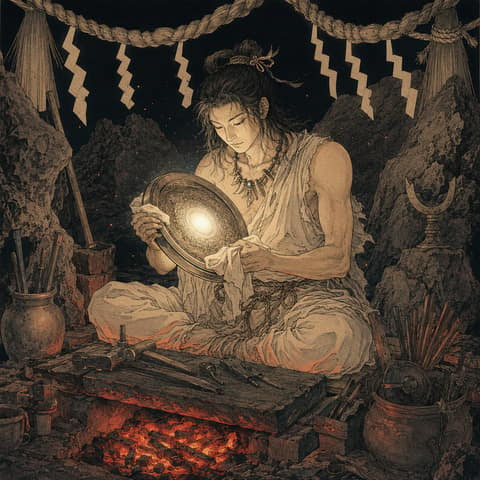
    Ishikoridome, casting the Yata-no-Kagami (Eight-Span Mirror) before the rock cave, is the deity in the Ama-no-Iwato myth who creates the vessel that reflects the lost light back onto itself. When Amaterasu-Omikami hides within the cave, the world goes dark. The gods gather at the Heavenly Tranquil River and prepare according to Omoikane's plan. The *Kojiki* (Ama-no-Iwato II) records that after seeking hard stones, iron, and a blacksmith, they commanded Ishikoridome to make a mirror. This mirror later becomes the central ritual implement used to lure Amaterasu out. The act of "making a mirror" is extremely proactive in the Ama-no-Iwato myth. If they merely wanted to wait for the light to return, the gods could have simply continued praying. However, Omoikane's strategy is to create a surface to catch the light in advance, even while the light is absent. Ishikoridome's mirror is not a trap to catch Amaterasu. It is a location of light, showing that the outside world is still prepared to welcome the deity. The mirrored surface is silent, but within that silence dwells the signal: "It is safe to return here." When Kokugakuin University's commentary reads the Ama-no-Iwato myth as an origin tale of ancient rituals, the mirror is a crucial implement alongside jewels, cloth, and oracle bones. A mirror possesses not only the practical utility of reflecting an image but the power to summon a deity and anchor its presence. As the deity responsible for crafting this implement, Ishikoridome bridges the beautiful surface of mythology with the heavy, gritty reality of metalworking. Fire, metal, stone, molds, and polishing—all of it converges into a single mirror placed before the gods. During the Descent of the Heavenly Grandson, Ishikoridome descends to earth as one of the Five Attendant Deities. The *Kojiki* identifies Ishikoridome as the ancestor of the mirror-making clan. This means the mirror-making technology that guided Amaterasu at Ama-no-Iwato is handed down to earthly clans and integrated into human rituals. Mirror-making is not merely a personal skill; it is a vocation rooted in myth, becoming a part of the ritual technology that supports the heavenly grandson's rule. The official history of Hinokuma Shrine and Kunikakasu Shrine connects Ishikoridome to another story of mirrors. Hinokuma Shrine enshrines the Hizokagami as its sacred body, while Kunikakasu Shrine enshrines the Hibokokagami. The official overview recounts that when Amaterasu hid in the cave, following Omoikane's advice, Ishikoridome acted as the master artisan and cast the sacred mirrors from copper. Here, the function of the mirror-making deity expands into the worship of two major shrines. While the Hizokagami and Hibokokagami belong to a different lineage than the Yata-no-Kagami, they are spoken of as mirrors born from the same darkness of Ama-no-Iwato. The shrines note that these two mirrors are revered by the Imperial Court as sacred treasures second only to the Three Sacred Treasures (which includes the Yata-no-Kagami). Here, Ishikoridome's divine status expands from "the deity who made a mirror" to "the deity who upholds the history of mirrors closely associated with the Imperial ancestors." A mirror is an image of the deity, and at the same time, the vessel (yorishiro) that welcomes the deity itself. Read in a modern context, Ishikoridome is a deity of reflection and recording. Mirrors, lenses, photography, video, measurement, inspection, design, and metal polishing—all are technologies centered on making an object visible without distorting it. The myth of forging a mirror in the darkness resonates with the act of preparing tools that reflect the truth in the midst of confusion. Ishikoridome is not a deity who wields blinding light. When the light returns, Ishikoridome is the deity who silently prepares the surface to catch it, reflect it, and return it to the world. Furthermore, this deity's mirror is a tool for self-recognition. When Amaterasu looks out from the cave, the mirror does not merely reflect the outside world; it returns the deity's own existence back to her. The hidden one sees her own light once more, reconnecting with the world. Ishikoridome creates that catalyst. To forge a mirror was to prepare the surface for a world that had lost its center to regain itself.
  • 玉祖命

    玉祖命

    Divine

    たまのおやのみこと

    岩戸に御珠を連ねる玉作神・玉祖命

    神霊・神格高天原・天岩戸神話 / 日前神宮・國懸神宮 (現·和歌山県和歌山市秋月)

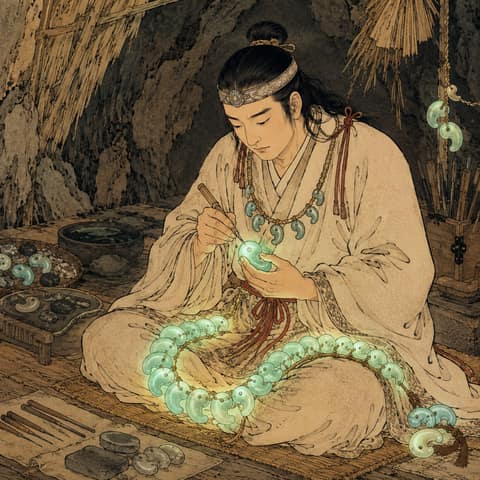
    Tamanooya, who strung the sacred beads at the rock cave, is the deity in the Ama-no-Iwato myth who gathers light into particles and brings them to order. When Amaterasu-Omikami hides in the cave, the gods follow Omoikane's plan: they make a mirror, craft jewels, hang cloth, and perform divination. The *Kojiki* (Ama-no-Iwato II) records that they had Tamanooya make the Yasakani no Magatama and the five hundred stringed Yasumaru beads. What Tamanooya creates here is not a single gem, but a spiritual rosary of many beads strung together to hang before the altar. The jewels stand in pair with the mirror at the Ama-no-Iwato scene. The mirror reflects Amaterasu's figure on one surface, while the jewels fill the sacred space with many particles. If the mirror is an implement for "seeing," the jewels are implements for "tying." By boring holes, threading strings, and aligning the particles without disorder, scattered small lights become a single ritual implement. Tamanooya's work is not merely to make the material beautiful, but to align individual brilliance into an order directed toward the divine. When Kokugakuin University's commentary reads the Ama-no-Iwato myth as an origin tale of ancient rituals, jewels—along with mirrors, cloth, ironware, and oracle bones—are major items that make the ritual possible. Jewels are implements close to the body; they decorate, protect, and indicate the status or spiritual power of the wearer. When hung on the true sakaki tree before the cave, a personal adornment transforms into a sacred symbol. Tamanooya is the deity who makes this transformation possible. In the Descent of the Heavenly Grandson, Tamanooya's vocation is connected to the history of human clans. The *Kojiki* (Tenson Korin II) counts Tamanooya among the Five Attendant Deities and designates him as the ancestor of the Tamanooya clan. This indicates that jewel-making descended to earth not just as manual labor, but as a vocation rooted in heavenly rituals. The techniques of polishing, piercing, and stringing jewels became part of the ritual technology supporting the heavenly grandson's world. In the official overview of Hinokuma and Kunikakasu Shrines, Tamanooya is enshrined in the auxiliary shrine of Kunikakasu Shrine. Kunikakasu Shrine enshrines the Hibokokagami (Sun Spear Mirror) as its sacred body, and the same page transmits the history of two sacred mirrors being cast during Amaterasu's seclusion in the cave. The enshrinement of Tamanooya in a shrine centered on mirror myths clearly shows that the ritual implements of the rock cave myth are not complete with mirrors alone. The jewels string light around the mirror. Tamanooya's power lies in not neglecting the details. Jewel-making requires selecting materials, polishing, boring holes, stringing, and arranging. If any one step is disrupted, the rosary will not take a form fitting for the gods. Rather than creating a massive light all at once, this deity refines small lights one by one, connects them, and makes them into a meaningful sequence. Tamanooya is the deity who teaches the weight of the finest manual labor within a grand ritual that changes the world. Seen in a modern light, Tamanooya resonates well with the senses of jewelry, accessories, rosaries, beads, souvenirs, design, lineage, and matchmaking. The work of polishing, selecting, and connecting small things is inconspicuous but supports people's memories and prayers. Tamanooya, who strung the sacred beads before the rock cave, is a deity who does not waste a single particle of light. He beautifully ties scattered things together and prepares the space to welcome the lost light. Those quiet, steady hands are the very essence of Tamanooya's divinity. Furthermore, Tamanooya is often paired with Ishikoridome. If Ishikoridome gathers light onto a single mirror surface, Tamanooya divides light into many particles and then creates a single chain from them. Concentration and connection, reflection and decoration, a single surface and many particles. Through these two crafts, the Ama-no-Iwato ritual simultaneously possessed light for seeing and light for tying. Tamanooya's jewels were not only beautiful but were implements that turned the gods' collaboration into a visible form. The gods' operation was not a single heroic act, but a collective ritual where wisdom, dance, prayers, cloth, mirrors, and jewels supported each other. Tamanooya is also the deity who symbolizes that collectivity as a chain of particles. The power to tie small things together deeply supports grand divine rituals.