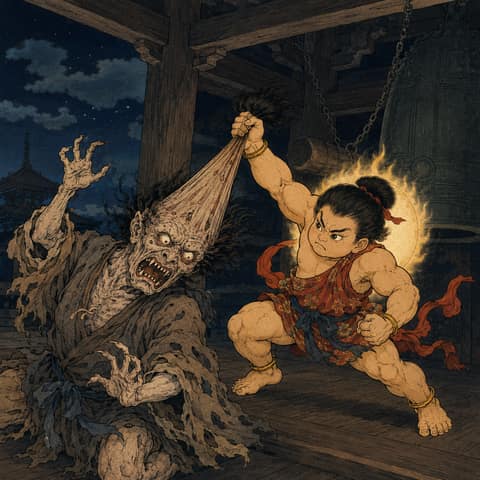
Oni of Gango-ji
GAHN-goh-jee no OH-nee
Canonical Folkloric Tradition
This version follows storylines found in Heian-period tale collections and represents the type fixed as the bell-tower apparition of Gangoji. The demon’s true form is the restless spirit of a servant connected to the temple, manifesting as a figure that frightens monks and children. It appears at midnight, and accounts say its form can be verified by lamplight, reflecting a folk view that sacred beings hide yet reveal themselves under certain conditions. A preceding thunder-god episode is linked as a strong-child birth tale, reinforcing the idea that the power of thunder can dwell in a person. The subjugation is not by beheading but by tactile restraint—“grabbing the hair,” “tearing it out”—with the hair remaining as a relic treasured by the temple. Thereafter the monster is calmed, and the child takes vows and is known as Dōjō Hōshi. Words like Gagoze and Gagoji appear regionally as generic terms for yokai, but their etymology is debated and left unspecified.