
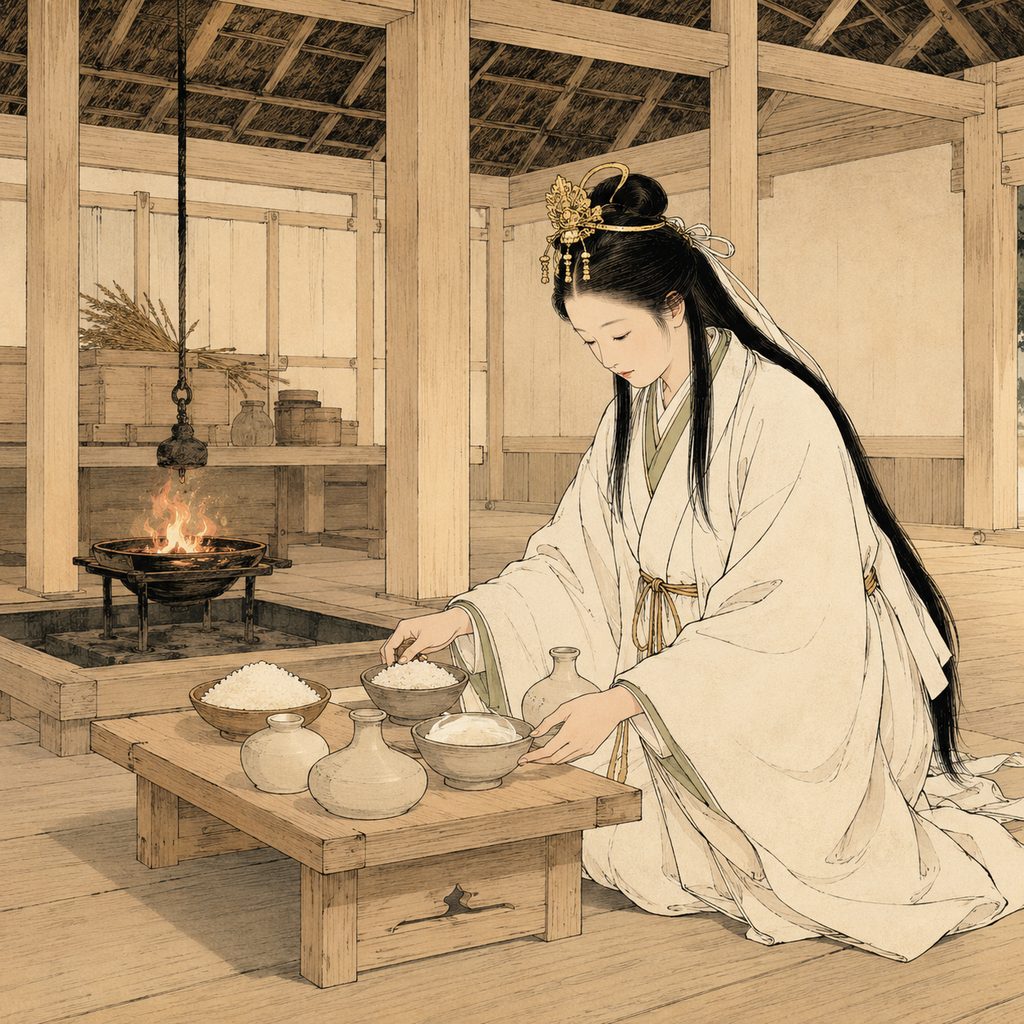
Toyouke-OmikamiToyouke-Omikami, the Great Deity of the Geku Who Presides Over Daily Sacred Meals
とようけのおおみかみ
Detailed Description
The core of Toyouke-Omikami lies in placing the simple fact of "the god who eats" at the center of religious rites. Amaterasu-Omikami is the imperial ancestral goddess, and the Naiku is the center of Ise Jingu, but the system of offering sacred meals to Amaterasu is supported by the Geku. When the official history of Ise Jingu calls Toyouke the Miketsu-kami of Amaterasu-Omikami[1], it does not merely mean she is a goddess in charge of food. The very act of purifying rice, water, salt, and fire, and offering them daily so that the sun goddess can continue to be welcomed as the sun goddess, is deified.
The story of the Geku's establishment portrays Toyouke as a "god invited because she was needed." In the official explanations of the Jingu based on the *Toyouke-gu Gishikicho*, Amaterasu appears in Emperor Yuryaku's dream, stating that being alone in one place is painful and she cannot peacefully enjoy her sacred meals, thus requesting that the Toyouke-Omikami residing at Hiji-no-Manai[1] be brought to her side. Here, Amaterasu does not appoint Toyouke from a superior position; rather, centered around the necessity of eating, she *needs* Toyouke. The heart of the myth is not domination, but a relationship of provision and dependence.
This relationship is enacted daily through the *Higoto Asayu Omikesai*. Twice a day, morning and evening, at the Geku's Mikeden, rice, water, salt, and other items[2] are offered to the deities of the Naiku, Geku, and auxiliary shrines. The items of the sacred meal are strictly prescribed, cooked using fire specially ignited in the Imibiyaden, and purified with sacred water drawn from the Kami-no-Mi'i Shrine. Toyouke's power does not manifest in an instant like thunder or a sword. It appears in the unbroken repetition of kindling fire, drawing water, cooking rice, offering it, reciting prayers, and doing it all over again the next morning.
The details of the sacred meals teach us that Toyouke is not a vague symbol of "food in general." Not just rice, but water, salt, sake, fish, seaweed, vegetables, and fruit are designated, and chopsticks are provided. This is not simply placing products of nature as they are; it is a series of etiquettes in which humans offer them to the gods through fire, water, and vessels. Toyouke's divine virtue encompasses both the yielding of the harvest and the process of purifying it, bringing it before the gods, and establishing it as a prayer.
In myth, Toyouke appears under multiple names: Toyouke-bime-no-Kami, Toyuuke-no-Kami, and Toyouke-Omikami. The Kokugakuin Deity Name Database identifies Toyouke-bime as the child of Wakumusubi, noting the possibility of reading her as the spirit of food or rice[3]. On the other hand, regarding Toyuuke-no-Kami, while considered the deity of the Ise Geku, cautious debate remains about her position in the *Kojiki* text and whether she is the exact same deity. In other words, Toyouke is not a deity completely closed within a single classic text. She is a deity with the thickness of ritual history itself, formed by overlapping the food goddess of the *Kojiki*, the Manai traditions of Tanba/Tango, and the rites of the Ise Geku.
The custom of *Geku-sensai* (worshipping at the Geku first) is also a key to understanding this divinity. In the Jingu's festivals, the Miketsu-kami is worshipped first at the Geku before proceeding to the Naiku. This does not mean the Geku is higher in status than the Naiku. Rather, it represents the order of preparing the act of offering food to the supreme deity before worshipping that supreme deity. Toyouke does not usurp the center. But she quietly and preemptively fulfills what is necessary for the center to continue being the center. This act of "preemptively fulfilling" is precisely what makes Toyouke stand out not as an auxiliary god, but as the god standing at the gateway of ritual. The sense that food must be prepared before welcoming the gods shows that prayer begins with the procedures of daily life.
This figure is easy for modern readers to understand. Those who cook, those who support the dining table, those who grow crops, and those who begin their necessary work at the same time every morning often do not become the protagonists of the story. But the moment that repetition is lost, both daily life and religious rites grind to a halt. Toyouke-Omikami is not merely behind the scenes of myth. From the Geku, she quietly continues to show us that the preparation of food itself is the central act that drives the order of the gods.
Source Information
種類全体の出典primary
伊勢神宮・正宮 豊受大神宮
著者: 神宮司庁
種類全体の出典primary
伊勢神宮・日別朝夕大御饌祭
著者: 神宮司庁
種類全体の出典primary
國學院大學古典文化学事業・豊宇気毘売神
著者: 國學院大學古典文化学事業
種類全体の出典primary
國學院大學古典文化学事業・登由宇気神
著者: 國學院大學古典文化学事業
バージョン固有出典 (朝夕の御饌を司る外宮の大神・豊受大神)primary
伊勢神宮・正宮 豊受大神宮
著者: 神宮司庁
バージョン固有出典 (朝夕の御饌を司る外宮の大神・豊受大神)primary
伊勢神宮・日別朝夕大御饌祭
著者: 神宮司庁
バージョン固有出典 (朝夕の御饌を司る外宮の大神・豊受大神)primary
國學院大學古典文化学事業・豊宇気毘売神
著者: 國學院大學古典文化学事業
バージョン固有出典 (朝夕の御饌を司る外宮の大神・豊受大神)primary
國學院大學古典文化学事業・登由宇気神
著者: 國學院大學古典文化学事業
Personality
Quiet and highly pragmatic, she prepares the daily food, fire, and water to support the center of light. Not the flamboyant star of myths, she maintains order through the ceaseless repetition of rituals.
Compatibility
Resonates with those who hold reverence for daily meals, the kitchen, agriculture, the act of offering, and the work of supporting others. She is closer to those who value unwavering, continuous duty over grand honors.
Abilities & Skills
Weaknesses
Her power does not stand out as a protagonist; it requires an object of offering and a place of ritual. If the order of food, fire, and water is disrupted and the daily repetition is broken, her divine virtues are difficult to fully manifest.
🔮Test your compatibility with Toyouke-Omikami now!
Analyze your personality and values to get a detailed compatibility rating with this yokai.
Free, simple, and results in just minutes.
Like this yokai?
Visit a shrine to discover your guardian yokai