
すねこすり雨夜の脛をくぐる小獣・すねこすり
すねこすり
Detailed Description
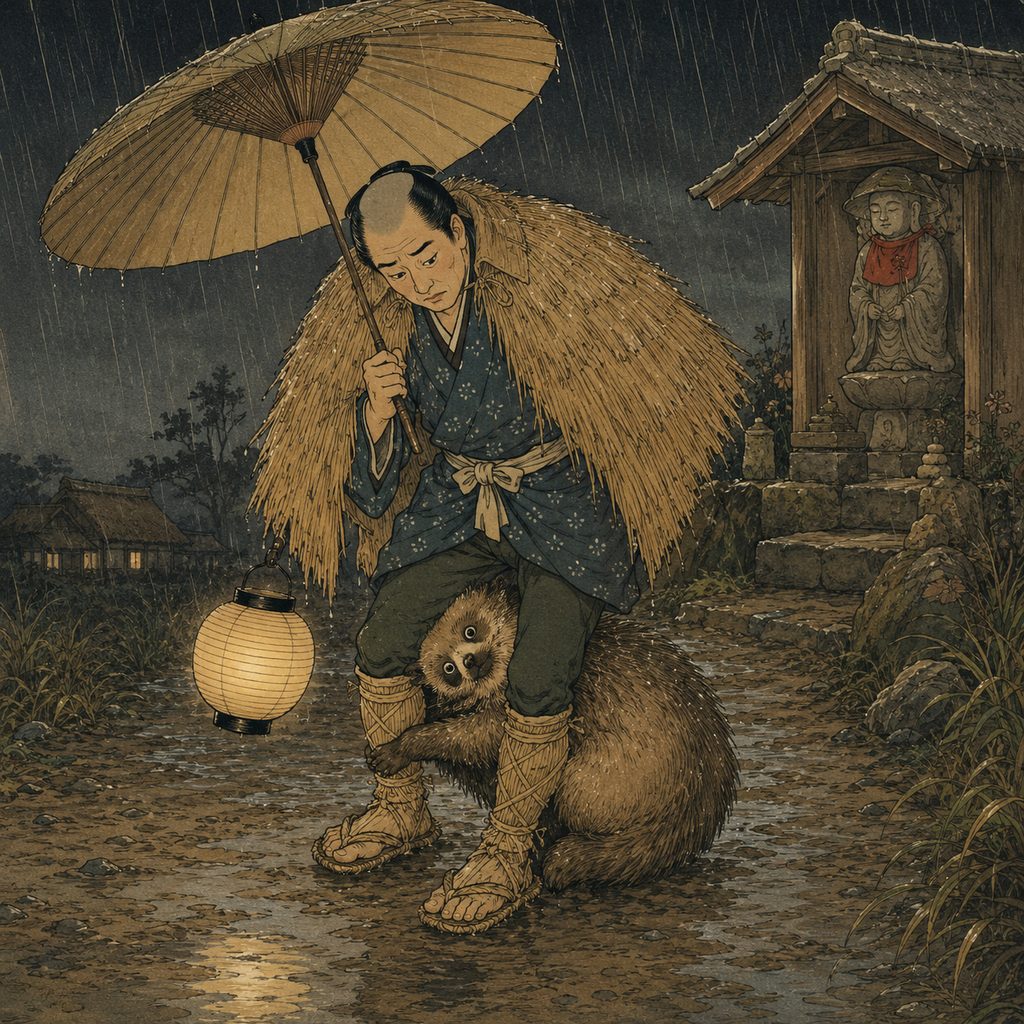
When viewed as a small beast of a rainy night, the essence of the Sunekosuri lies not in being a "visible anomaly," but an "anomaly that makes you unable to walk." While many yokai frighten people with their faces, voices, enormous size, or bizarre shapes, the Sunekosuri slips right by your feet. When people lose their vision on a night road, they worry more about the ground one step ahead than terrors far away. The rain dampens the grass and soil, making hems and sandals heavy, and giving birth to a sensation akin to the touch of beast hair. The people of Okayama named that sudden contact "that which rubs the shins." Because the name itself serves as the explanation, this yokai is closer to an experience than a narrative.
The folklore tied to the Iryodo shrine in Nanokaichi-cho, Ibara City[1] shows the Sunekosuri not simply as a wild beast, but as something belonging to the memory of the road. A small hall like Iryodo is a place where village faith, memorial services for the dead, and prayers for safe journeys softly gather; at night, it also becomes a boundary with sparse foot traffic. The telling that a dog-like creature slips between one's legs there does not exaggerate the stage of the anomaly. It occurs not deep in the mountains or in a castle, but beside the road one usually walks; this is exactly why the Sunekosuri remains as a "plausible anomaly." This is also the significance of reading local cases in an overlapping manner.
Even within Okayama, the Sune-kosuri, Mata-kuguri, and Sunekkorogashi seen in Ukan-cho allow us to understand the Sunekosuri not as a single fixed character, but as a swarm of anomalies that steal one's footing on a night road. Rubbing the shins, passing through the crotch, pulling and tripping. The actions differ slightly, but they all disrupt a person's walking from below. Here, what the name captures is not "who the yokai is," but "what you felt was done to you." That is why it leans toward both dogs and tanuki. Explaining it as the work of a tanuki functions less to determine its true identity, and more to place the Sunekosuri within the vocabulary of beasts in the wild that confuse humans.
The Sunekosuri appearing in Kunio Yanagita's Yokai Glossary[2] should be read not as a lengthy folk tale, but as an entry where a name and a phenomenon are briefly linked. In such glossaries, rather than lineages or monster-slaying tales, the very name used in the local area holds documentary value. There are no famous slayers like with great yokai, no shrine histories, and no magnificent illustrations. Yet the name survives because the experience of the area around one's feet on a night road is shared by many. The value of the Yokai Glossary lies in placing such small names without erasing them.
Taxonomically, reading the Sunekosuri solely as a dog yokai or solely as a tanuki anomaly becomes too narrow. The dog form indicates the eyewitness shape of "some small beast slipping past the feet," while the tanuki theory indicates the explanatory model of "beasts in the wild that confuse humans." Neither is a definitive determination of its true identity, but words used to understand the contact felt on a dark road. Therefore, while being an animal transformation, the Sunekosuri is simultaneously a yokai of roads, rain, and walking.
The modern image of the Sunekosuri cannot be discussed without Shigeru Mizuki's illustrations. Mizuki transformed the rustic information of "something dog-like" into an endearing, round little beast[3]. Following that, through the movie "The Great Yokai War," anime, and games, the Sunekosuri moved away from being a troubling anomaly and closer to a soft yokai that approaches humans. What is important here is that cuteness did not erase the folklore. The actions of clinging to the feet, snuggling up, and slowing one's pace weaken the fear while simultaneously turning into charm. Precisely because the Sunekosuri is a yokai of physical contact, it opened toward both terror and intimacy.
The Sunekosuri read in this form, while being a local yokai of Okayama, is also representative of modern "small yokai." It neither eats nor curses people. It simply appears at the feet of walkers and disrupts their stride for just a moment. That weak interference, ironically, makes it hard to forget. When hurrying down a night road, you feel something touch your foot. You look down, but nothing is there. Yet, for your very next step, you become just a little more cautious. The Sunekosuri is the yokai that gives a name to that one step's hesitation.
Source Information
種類全体の出典primary
日本妖怪大全 妖怪・あの世・神様
著者: 水木しげる [著]
年代: 2014
出版社: 講談社〈講談社文庫〉
種類全体の出典primary
岡山の妖怪事典 妖怪編
著者: 木下浩 編著
年代: 2014
出版社: 日本文教出版〈岡山文庫290〉
種類全体の出典primary
妖怪談義
著者: 柳田国男 [著]、小松和彦 校注
年代: 2013
出版社: 角川学芸出版〈角川ソフィア文庫〉
バージョン固有出典 (雨夜の脛をくぐる小獣・すねこすり)reference
日本妖怪大全 妖怪・あの世・神様
著者: 水木しげる [著]
年代: 2014
出版社: 講談社〈講談社文庫〉
バージョン固有出典 (雨夜の脛をくぐる小獣・すねこすり)reference
岡山の妖怪事典 妖怪編
著者: 木下浩 編著
年代: 2014
出版社: 日本文教出版〈岡山文庫290〉
バージョン固有出典 (雨夜の脛をくぐる小獣・すねこすり)reference
妖怪談義
著者: 柳田国男 [著]、小松和彦 校注
年代: 2013
出版社: 角川学芸出版〈角川ソフィア文庫〉
Personality
Quietly approaching people's feet, it leans toward disrupting their pace rather than threatening them. Its malice is thin, but on a dark road, its mere presence is enough to make travelers uneasy.
Compatibility
It is incompatible with those who rush too much or ignore the signs around their feet. To those who notice small incongruities and walk the road cautiously, it may instead feel like a mysterious travel companion.
Abilities & Skills
Weaknesses
It has no strong monster-slaying tales or clear true identity, and its presence fades on well-lit roads or crowded places. When covered by modern cute illustrations, its original core—the anxiety of the night road—becomes difficult to see.
🔮Test your compatibility with すねこすり now!
Analyze your personality and values to get a detailed compatibility rating with this yokai.
Free, simple, and results in just minutes.