
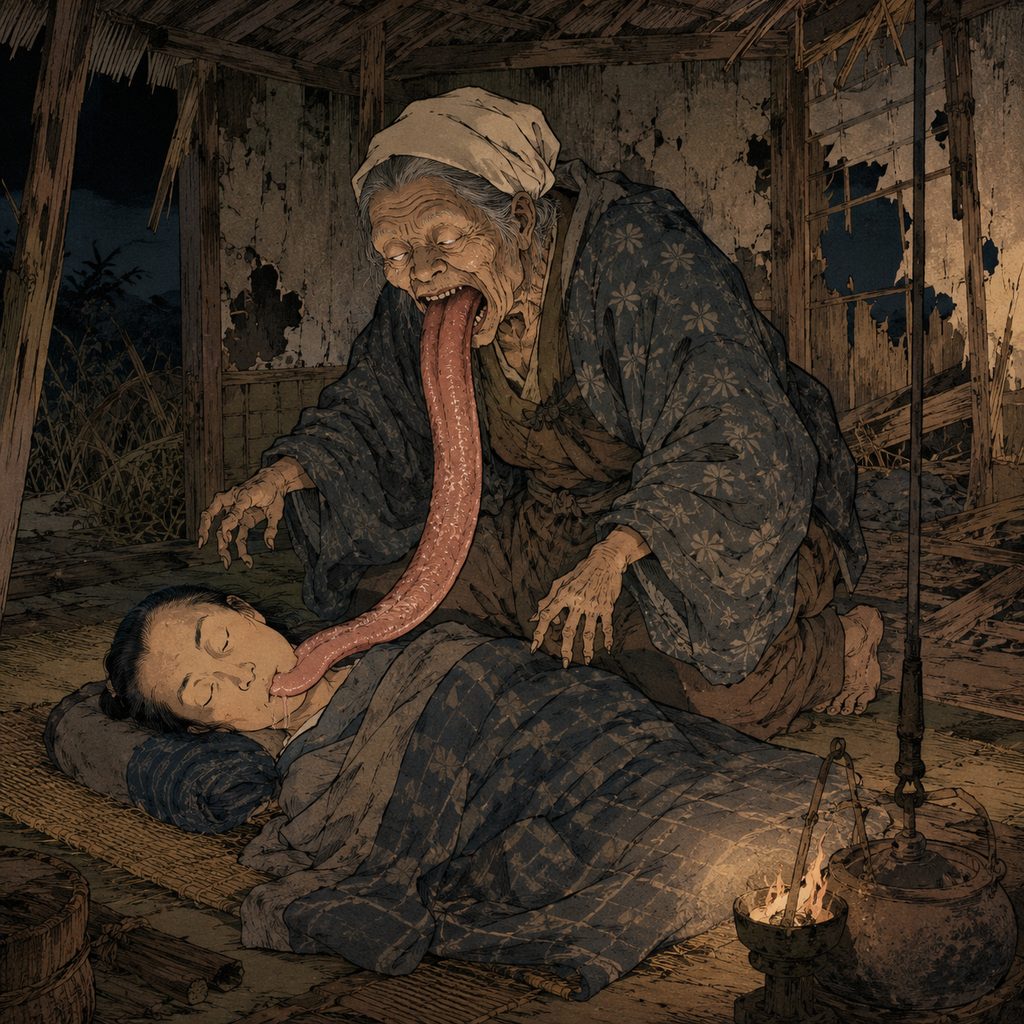
舌長姥荒野の破屋に舌を伸ばす姥・舌長姥
したながうば
Detailed Description
When viewed as a hag extending her tongue in a ruined shack in the wilderness, the terror of the Shitanaga-uba lies less in the monster's appearance itself and more in the moment hospitality flips into predation. The travelers, conditioned by nightfall, getting lost, and fatigue, search for a house and believe they are saved by the old woman's invitation. However, the night's lodging is not a safe zone of the human community, but a trap waiting in a closed room for them to fall asleep. In the scene where the tongue extends to the sleeper, the everyday and soft action of "licking"—rather than the use of blades or claws—transforms into the violence of obliterating the flesh, producing a tactile terror much closer than the red face of Shu-no-banbo.
This hag monster's outline becomes clearest when working as a pair with Shu-no-banbo. In the setting of the journey from Echigo to Edo[1], the Shitanaga-uba is placed inside the house, while Shu-no-banbo acts as a voice from the outside. It is the Shitanaga-uba whose name is called first, and Shu-no-banbo appears saying, "Shall I help?" In other words, the Shitanaga-uba is not a mere servant, but one of the principal culprits moving in front of the prey. If Shu-no-banbo is a yokai of sight, the Shitanaga-uba is a yokai of touch, and the two terrors mesh seamlessly within the same night.
While the story connects Echigo Province and Edo on the map, pinning the Shitanaga-uba down solely as a "yokai of Niigata Prefecture" misses the core of the tale. What is important is that an unnamed wasteland opens its jaws halfway between a known land and a known city. The ending, where the house vanishes, suggests the possibility that the anomaly's dwelling was not permanently there, but rose up for just one night to absorb the travelers. Thus, on this page, Echigo Province is listed as the story's starting point, Edo as the destination, and "Unknown" side-by-side as the limit of her origin.
In later yokai culture, while Shu-no-banbo stands out by gaining the iconography of a red face and large mouth, the Shitanaga-uba is easily compressed into the short name "the old woman with the long tongue." Yet, that very compression is the strength of this yokai. The moment you hear her name, you know her shape, and the moment you know her shape, you know what she will do. She is not a flashy protagonist, but an anomaly that lingers in the reader's bodily senses through the minimal elements of an inn, sleep, and a tongue.
Source Information
種類全体の出典primary
近世奇談集成 1 (叢書江戸文庫 ; 26)
著者: 高田衛ほか校訂
年代: 1992
出版社: 国書刊行会
種類全体の出典primary
近世奇談全集 (続帝国文庫 ; 第47編)
著者: 田山花袋・柳田国男 編校訂
年代: 1903
出版社: 博文館
種類全体の出典reference
妖怪事典
著者: 村上健司 編著
年代: 2000
出版社: 毎日新聞社
バージョン固有出典 (荒野の破屋に舌を伸ばす姥・舌長姥)reference
近世奇談集成 1 (叢書江戸文庫 ; 26)
著者: 高田衛ほか校訂
年代: 1992
出版社: 国書刊行会
バージョン固有出典 (荒野の破屋に舌を伸ばす姥・舌長姥)reference
近世奇談全集 (続帝国文庫 ; 第47編)
著者: 田山花袋・柳田国男 編校訂
年代: 1903
出版社: 博文館
バージョン固有出典 (荒野の破屋に舌を伸ばす姥・舌長姥)reference
妖怪事典
著者: 村上健司 編著
年代: 2000
出版社: 毎日新聞社
Personality
She behaves like the old woman of a kind inn, but extends her tongue to sleeping travelers. She possesses both the quietness to invite people in and an eerie coordination responding to the calls of Shu-no-banbo.
Compatibility
Compatible with lore dealing with travel ghost stories, Shu-no-banbo, vanishing houses, long-tongued monsters, and hag mimicry. While sharing physical abnormalities similar to a Yama-uba or Rokurokubi, she differs in that she turns a roadside inn into a trap.
Abilities & Skills
Weaknesses
Unlikely to appear in bright daylight or in bustling post towns full of human presence. In the story, Shu-no-banbo retreats when the awake traveler retaliates with a sword, but no specific method for vanquishing the Shitanaga-uba herself is stated.
🔮Test your compatibility with 舌長姥 now!
Analyze your personality and values to get a detailed compatibility rating with this yokai.
Free, simple, and results in just minutes.