Reconstructing the 1979 phenomenon's outbreak timeline. The general overview of this entry outlined the 7-month progression, but here we delve into a finer timeline. Early December 1978: A farmer's elderly woman's toilet sighting in Shinsei-cho, Motosu-gun, Gifu Prefecture -> January 26, 1979: Gifu Nichinichi Shimbun "Editor's Notes"[1] (written by editorial writer Mutsumi Murase) notes "According to rumors among Gifu children, a beautiful woman resembling an actress," forming the oldest layer as a local paper before national papers -> March 23 issue: Shukan Asahi's "The Tokaido Trek of the Kuchisake-onna Legend" by Teruo Kanauchi et al. marks the first national magazine appearance -> April-May: Nationwide strengthening of school commute patrols -> June 29 issue: Shukan Asahi's large feature by Etsuro Hiraizumi[2] peaks the event -> June 21: A 25-year-old woman in Himeji City, Hyogo Prefecture, arrested for violating the Swords and Firearms Control Law while wandering around carrying a kitchen knife dressed as Kuchisake-onna (first copycat) -> July: Shukan Josei and Josei Jishin follow up -> August: Rapid subsidence with the start of summer vacation. This 7-month progression can be accurately tracked through newspapers, weekly magazines, and police records. Concurrently, police cars were dispatched in Koriyama City, Fukushima Prefecture and Hiratsuka City, Kanagawa Prefecture, group dismissals were implemented in Kushiro City, Hokkaido and Niiza City, Saitama Prefecture, and hostesses in Ginza started services asking customers "Am I pretty?", showing ripples into the adult world. These precise timeline trackings are theoretically impossible for Edo-period oral yokai, demonstrating a unique case of the undulation structure where a yokai of the post-war mass media age "conquers the country in a short period and disappears in a short period".
The dual mechanism of cram schools and national magazines: Yoshiyuki Iikura's point. Yoshiyuki Iikura of Kokugakuin University (oral literature, modern folklore) points out that post-war cram schools served as the medium for the spread of Kuchisake-onna. Pre-war children's rumors were basically confined within school districts, but post-war cram schools created places where children gathered across school districts, acting as a catalyst for cross-district word-of-mouth diffusion before mass media. This, combined with national magazine features from March 1979 onwards, established a diffusion mechanism where word-of-mouth and print mutually amplified each other. Edo-period yokai basically spread through oral media alone (although ukiyo-e and picture books intervened, the mutual amplification of children's daily word-of-mouth and print did not occur), and modern folklore collections were recorded solely by researchers' investigations. In contrast, Kuchisake-onna covered the country in half a year through a three-layer structure of cram school word-of-mouth + national magazine print + television wide shows. This is a form of yokai generation born from the urban space of 1970s Japan, unique to the post-war mass media age.
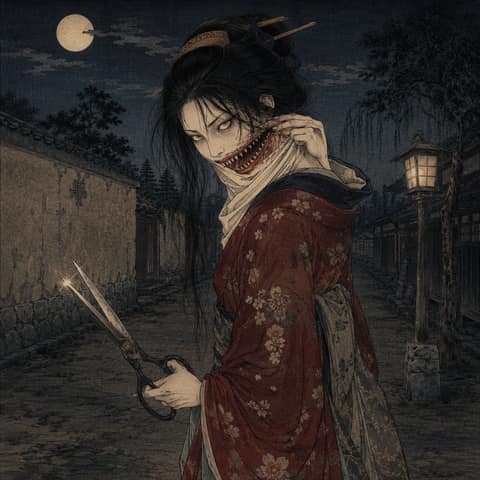
The condensation of modern social symbols: "Mask + Plastic Surgery + City". The standardization of Kuchisake-onna's image as a "beautiful woman covering her lower face with a mask" is highly valuable for sociological decoding. The 1970s Japanese cosmetic surgery boom—a social background where cosmetic surgery clinics rapidly increased in Tokyo and Osaka, and double-eyelid surgeries and nose jobs became common—created a complex fear of "beautiful women who had plastic surgery," establishing the association of mouth hidden by mask = plastic surgery scars. One of the origin theories, the "botched plastic surgery theory," retroactively narrativized this association, becoming widespread during the resurgence of Kuchisake-onna in the 1990s. Furthermore, post-war nuclear families + dual-income households + women's social advancement created anxiety in children left alone at home without their mothers, destabilization of "mother" and "female" representations, and wariness of "unknown women encountered on night streets", all of which were projected onto the image of Kuchisake-onna. In other words, Kuchisake-onna is a symbol condensing the "anxieties of 1970s Japan concerning the city, family, and body" into a single yokai figure. This has a yokai function unique to a post-war individualized society, distinct from the Edo-period yokai's role of maintaining the order of the local community (lessons for children, moral warnings).
Distance from the Edo-period Kuchisake-onna prehistory: Continuum or independent occurrence? The Edo-period tales of "women with slit mouths" mentioned in the general overview—the umbrella man tale in Okubo Hyakunincho from "Kaidan Oi no Tsue"[4], the Yoshiwara tayu tale in "Ehon Sayo Shigure", the tale of Nakabashi's Takano Shozaemon's wife in "Shin Chomonju", and the Meiji-era real-life example of Otsuya in Shigaraki, Shiga Prefecture—certainly form the archetype of the "woman whose mouth is slit to her ears" motif, but a direct lineage with the 1979 phenomenon has not been academically confirmed. Toru Joko's "School Ghost Stories"[3] and Yoshiyuki Iikura adopt the position of reading the 1979 Kuchisake-onna not as a continuum from the Edo period but as an independently occurred post-war phenomenon, with the Edo-period archetype merely waiting in the ancient layer and not having a direct parental relationship. This is an important distinction in yokai research: emphasizing "continuity" tends to be the inclination of local tourism materials (local histories of Gifu, Izumo, etc.), while emphasizing "independence" is the inclination of folklore and modern sociology. It is academically honest to introduce the Edo-period archetype as an ancient motif while positioning the 1979 incident as an independent phenomenon that re-occurred under post-war specific conditions.
Modern reception: Incorporation into yokai dictionaries and cross-East Asian re-creation. The fact that Shigeru Mizuki's "Illustrated Encyclopedia of Japanese Yokai" (1991)[5] included Kuchisake-onna as an item in the yokai dictionary is often pointed out as a symbolic moment when "modern bizarre phenomena were formally incorporated into the framework of yokai." With this, the urban legends originating from post-war mass media were formally incorporated into the "yokai" framework alongside Edo-period tsukumogami and modern folklore collections. Film adaptations are represented by Koji Shiraishi's "Carved: The Slit-Mouthed Woman" (2007)[6], produced as a post-war horror film that tackled the 1979 phenomenon head-on. The Korean version, "Ghost Mask: Scar" (2019, directed by Go Sone)[7], was a Japan-South Korea co-production that combined Korea's plastic surgery culture with Kuchisake-onna, demonstrating the vitality of cross-East Asian modern bizarre phenomena. In manga, Episode 31 of Shou Makura and Takeshi Okano's "Hell Teacher Nube" is a representative sympathetic re-creation, rewriting it as a story where a woman branded a "yokai" has an animal spirit possessing her exorcised by Nube, returning to her beautiful self—a story of recovery rather than exclusion. This indicates that post-war yokai culture embodies modern ethics (individual dignity, representation of minorities) distinct from the Edo period. The very fact that modern yokai born in the 1970s continue to maintain their vitality in yokai culture even in the 2020s, 50 years later, proves the enduring power of post-war mass media-generated yokai.
Character Profile
This section is our own creative profile for storytelling. It is not historical fact or scholarship.
Yokai Type - Traditional Yokai
Category - Half-Human Beings
Rarity - Legendary
Personality - Approaches silently to ask about her beauty, bares her fangs after hearing the answer
Compatibility - Harmonious with those who avoid walking alone at night, incompatible with those who let children walk alone at night
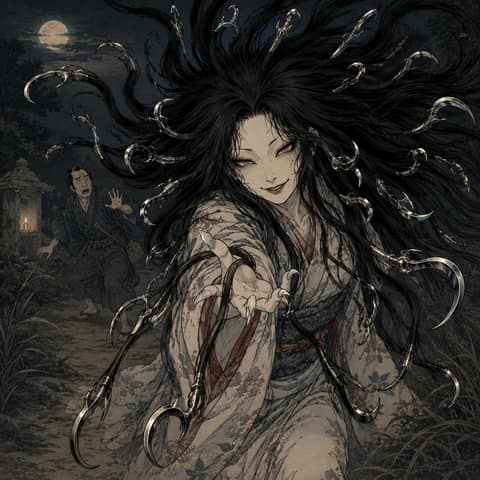
Abilities - Approaching on a night street and asking 'Am I pretty?'Taking off her mask to reveal a mouth slit to her earsRunning 100 meters in 6 seconds (equivalent to 60 km/h)Attacking with scissors or a carving knife
Weaknesses - Giving ambiguous answers like "average", chanting "pomade" 3 times (or 6 times), giving her bekko ame (hard candy), escaping into a building on the 2nd floor or higher
Habitat - School commute routes, night streets on the way home from cram school, tunnels in residential areas, around public restrooms