
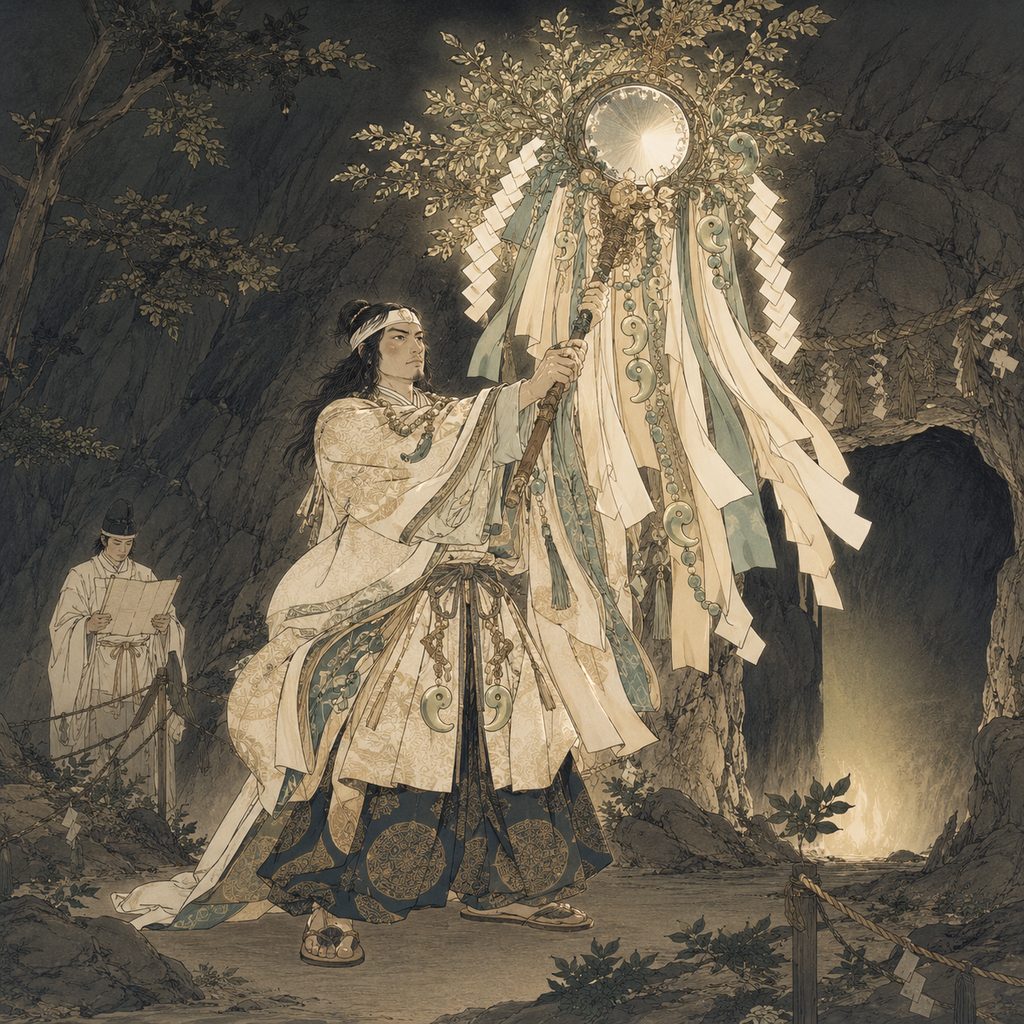
布刀玉命岩戸に御幣を取り持つ祭具神・布刀玉命
ふとだまのみこと
Detailed Description
Futodama, holding the *gohei* (ritual wand) before the Heavenly Rock Cave, is the deity in myth who transforms the objects prepared by the gods into the active power of ritual. When Amaterasu-Omikami hides within the cave, the world sinks into darkness. Following Omoikane's plan, the gods make the long-singing birds cry out, gather hard iron, forge a mirror, craft curved jewels, perform divination with deer bone and *hahaka* wood, and hang jewels, a mirror, and cloth upon a *Sasaki* tree. At the conclusion of these preparations, the *Kojiki* (Ama-no-Iwato II) records: Futodama, holding the grand *gohei*[1]. In this moment, Futodama transitions the completed ritual tools into active divine service.
The power of this deity lies in the very act of "holding." The *gohei* is not merely paper or cloth; it is a marker directed toward the divine, a pathway for prayer, and a medium to purify the space. When Futodama takes it in his hands, the jewels, mirror, cloth, and divination are no longer disparate materials, but a singular, unified ritual offered to Amaterasu. If Ame-no-Koyane's prayers form the center of voice, Futodama's *gohei* is the center of physical matter. Voice alone lacks form, and objects alone remain silent. Only when both are present is a space established before the cave to welcome the deity.
Kokugakuin University's commentary highlights how the myth is densely layered with elements of ancient ritual[2]. The mirror reflects Amaterasu, the jewels bear sacred adornment and spiritual power, the cloth is an offering, and the oracle bones seek divine will. Within this material worship, Futodama stands at the juncture where ordinary objects are transformed into "sacred offerings." Therefore, viewing him merely as a keeper of props is entirely insufficient. Futodama is the deity who presides over the exact moment when objects enter the sacred order.
During the Descent of the Heavenly Grandson, this role is brought down to earth. In the *Kojiki* (Tenson Korin II), Futodama descends as one of the Five Attendant Deities and is named the ancestor of the Inbe clan[3]. The Five Attendant Deities each carry functions such as ritual, dance, mirror-making, and jewel-crafting, demonstrating that the heavenly grandson's rule over the earth relies on more than just military might or lineage. It requires the techniques of worship, creation, and offering. Futodama is the deity who connects heavenly ritual tools to earthly vocations.
The official deity description of Awa Shrine makes this connection remarkably concrete. The Upper Shrine's main deity, Ame-no-Futodama, served closely by Amaterasu and is revered as the ancestral god of the Inbe clan[4]. The shrine further explains that because he led the Inbe deities in overseeing the creation of mirrors, jewels, textiles, weapons, and shrine construction, he is worshipped as the founding deity of all industries in Japan[4]. Here, the hands that held the *gohei* before the cave have expanded to encompass crafts, architecture, textiles, and weaponry.
The history of Oasahiko Shrine in Awa paints him as the "ancestral god who founds industry" in that region. During Emperor Jimmu's reign, his grandson Ame-no-Tomino-Mikoto is said to have arrived in Awa Province to sow hemp and paper mulberry seeds[5], producing cloth to establish the region's industry, while enshrining Futodama as a guardian deity. Materials like hemp, paper mulberry, and cloth resonate deeply with Futodama's nature as a deity of ritual implements. The cloth draped before the gods is the same cloth that pioneers new lands and builds industries. Here, we witness an ancient mindset where ritual and production were inseparable.
Awa Shrine's traditions continue this narrative, stating that Ame-no-Tomino-Mikoto later led a branch of the Inbe clan from Awa across the sea to the Boso Peninsula, planting hemp and grain, and enshrining Futodama and his consort at Mera Beach. This migration story connects Futodama's divinity to tales of movement and pioneering. The deity who holds ritual tools appears not only before the gods but also at the sites where land is cleared, crops are planted, and shrines are built. Treating physical objects with sacred respect was, in itself, the act of laying the foundation for human life.
Read in a modern context, Futodama may be a "behind-the-scenes" deity, but he is by no means a minor one. The preparation of ceremonies, the setting of stages, the management of sacred tools, architecture, paper-making, textiles, metalwork, crafting tools, and the passing down of family trades—to support the voices and dances on stage, one needs the technical skill to gather materials, arrange procedures, and maintain the integrity of the space. Futodama grants divine grace to these very skills. When praying, creating, or inheriting, one must never treat the materials at hand with disrespect. This quiet, steadfast ethic is the true power of Futodama.
Source Information
種類全体の出典primary
ご祭神・ご由緒の案内
著者: 安房神社
出版社: 安房神社
種類全体の出典primary
古事記ビューアー・天の石屋②
著者: 國學院大學古典文化学事業
出版社: 國學院大學
種類全体の出典reference
器物データベース・天の石屋と古代祭祀
著者: 國學院大學古典文化学事業
出版社: 國學院大學
種類全体の出典primary
古事記ビューアー・天孫降臨②
著者: 國學院大學古典文化学事業
出版社: 國學院大學
種類全体の出典primary
由緒書
著者: 大麻比古神社
出版社: 大麻比古神社
バージョン固有出典 (岩戸に御幣を取り持つ祭具神・布刀玉命)reference
ご祭神・ご由緒の案内
著者: 安房神社
出版社: 安房神社
バージョン固有出典 (岩戸に御幣を取り持つ祭具神・布刀玉命)reference
古事記ビューアー・天の石屋②
著者: 國學院大學古典文化学事業
出版社: 國學院大學
バージョン固有出典 (岩戸に御幣を取り持つ祭具神・布刀玉命)reference
器物データベース・天の石屋と古代祭祀
著者: 國學院大學古典文化学事業
出版社: 國學院大學
バージョン固有出典 (岩戸に御幣を取り持つ祭具神・布刀玉命)reference
古事記ビューアー・天孫降臨②
著者: 國學院大學古典文化学事業
出版社: 國學院大學
バージョン固有出典 (岩戸に御幣を取り持つ祭具神・布刀玉命)reference
由緒書
著者: 大麻比古神社
出版社: 大麻比古神社
Personality
He does not seek the spotlight, but rather prepares what is needed, arranges the procedures, and firmly supports the core of the occasion. He is a deity of practical affairs who imbues manual labor and offerings with divine intent.
Compatibility
Deeply compatible with those in crafts, architecture, textiles, paper-making, tool manufacturing, ritual design, those who support operations behind the scenes, and those seeking to solidify the foundations of their family business or industry.
Abilities & Skills
Weaknesses
He is not a deity who single-handedly turns the tide with a flashy display. Without ritual tools, materials, artisans, prayers, or the order of the space, his power struggles to take a concrete form.
🔮Test your compatibility with 布刀玉命 now!
Analyze your personality and values to get a detailed compatibility rating with this yokai.
Free, simple, and results in just minutes.